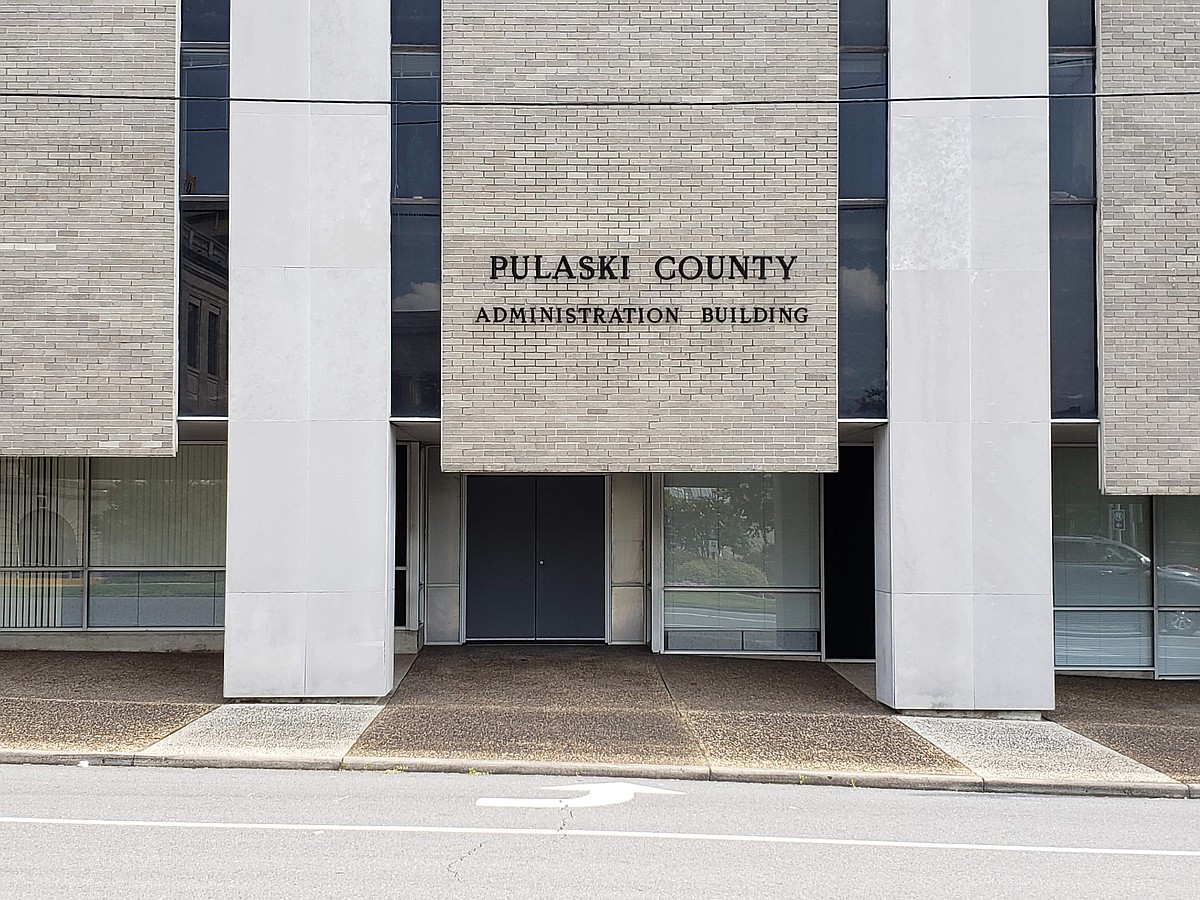
Pulaski County’s Agenda Committee sent one of two proposed data center moratoriums to the full Quorum Court after a contentious Tuesday night meeting.
The committee advanced — with a vote of eight ayes, one nay and one present — the ordinance drafted and submitted by District 7 Justice of the Peace Dianne Curry after consulting with officials from Entergy.
The ordinance is specifically designed to allow the controversial AVAIO data center project in Wrightsville to continue and prevent the county from being sued.
A separate ordinance drafted by Wendell Griffen, the Democratic candidate for county judge, failed after a 5-5 vote.
Both votes came after the committee chose not to allow public comments beforehand, which elicited anger from the audience and calls that the committee had violated the First Amendment.
When committee Chair Curtis Keith had asked the present members who wanted to hear public comments before the votes, only District 5’s Steven Person said “aye” while the others remained silent.
Only 11 of the Quorum Court members were initially present for the meeting. Rebekah Davis, Patricia Young-Baker and Staci Medlock were absent.
However, Julie Blackwood, a sponsor of Griffen’s ordinance, had to leave in the middle of the meeting after becoming “really sick,” according to District 9 Justice of the Peace Tina Ward.
Flyers detailing “a battle of two moratoriums” were distributed to audience members before the meeting.
The flyer, inspired by the ongoing FIFA World Cup, compared the “Griffen & Blackwood Proposal” with the “Curry & Hyde Proposal” as a green card and red card.
Audience members were given pieces of cardboard that were colored green and red to display whether they approved or disliked statements made during the evening.
One anti-data center activist was asked by Keith to remove a sign from the Quorum Court chamber that read “liar” on one side and “Curry is complicit” on the other.
Both Blackwood and Curry took time before the vote to defend their ordinances.
Blackwood said Griffen’s ordinance was “more thoughtful, comprehensive and legally defensible,” while allowing the county “the opportunity to develop appropriate regulations before approving projects, unlike anything we have regulated before.”
“Our responsibility as the Quorum Court is not simply to approve development,” Blackwood said. “Our responsibility is to ensure that development occurs in a way that protects the citizens of Pulaski County.”
During her time, Curry read from her ordinance, saying it “shall not apply to projects that have executed contracts for utility for electric utility service before the effective date on any final approval.
“Therefore, we will be stepping out of bounds to try to put a moratorium (in place). Even with the moratorium, it doesn’t stop the current process with AVAIO.”
Dominique Lane, the county’s new attorney after the resignation of Hamilton Kemp, was peppered with questions from Quorum Court members.
She was asked by Blackwood if the county had made the determination that AVAIO had vetted rights under state law.
“If I’m an attorney for a AVAIO, and my project is halted, I am most certainly looking at my legal avenues for redress,” Lane said. “Here the issue would be whether or not it is considered a ‘taking.’”
She explained the government cannot take land or property “without just compensation.”
Lane was asked by Ward to clarify a statement she had made about both ordinances potentially opening the county to litigation.
“It is not a question of good or bad,” Lane said. “It is merely a question of what introduces the county to legal risk, and whether or not I, as your attorney, can defend us on those risks. That is the question I have to ask myself upon being presented with anything to sign, is ‘can I defend this? Is there some legal course that I can defend?’”
Jim Cranor, the interim director of the Planning Board, informed the justices of the peace that AVAIO had originally planned for nine buildings before revising it to six. It’s currently preparing to build three buildings.
Aaron Robinson, the justice of the peace for District 11, asked if Curry’s ordinance passed how the county would look at it if AVAIO came back with plans to build the second set of buildings.
“If AVAIO came back with another site plan for additional buildings beyond what was proposed in the initial site plan, in my opinion, that would be held to whatever regulations that the body passed,” Cranor said.
“That just makes it muddier,” Robinson said.
Lane affirmed Cranor’s belief.
“We may find ourselves in a situation where a portion of the project is being controlled (by) one set of regulations, and then the other portion is controlled by whatever new ordinances are passed,” Lane said.
Before either vote was taken, District 6 Justice of the Peace Donna Massey drew cheers when she said a “situation doesn’t make any sense.”
“I mean, we have a moratorium to defeat another moratorium, and then the purpose of the first moratorium just goes down the drain,” Massey said. “We’ve not accomplished anything. That’s pretty much what I’m seeing here.
“I don’t want us to incur any legal ramifications. However, this is rather serious, and it could have very serious implications in regards to our environment, as well as costs that are passed on to our constituents. So when you think of things like that, sometimes you just have to fight.”
Ward described having to choose between moratoriums as feeling like “gambling.”
During the public comment period, a woman named Robyn Deese addressed the handful of justices of the peace who had remained to listen.
“I know that your goal is not to be sued, but the truth is that you will get sued,” Deese said. “It’s just a question if you want to take it before they destroy our communities in our state or afterwards.”
Deese then addressed the influence of corporations on government entities.
“I’d like to read to you a definition, and it’s about companies and other entities that involve acts dangerous to human life,” Deese said. “They like to influence the policy of government by intimidation or coercion.
“This is domestic terrorism.”
Daniel McFadin
dmcfadin@adgnewsroom.com
Daniel McFadin is a general assignment reporter who has been with the Arkansas Democrat-Gazette since October 2022. He previously worked at NBC Sports, and has also been a writer covering NASCAR for Frontstretch — which is not affiliated with the Democrat-Gazette — since 2014. Daniel also has and continues to be involved in podcasting at the newspaper.