Rupmoni Das, a 26-year-old and seven-month-pregnant woman, spends nearly six hours every day standing beside one of Guwahati’s busiest roads, sincerely slicing summer fruits (mango, pineapple, grapes, cucumber) and selling them to passing customers at her makeshift road stall on Beltola-Baisistha Road.
For Rupmoni, her second pregnancy has brought not only the anticipation of embracing motherhood again but also a heavier financial burden. Regular antenatal check-ups, nutritional needs, and rising household expenses have compelled her to continue working, braving illness, to support her husband, Pranjal Das, in sustaining their family.
Rupmoni Das
“On most days, I return home with severe body pain after standing for many hours. By evening, my legs ache so much that even walking becomes difficult,” said Rupmoni while interacting with EastMojo.
She informs of frequently suffering from coughs and colds because of the extreme heat, smoke, “There are many nights when I cannot sleep because of continuous coughing, breathlessness, headaches etc but whatsoever the situation the next day I have to be back at my stall, as one day loss equals to losing a significant portion of the family’s daily earning.”
Cradling her three-year-old son in one arm, Rupmoni is regularly exposed to smoke from passing vehicles, burning waste, or dust from construction work. “The vehicle smoke or waste burning is worst when it is emitted; immediately my throat starts burning, and it becomes dry, and breathing issues start. My son also starts crying,” she shared.
“But baideo, we have no choice as this shop is our only source of livelihood,” Rupmoni whispers silently.
As per the AQI parameters in the 187 days of 2026 (till filing of the report), Guwahati recorded 2 hazardous, 25 severe, 56 unhealthy, 90 poor and 14 moderate days. Besides, according to the information, the city’s annual 2026 AQI (US) (154) shows an average percentage change of 39.5% (worsened AQI (US) compared to previous years: 2020 (96), 2021 (122), 2022 (112), 2023 (122), 2024 (105), 2025 (110).
“Guwahati’s air quality in the recent past has deteriorated drastically, while air pollution has been a discussion among middle or upper middle class as we think educated people can only feel or understood it, we unintentionally ignore the economically vulnerable communities who are the most overlooked victims of the issue,” said Ilusmita Konwar, a city based social worker and co-ordinator of SAKHI one stop centre.
Konwar further added that while a pregnant doctor, engineer or teacher has the luxury to take possible precautions, a pregnant daily wage labourer has no option but to keep herself and her unborn child safe and continues to work in an unhygienic condition, braving heat, humidity and dust.
Pregnant women from low-income families not only suffer from outdoor pollution; indoor pollution also contributes a lot to the tragedy.
The gas cylinder shortage happened recently due to the Iran war and disruption in the Strait of Hormuz, forcing several economically weaker households to keep aside cooking gas and return to traditional chullah-based cooking using firewood, coal and biomass fuel.
In Dhirenpara, a densely populated locality in West Guwahati, a 24-year-old Ruksar Begum has faced the exact reality. Six months pregnant when this reporter spoke to her, Ruksar switched back to traditional cooking two months back after her family found it impossible to afford LPG refills.
“I heard that the price of LPG cylinders has gone up because of a war, and it has become so expensive that we can no longer afford it. Left with no choice, we have gone back to cooking on a traditional chulha,” shared Ruksar while sitting near the firewood at her poorly ventilated, cramped kitchen.
Ruksar goes on to mention that with the increase in temperature, the kitchen is slowly turning into a hot box, “The smoke fills the kitchen, making it difficult to breathe properly; also, eyes and throats start feeling a burning sensation.”
She has also developed skin rashes and irritation, “I know cooking like this takes a toll on my health, but preparing food for my family gives me a sense of peace. Serving them a wholesome, home-cooked meal at every sitting is my way of caring for them, and that makes all the effort worthwhile,” she added.
Guwahati currently has 11 NAMP (National Air Quality Monitoring Programme) located at- Bamunimaidam, Khanapara, Santipur, Gauhati University, Boragaon, Bonda, Gopinath Nagar, Kahilipara, B. Borooah College, Maligaon & Byrnihat and 10 fully automated CAAQMS (Continuous Ambient Air Quality Monitoring Stations) installed at- Assam Pollution Control Board office in Bamunimaidam, Cotton University, Gauhati University, Lokpriya Gopinath Bordoloi International Airport, Indian Institute of Technology Guwahati also one at Byrnihat.
Adverse medical consequences
According to medical experts, prolonged exposure to pollution for pregnant women can have far-reaching negative consequences.
Pratiksha Sharma, a resident doctor in the Department of Gynaecology at Gauhati Medical College and Hospital, explains that polluted air directly impacts maternal blood quality and ultimately affects the baby’s development.
“Air pollution reduces the quality of blood, which directly affects the child’s health and can lead to low birth weight; it also has a huge chance of reducing the oxygen supply reaching the fetus. When expecting mothers continuously inhale polluted air, oxygen transfer to the baby can become deficient, which potentially impacts the brain development of the infant,” she informed.
Going beyond, maternal exposure to polluted air can significantly affect the pulmonary development of unborn children; this was asserted by Manas Jyoti Saikia, Associate Professor of Pulmonary Medicine at GMCH, “Air pollution penetrates the human body far more deeply than most people realise; it invisibly enters into cells and organs in our body, especially the lungs, heart, blood, and brain.”
Saikia pointed out that pollutants such as nitrogen dioxide (NO₂), largely emitted by vehicles and industrial combustion, can hamper normal lung growth during pregnancy, thus leading to neonatal respiratory distress syndrome and long-term childhood asthma. “Children born to mothers with high pollution exposure have nearly 1.29 times higher risk of developing asthma by the age of four.”
Frontline health workers working at the grassroots are closely witnessing the worrying situation. As per Sahida Begum, an ASHA worker, health complications among expecting mothers have become increasingly common in recent months: “A major chunk of pregnant women complain about breathing problems, weakness, constant fatigue and loss of weight.”
Rahul Mahanta, Director of Centre for Clouds and Climate Change Research, Cotton University, cites rapid urbanisation, increase in infrastructure, vehicle emissions and chronic traffic congestion behind the alarming rise in PM2.5 and PM10 levels across the city.
“Guwahati’s topography is a bowl; with the increase in temperatures, the pollutant gets trapped inside the city instead of allowing it to disperse. As a result, people continue breathing contaminated air for longer durations,” Mahanta noted.
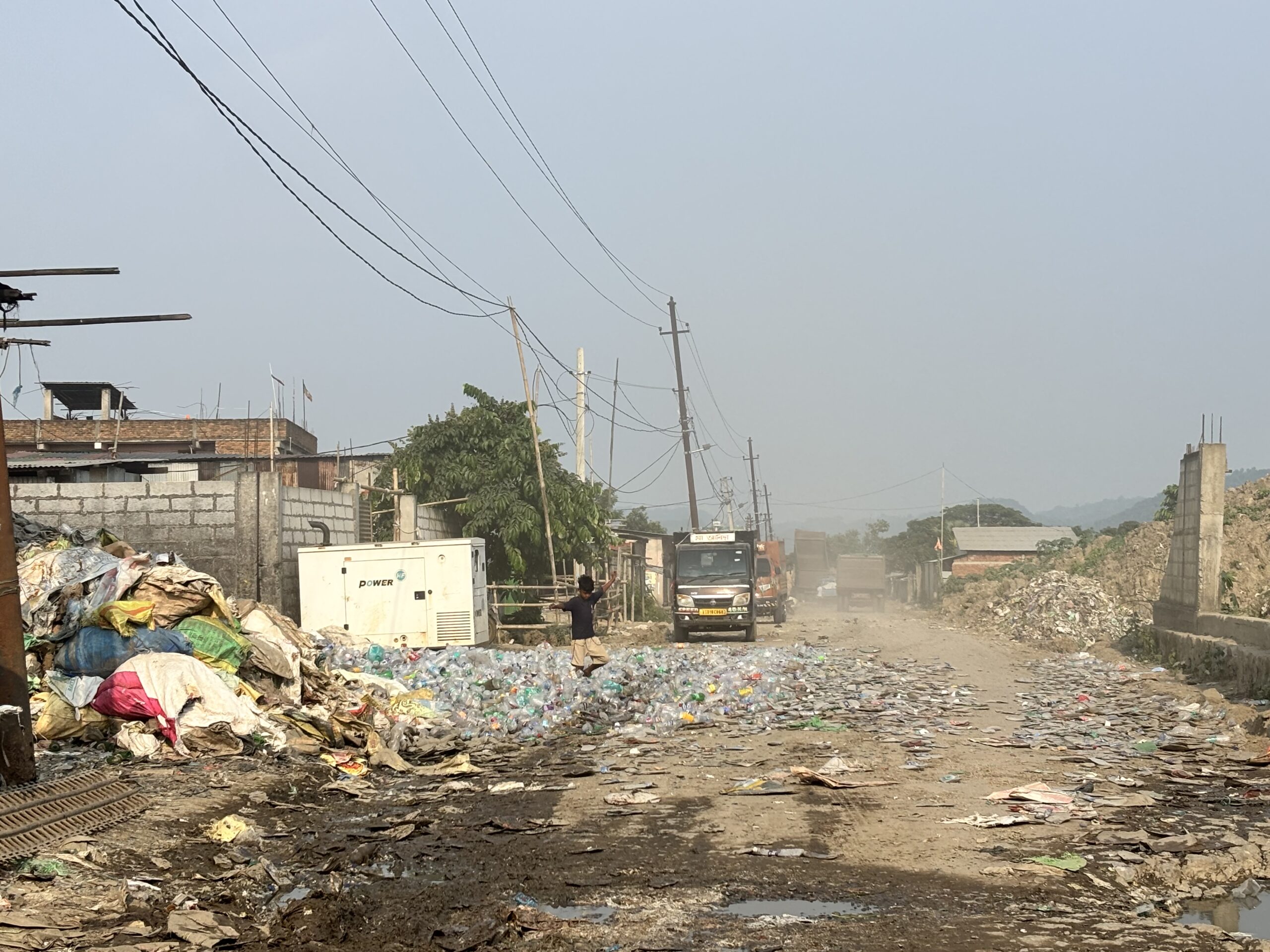
A study conducted by think-tank International Forum for Environment, Sustainability and Technology (iFOREST) in collaboration with the Assam Pollution Control Board (APCB) has identified open waste burning, residential cooking and heating, commercial eateries, road dust, transport emissions, and industrial activities as the dominant contributors to air pollution in Guwahati.
The study also revealed that about 47 industrial units are operational within the city boundary, with iron and steel, oil refineries and ferrous and non-ferrous metal processing units identified as the major polluting industries.
Additionally, around 545 industrial units are operational in the Kamrup Metropolitan Region. Industries located within the city boundary contribute approximately 396 tonnes per year (Tonne/yr) of SO₂ emissions, followed by 370 Tonne/yr of PM₁₀ emissions.
State’s Effort
Arup Kumar Misra, Chairman of Assam Pollution Control Board, said the government is all set to start a large-scale awareness campaign in this regard across Guwahati, reaching schools in every corner of the city.
“The best investment lies in educating children, creating awareness among students and making them active stakeholders in this mission; we are empowering our future generation,” said the chairman.
Also Read: The untold true story behind Manipur’s acclaimed film Oneness
Sayantani Deb
Reporter, EastMojo
You just read a story that took days to report. Help us keep our reporters on the ground in the Northeast.
For Rs 83/month – less than a cup of coffee
Ad-free reading, support and keep important stories alive
Become a Member
OR
Support once (any amount)
or
Scan to pay via UPI