The city’s Department of Construction wants the towers finished in 2026 to add space in the crowded urban core and pull more riders onto public transport.
Two would rise at Cho Lon bus station, in zones A and B of Cho Lon Ward in the city’s Chinatown. The others would go up at Saigon bus station in the downtown Ben Thanh Ward and Tan Phu bus station in Tay Thanh Ward on the northwestern outskirts.
Each 250-square-meter site pairs a 28-meter automated car tower holding 50 vehicles with a seven-story automated tower holding 120 motorbikes.
The modular structures run on automated controls, AI license-plate recognition and a built-in fire-suppression system, at a preliminary VND20 billion (US$760,000) apiece.
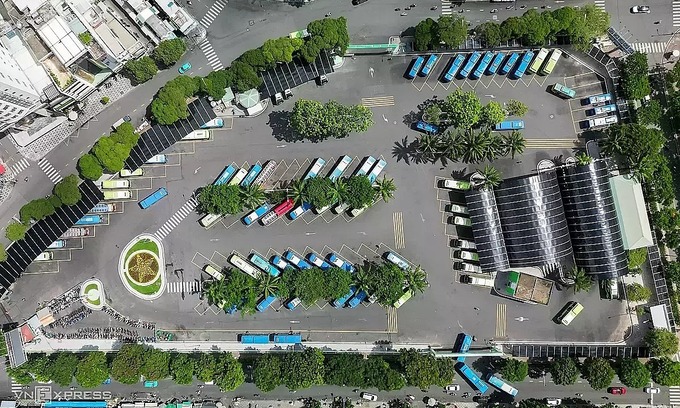
Saigon bus station in central Ho Chi Minh City, where one of the automated parking towers is set to be built. Photo by VnExpress/Quynh Tran
Central Ho Chi Minh City was mapped years ago for four underground parking lots with room for roughly 6,300 cars and 4,000 motorbikes, none of which was ever built.
The department says the above-ground towers would ease a shortage that has pushed cars onto sidewalks and roadsides, and would nudge drivers to park at the stations and finish their trips by bus.
The city has developed only about a fifth of its planned parking capacity, leaving it short by more than 900 hectares against a target of nearly 1,200, according to municipal authorities.
Similar modular automated lots already run at its Mien Dong and Mien Tay coach terminals and at Tan Son Nhat airport.
The department has separately proposed about VND80 billion ($3 million) to upgrade bus infrastructure, repairing or replacing stop poles at 800 sites, renovating some 80 shelters, and adding cameras and electronic information boards.
That work is set for completion in the fourth quarter of 2026.
Ho Chi Minh City became Vietnam’s most populous city last year, when it absorbed neighboring Binh Duong and Ba Ria-Vung Tau to reach more than 14 million residents across 6,772 square kilometers.