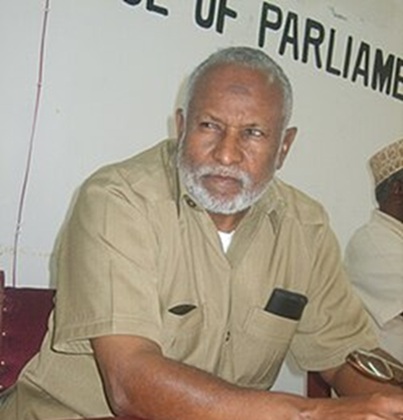
Hargeisa (WDN) – Somaliland’s long-serving Speaker of the House of Elders (Guurti), Saleebaan Maxamuud Aadan, has formally announced his resignation, bringing to a close more than two decades at the helm of one of Somaliland’s most influential institutions.
The announcement came during an extraordinary session of the Guurti on Sunday, where the 92-year-old veteran politician said advancing age and declining physical strength had convinced him it was time to relinquish office.
“I am tired; age has caught up with me,” Saleebaan told members of the House. “Even if my mind remains sharp, my physical strength is no longer what it was, and my steps have become slower. While my memory is still intact, I want to hand over this responsibility. Elders, I ask you today to accept my resignation, and I am signing it.”
Saleebaan, who has served as Speaker of the Guurti since 2004, is widely regarded as one of Somaliland’s longest-serving senior political figures. Throughout his tenure, he played a central role in mediating political disputes and facilitating dialogue between rival political factions during periods of heightened tension.
Supporters credit him with helping preserve Somaliland’s relative political stability through traditional conflict-resolution mechanisms, arguing that his leadership of the Guurti was instrumental in defusing recurring political crises.
However, his lengthy tenure was not without controversy. Both Saleebaan and the House of Elders faced sustained criticism from opposition parties, civil society organizations, and political analysts, particularly over the chamber’s repeated extensions of the terms of key government institutions. Critics argued that the Guurti had, at times, exceeded its constitutional mandate by approving term extensions that delayed scheduled elections and prolonged the tenure of elected officials.
His resignation therefore marks the end of a significant chapter in Somaliland’s political history. As one of the country’s most enduring political figures, Saleebaan’s departure closes an era that shaped Somaliland’s governance through both traditional authority and modern political institutions.
Attention now turns to the process of selecting his successor, a decision expected to carry considerable political significance as Somaliland navigates its next phase of institutional and democratic development.
WardheerNews