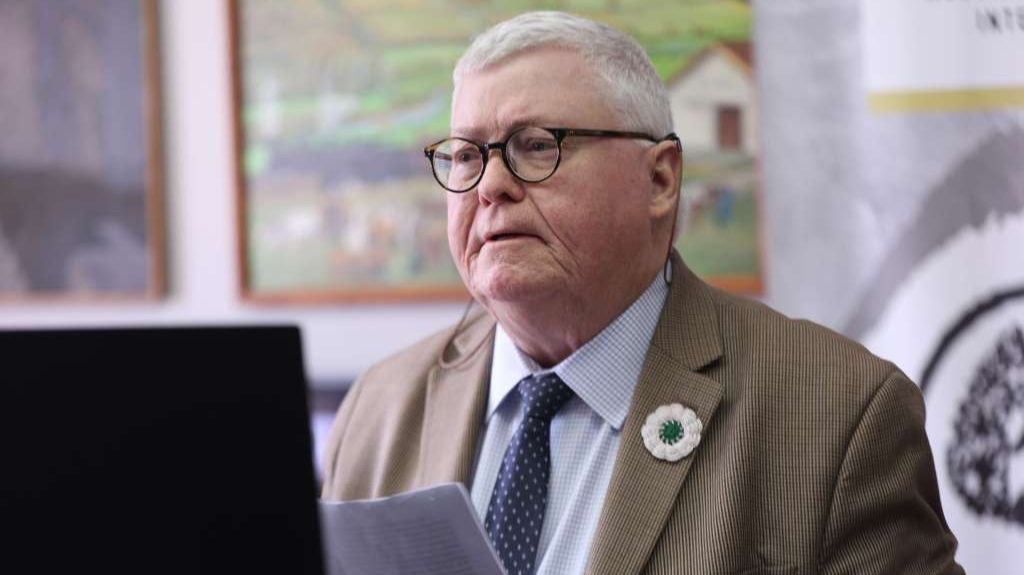
“An Appeal for a Commitment to the Values of Transitional Justice in order to Nurture a Culture of Remembrance in BiH on the Occasion of the Commemoration of the Srebrenica Genocide in 2026”. prof. dr. David Pettigrew, Connecticut State University Professor of Philosophy and Holocaust and Genocide Studies, Southern Connecticut State University, and Member, Advisory Committee, Yale University Genocide Studies Program.
As we commemorate the Srebrenica Genocide, we reaffirm the truth about the genocide and honor the memory of the victims. However, in spite of the UN Resolution establishing an International Day of Reflection and Commemoration of the1995 Genocide in Srebrenica, and the High Representative’s historic amendment to the Criminal Code of BiH in 2021, it is troubling that genocide denial and the glorification of war criminals continue unabated, undermining hope for transitional justice in BiH.
Along with the denial of the Srebrenica Genocide, authorities in Republika Srpska have prevented the installation of memorials at sites where the atrocities have been judged to be war crimes,including at Barutni magacin in Kalinovik, as well as at Kravica Warehouse and Dom Kulture in Pilica, where war crimes were committed as part of the Srebrenica Genocide.
It should be a matter of great shame for the international community that no memorial has been permitted for the 102 children who were victims of the atrocities in Prijedor municipality in 1992. It should also be a matter of great shame for the international community that although Partizan Sports Hall was the site of unspeakable crimes committed against women and girls, crimes that led to a landmark ICTY judgment,no plaque or memorial has been permitted at the building. It is apparent that international community and EU have abrogatedtheir responsibility to the values of transitional justice since they have not supported the installation of a memorial for the children in Prijedor or of a plaque on the building in Foča.
With such dishonorable inaction, it seems increasingly impossible to achieve transitional justice and establish a culture of remembrance in BiH that would prevent a repetition of the atrocities in the future. Although Ratko Mladić was convicted of genocide for the atrocities in Srebrenica there has been a complete absence of any political will or moral courage to remove the mural at the entrance to Kalinovik that declares him to be a hero. The mural, which was installed illegally, violatesBosnia’s Criminal Code that prohibits the glorification of convicted war criminals, as well as the universal principles of transitional justice.
Perhaps the absence of support for transitional justice initiatives can be attributed to the recent shift in U.S. foreign policy in BiH that has prioritized transactional business deals or political appeasement over values, human rights, and social justice. For example, the U.S. has seemed singularly focused on promoting the Southern Interconnection Gas Pipeline deal. At the same time, it lifted the sanctions against Milorad Dodik who consistently denies the Srebrenica Genocide. With the sanctions lifted, Mr. Dodik was able to travel to the U.S. to lobby for the destabilizing and separatist goals of Republika Srpska in spite of a criminal conviction that led him to be removed from office.Such an approach to foreign policy seems to be devoid of values, and, in that way, to be devoid of merit.
In spite of these challenges, it is important that we do not abandon the values and hopes of transitional justice. Transitional justice holds the dignity of the victims and human rights of the survivors at the forefront of its considerations, demanding that the memory of the victims be honored with appropriate memorials and commemorations, thereby guaranteeing that the crimes will not be repeated. Our commitment to transitional justice must not waiver, especially as we commemorate the Srebrenica Genocide in 2026.
Therefore let us appeal with the greatest possible urgency to Volker Türk, United Nations High Commissioner for Human Rights, and to Michael O’Flaherty, Commissioner for Human Rights of the Council of Europe, to encourage the Office of the High Representative in Sarajevo to take action and render a comprehensive decision with BONN Powers that would permit the installation of memorials and museums at the atrocity sites where atrocities have been judged to be genocide and other war crimes. Such an initiative would reaffirm our commitment to thevalues of transitional justice and pave the way for a culture of remembrance affirming the dignity of the victims and human rights of the survivors. Such values are crucial for transforming the culture in BiH in order to ensure a democratic future under the rule of law.