Your support helps us to tell the story
From reproductive rights to climate change to Big Tech, The Independent is on the ground when the story is developing. Whether it’s investigating the financials of Elon Musk’s pro-Trump PAC or producing our latest documentary, ‘The A Word’, which shines a light on the American women fighting for reproductive rights, we know how important it is to parse out the facts from the messaging.
At such a critical moment in US history, we need reporters on the ground. Your donation allows us to keep sending journalists to speak to both sides of the story.
The Independent is trusted by Americans across the entire political spectrum. And unlike many other quality news outlets, we choose not to lock Americans out of our reporting and analysis with paywalls. We believe quality journalism should be available to everyone, paid for by those who can afford it.
Your support makes all the difference.Read more
Cape Verde’s capital, Praia, saw thousands of flag-waving fans welcome their returning national football team, mobbing players at the airport after a stunning debut World Cup performance.
In downtown Praia, students as young as nine at a prestigious training academy believe this is just the start of their island nation’s transformation into a footballing powerhouse.
From an opening group-stage draw against heavyweight Spain to a heartbreaking 3-2 knockout loss to defending champions Argentina, the “Blue Sharks” frustrated elite strikers and showed scoring flair, pushing Lionel Messi’s team into extra time.
Supporter Renato Ribeiro said he was overjoyed to see his team, representing a country off West Africa with a population of around 500,000 — the least populous ever to reach the World Cup knockout rounds — defy the world’s low expectations.
“They only gave us a 1% chance, but I always said that 1% is a lot for us,” he told Reuters during a party at a fan zone on Sunday, where the players made an appearance.
Cape Verde fans Ginaldo Verdieu, Alex Monteiro and Bruna Barbosa react as they watch the match on a screen at Town Field Park in Boston, Massachusetts (Reuters)
“My greatest pride is to see that our national team will leave young people with more desire to play.”
Young players eye shot at stardom
The inspirational nature of the Blue Sharks’ strong showing is already on display at Praia’s Bola Pra Frente — “Ball Forward” — Academy, which was founded in 2010 and quickly established itself as a top national development centre.
“The future of football in Cape Verde, both women’s and men’s, is strong — it is big,” said Silveria Nedio, the head coach at the academy and for the women’s national team.
The academy was an early training ground for several players on the 2026 men’s World Cup team, including defender João Paulo Fernandes and midfielder Kevin Pina, who notched Cape Verde’s first World Cup goal in a group-stage match against Uruguay.
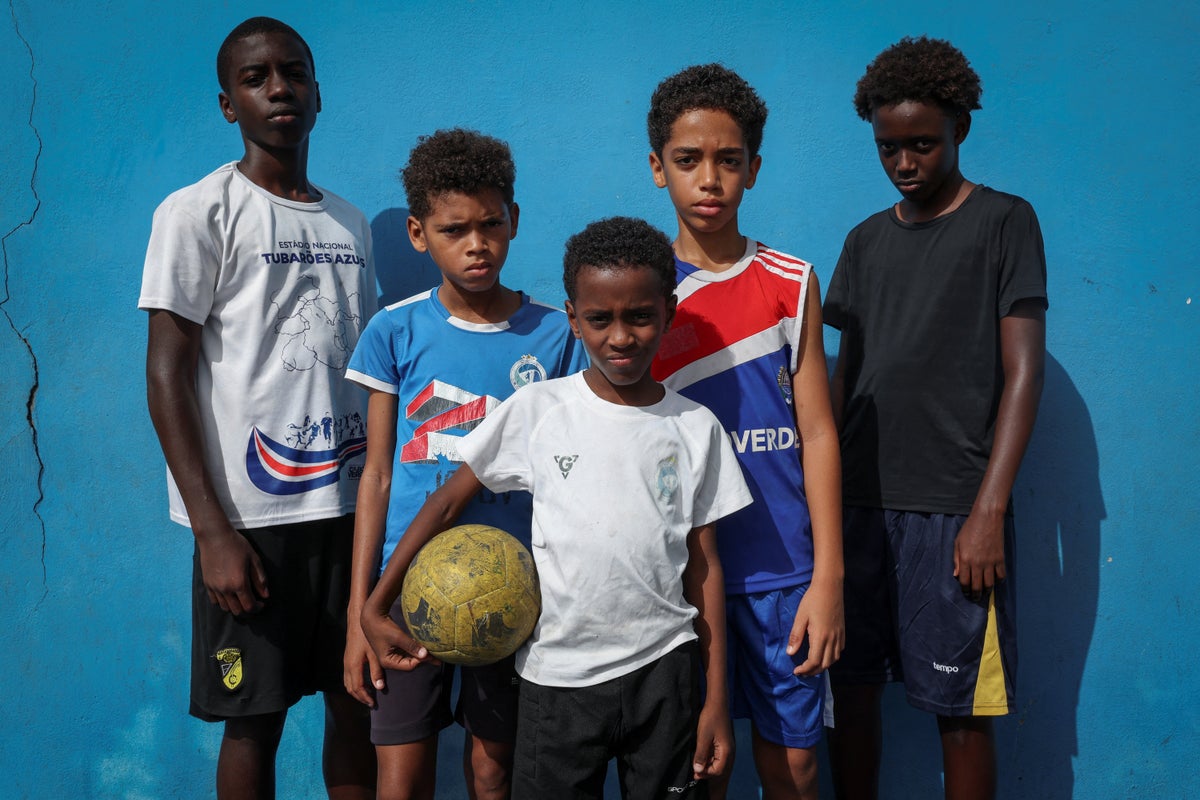
There are currently around 240 players aged between four and 17 training at Bola Pra Frente, all of them plugged into the Blue Sharks’ recent heroics.
Youth trainees prepare ahead of a football training session in Bola Pra Frente football academy in Praia, Cape Verde (Reuters)
“I want to get to the top where football can take me,” said César Alexandre França, 12, who has been training at the academy since he was six. “I like my family and want to make them proud.”
Marcelo Pereira Valera, 9, has been at the academy for three years and also dreams of being called up to the national team.”I want to do great things with football,” he said.
Financial constraints persist
Bola Pra Frente is one of more than 20 football academies in Praia alone, and there are others scattered across the 10 volcanic islands that make up the archipelago, said Mario Semedo, president of the national football federation.
“I believe we have indeed made real investments,” he said, adding that this had “played a major part in the development of our national team”.
The national programme still faces financial constraints, however, prompting many young talents to seek development abroad. Nedio said this was ultimately good for the country because of the opportunities the players were exposed to.
‘I want to get to the top where football can take me,’ said César Alexandre França, 12 (Reuters)
“Every time a child from Cape Verde leaves for Portugal at 13 or 15 years old, it is an advantage for us,” she said.
Even before the World Cup started, Nedio was helping put Cape Verdean soccer on the map, securing the women’s team’s first qualification last year for the Africa Cup of Nations tournament that begins later this month in Morocco.
It’s yet another sign that the national soccer programme is gathering momentum, she said.
“From this moment onwards, things can change completely – both in football and in the country.”