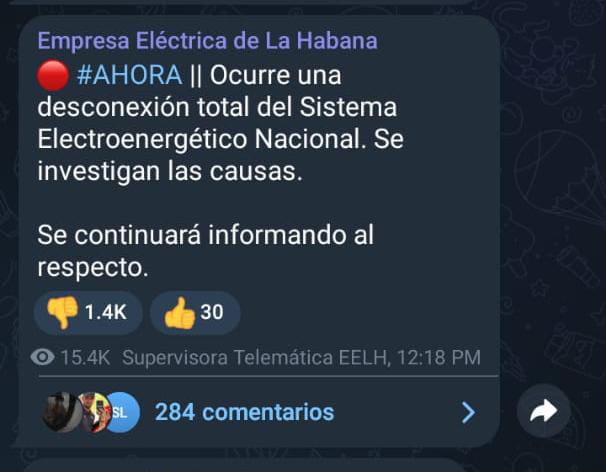
The official announcement of yesterday’s collapse of the National Electric System.
By Safie M. Gonzales
HAVANA TIMES – Yesterday at midday, Cuba’s National Electric System collapsed once again. Twenty-four hours later, most of the country remains in darkness. Eleven of the country’s sixteen thermoelectric plants are still offline. Available generation barely reaches 935 MW against a demand of 3,100 MW. But these figures, repeated to the point of exhaustion, barely scratch the surface of what it means to live like this.
The Night, Always the Night
In Havana, the Malecon seawall has become a natural extension of people’s homes. For months, families have been sleeping along the seawall, seeking the cool breeze their houses can no longer provide. Rooftops fill with mattresses and bedsheets every evening, a ritual that no longer surprises anyone.
“We sleep better here than inside,” says a resident of Vedado as he spreads out his blanket. The body adapts, but the exhaustion keeps building.
Delcy Perez, 78, has gone nights without sleeping well. “My body just doesn’t respond anymore,” she says, her voice trembling. Whether the power griid is operating or has collapsed makes little difference: the heat shows no mercy.
Living Meal to Meal
Without refrigeration, food has a shelf life measured in hours. At improvised markets, the price of a tray of 30 eggs has fallen to 2,000 pesos—not because they are plentiful, but because no one trusts they can keep them from spoiling. People buy only what they will eat that day.
“If I cook more, it goes bad. There’s no way around it,” says a produce vendor in Havana’s 10 de Octubre district. What was bought yesterday for lunch is no longer fit to eat. Refrigerators, those used to be important household fixtures, have sat silent for days, and cooking one meal at a time has become the only viable strategy.
Even private restaurants with generators are beginning to close. Diesel is in short supply, forcing owners to choose between using their generators to preserve food or to serve customers. Nothing is certain—not even whether there will be fuel tomorrow for the engine providing relief today.
Water, the Other Absence
Without electricity, there is no pumping.
In the Mantilla neighborhood, residents have gone four weeks without a single drop of water from their taps. Water trucks appear from time to time, but the supply lasts only a few hours for hundreds of families.
In Jaimanitas, tensions continue to rise. Residents complain that while they remain in darkness, the perimeter around the fortified Punto Cero residential neighborhood continues to glow suspiciously.
“It’s outrageous that some have electricity while the rest of us don’t,” people murmur as crowds gather on the sidewalks, trying to catch a bit of fresh air.
Life in the Shadows
As these lines are being written, electricity has still not returned to most neighborhoods. The midday sun beats down on Havana, and those on the Malecon, on rooftops, and under front porches continue waiting. No one knows when the power will return.
The only certainty is that when it does, the cycle will continue: it will go out again—perhaps tomorrow, perhaps tonight, perhaps without warning.
But that no longer seems to matter. Life has learned to function in the shadows, with sweat on every brow, rationed water, and carefully counted meals. Cubans have developed a resilience that withstands even endless blackouts, but the human body—and human patience—have their limits.
And those limits are tested every single day.
As I write this, the state power company (UNE) has just reported another total collapse of the National Electric System due to “unknown causes.” Some nine million people are without electricity at this moment.
On the Malecón, on rooftops, and under front porches, Cubans wait. They do not know when the power will return.
But they do know that when it does, it will only be a matter of time before it goes out again.
Read more from the diary of Safie M. González here on Havana Times.