When I first read Jason Prokowiew’s application for the Memoir Incubator, the one-year intensive I taught at GrubStreet from 2018 to 2023, I knew he would become a published author. Some aspiring memoirists possess remarkable stories but are just okay writers. Others are beautiful prose stylists but are saddled with ho-hum stories. Jason is that rare breed of memoirist who can both write like a house on fire and has the kind of story you’ve truly never read before.
“War Boys” is Jason’s debut memoir, but it’s likely you’ve seen his byline. In addition to being a regular contributor to Cognoscenti, he’s published in Roxane Gay’s The Audacity, Salon and The Guardian. A Fulbright Scholar and recipient of a PEN America/Jean Stein Grant for Literary Oral History, Jason performed a piece for World Channel’s Stories from the Stage that is the most watched in the show’s history.
His memoir, published July 1, first takes the reader to the war-torn streets of Belarus, 1941, where a young boy, Jason’s father, is at summer camp and sees Nazi planes flying overhead. By the time he reaches his home in Minsk, he finds only a bombed-out shell, his mother and sister nowhere in sight. His only chance of survival comes at the hands of a Nazi general who sees in his fair looks proof of Aryan blood and takes him into his home.
Fifty years later, on a suburban street of Sudbury, Massachusetts, we meet another boy trying to survive. This time it’s Jason, the youngest of 13 children, who also lives in fear — not of where he’ll find his next meal, but of the sometimes violent, drunken father who calls him “stupid” and “fat.” These twinned storylines, and the 50 hours of interviews between father and son that made the telling possible, form the backbone of this harrowing, cinematic memoir.
— Alysia Abbott, author of “Fairyland, A Memoir of My Father”
Alysia Abbott: How much did you know about your father’s past when you were growing up in Sudbury?
Jason Prokowiew: I often heard my father’s stories growing up, during family gatherings when he told them to older family members (my oldest sister was 22 years ahead of me). Even when I was young, the writer in me was intrigued by the conflict his stories contained.
As I think back about those early tellings, he seems eager to share, but how he told the stories was very set. It’s hard to remove the brutality from his history, but he sterilized them somewhat for listeners. He cast himself as a survivor, which he certainly was, but I’d come to think of him later, and portray him in “War Boys,” as also a victim — of war, of Nazis, of a world gone totally mad, one that didn’t care very much how conflict hurt people. Timely stuff, I think.
As a child I assumed that all dads in our affluent suburban town had been through similar trials. “Adopted by Nazis? Whose dad wasn’t?” was how my young mind thought of and normalized my dad’s history.
The cover of “War Boys,” by Jason Prokowiew, published by Trio House Press. (Courtesy Jason Prokowiew)
What was the original impetus for you sitting down to interview your father? How many hours did you log before you thought these interviews might one day become a book?
I took a Russian politics course in 1998 during my first semester at Oberlin College. My professor, Steve Crowley, showed us the Russian film “Come and See,” a vicious depiction of the 1943 Nazi invasion of Belarus. I felt drawn to Steve’s office hours, to talk about the connections I made between the film and my dad’s life. Steve asked questions I couldn’t answer: What had happened to my grandma Valentina (my dad’s mother); what did it mean that my dad “lived with the Nazis” in Belarus?
Steve later called upon me in class to tell my peers about my dad’s history, and I babbled my way through my first version of this memoir. As my own curiosity grew, and Steve’s ongoing interest fueled me, I started to think, maybe there is something interesting here, and not just interesting to me.
Steve gave me academic credit to interview my dad about his wartime history. I recorded with my dad for the first time in early 1999. When I graduated in 2001, I went home to Massachusetts and we finished the 50 hours of recordings that became the foundation of War Boys. Then, as I was applying for nonfiction MFA programs in 2002, I knew my father’s story, and mine, would be the focus of my MFA work.
Your book threads together these two storylines: you as a boy and your father as a boy. Was this always the structure you intended for the book? How did it come to you?
Credit goes to the writer Mike Scalise for helping me find the structure. Mike was my “second reader” — an outside writer who read the full manuscript and offered feedback — during my year with you in the Memoir Incubator.
I gave Mike a draft that tried to make these two boys’ stories equal, in an AB structure. Mike started his critique by acknowledging how hard it must have been to find a container to hold these two storylines — of 1940s Belarus and Germany and 1970s (and onward) United States — which was validating. He pointed me to Sven Birkert’s “The Art of Time in Memoir,” which suggests using a present-moment “now.” Mike suggested my interviews with my dad could be that “now.” I pushed back, believing I couldn’t interrupt my or my father’s storylines with the interviews, but Mike persisted in his belief that it could work, so I tried. It was clunky at first and for a long time, but after many revisions, the interruptions began to feel smooth. I eventually wondered how this hadn’t been the structure all along.
This structure relieved me of trying to make these two storylines equal and instead allowed them to communicate. Suddenly, it wasn’t about conveying “this event was hard for my dad, but there is a similar event that was also bad for Jason,” but rather, allowed me to explore how the terrors my father survived influenced the terrors that Jason the character experienced as the son of this traumatized man.
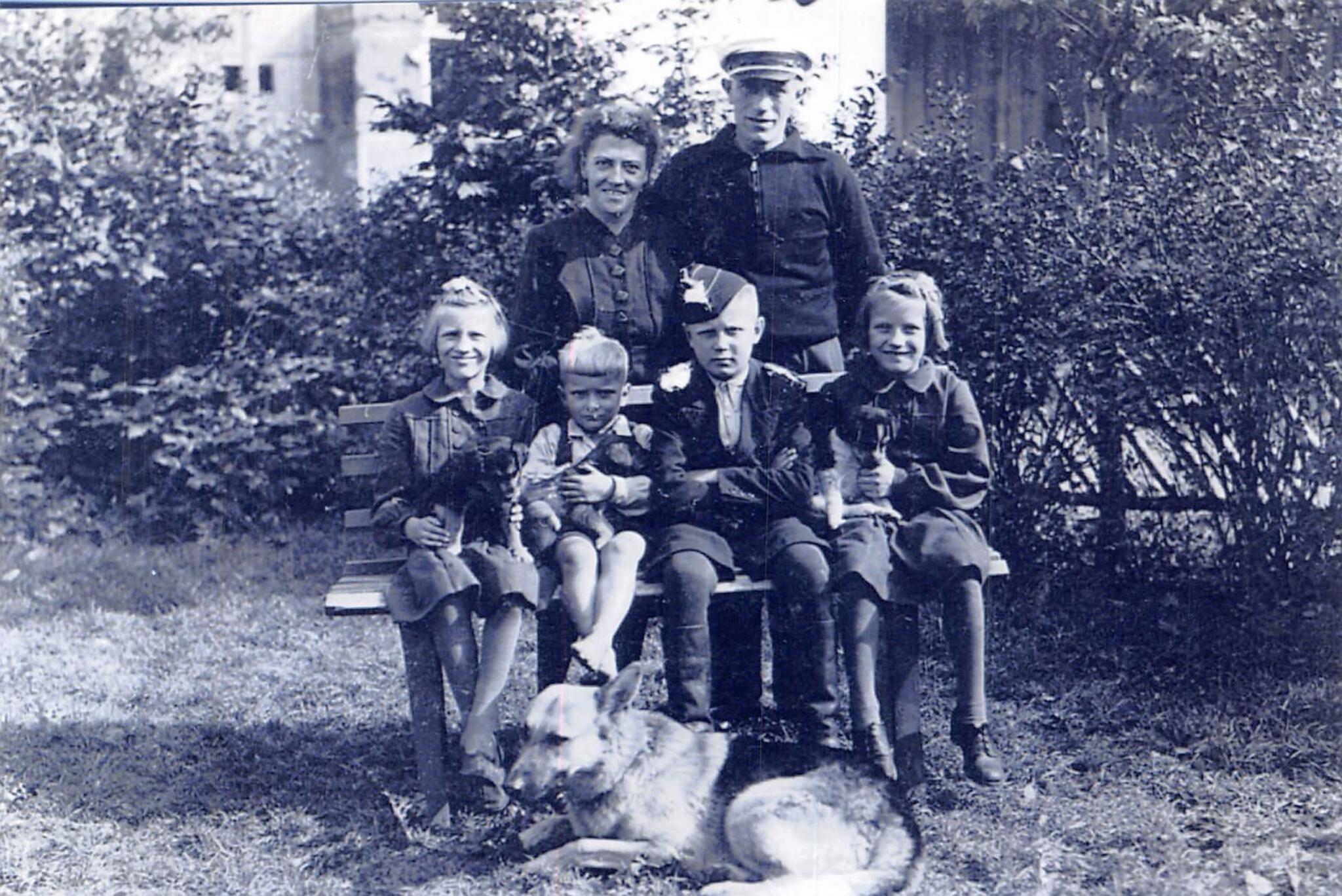
The author’s father, Walter, second from left, after retreating to Germany with the Nazis in 1945, outside the bakery in Hamburg where Herr Kroutsick found him a job. (Courtesy Jason Prokowiew)
Let’s talk about research. Some people don’t realize that memoirists can’t simply rely on memory to write. In your case, you had to not only bring to life 1990s Sudbury, but also 1940s war-torn Europe. Can you tell us, beyond talking with your father, what sources you consulted to write this book? I know you did a Fullbright in Germany, for example. What did you find out there?
During my first three-week research trip to Belarus, in 2006, I visited locations my father did during the war. I went during the winter to get a sense of the weather my father endured during the first year of the occupation, as a starving, unhoused 10-year-old orphan wearing his summer clothes. I walked Minsk during a snowstorm — as a 29-year-old man, well-fed, fully wrapped-up in warm garb — and I said to myself, “How did he do this?”
I also worked with a guide from an organization called Family Tree Belarus who arranged tours for me at museums and libraries, where I encountered the photographic evidence of a devastated Minsk during the war.
Archivists at the State and KGB archives helped me find documents that fleshed out my family’s history. For example, many people I spoke to before that point about my grandmother Valentina, my dad’s mom, suggested she likely wasn’t a high-ranking Communist Party member as my father claimed, assuming he spoke from a child’s wishful point of view. It was validating to learn how spot-on he was about her position as head of the Chemistry Workers’ Union.
Load YouTube video
Through my work in the archives, I also learned of my grandma Valentina’s fate: targeted and murdered by the Nazis for her role in the Party, in the early days of the Nazi invasion of Belarus. My father passed away three years before I learned this information, so he never knew it. On some deeply emotional level, he always believed she’d abandoned him when the war broke out, when he was at camp and she was back home in Minsk. She had not abandoned him — she was murdered.
As a Fulbright Scholar in Germany, I finished my pilgrimage to the locations my father traveled during the war, including to Lübeck in northern Germany, where my father lived as a Displaced Person (DP) after the war. My Fulbright broadened my understanding of my father as a DP and a Volksdeutscher, a term Hitler coined to account for people who didn’t have German citizenship but had German roots.
The Volksdeutscher designation was critical to his survival. He had no German heritage, but the Nazi who adopted my dad, Herr Kroutsick, created this fiction through bogus blood tests that indicated my dad had “German blood.” (I found a copy of this blood test in the Minsk State Archives.) And later, testing opined that he was a Volksdeutscher because of the size of his skull, the distance between his facial features, the results of IQ tests — eugenics nonsense. Realistically, as a Russian child, my dad should have just been killed during the Holocaust. My Fulbright work helped me to contextualize how the Nazis manipulated the Volksdeutscher designation to justify my dad’s existence amongst them.
The author and his father in Massachusetts, 1994 (left), and the author and his father giving their first and only talk about the content of “War Boys” to the author’s niece’s second-grade class, in 2001 (right). (Courtesy Jason Prokowiew)
Your father had many names: Volodya, Wolfgang and then Walter. Can you tell us the story of these different names? And how important these name changes were to your father’s ability to survive?
Volodya was his given name at birth. Wolfgang was the name Herr Kroutsick gave my dad during the German occupation of Minsk. This name change made him more acceptable in Nazi circles. When he got to the U.S. in 1949, the Americans changed his name to Walter. The names were important to my father’s survival and assimilation into the cultures around him. As my father said in one of our interviews, people could call him whatever they wanted, so long as they gave him food and didn’t kill him.
Many readers grew up with abusive or alcoholic parents. Not many of those readers have interviewed those parents about their childhoods and then published a book about it. How did researching and writing this book help you understand and maybe even forgive your father?
In my opinion, forgiveness was never on the table because my dad never asked for it. There is a chapter in “War Boys” called “Not So Bad,” where my dad uses that phrase to describe the physical abuse that he subjected his children to. I don’t feel my father ever adequately owned his abuse towards his family, but that was never the point of the work. What guided me in my initial work with him was a desire to understand how my father had become the monster I knew as a child. In my therapy now, we call this sense-making. I’ve found a lot of healing through sense-making, but for me, forgiveness is a two-way relationship, and my father never sought forgiveness for his abuse.
I have great respect for my father as a survivor, and great empathy for him as a victim, and, in important ways, I have great respect for him as a father; I also happened to love him — he was fun, funny, sweet, smart, ridiculous, musical, interesting, intellectual, friendly, loved the arts, and, in so many ways, he supported and loved me, especially after he became sober, when I was 10. In other ways, he was an absolutely terrible father. As a man with my own life to live, I hold all of these complicated things at once.
Jason Prokowiew will be in conversation with Alysia Abbott on July 16 at Belmont Books.