When Europeans first reached the southern tip of Africa, Portugal appeared to have every advantage.
Portuguese sailors were the first Europeans to round the Cape, the first to map much of the coastline and the first to establish contact with many of the local inhabitants.
Yet despite this early lead, South Africa never became a Portuguese colony.
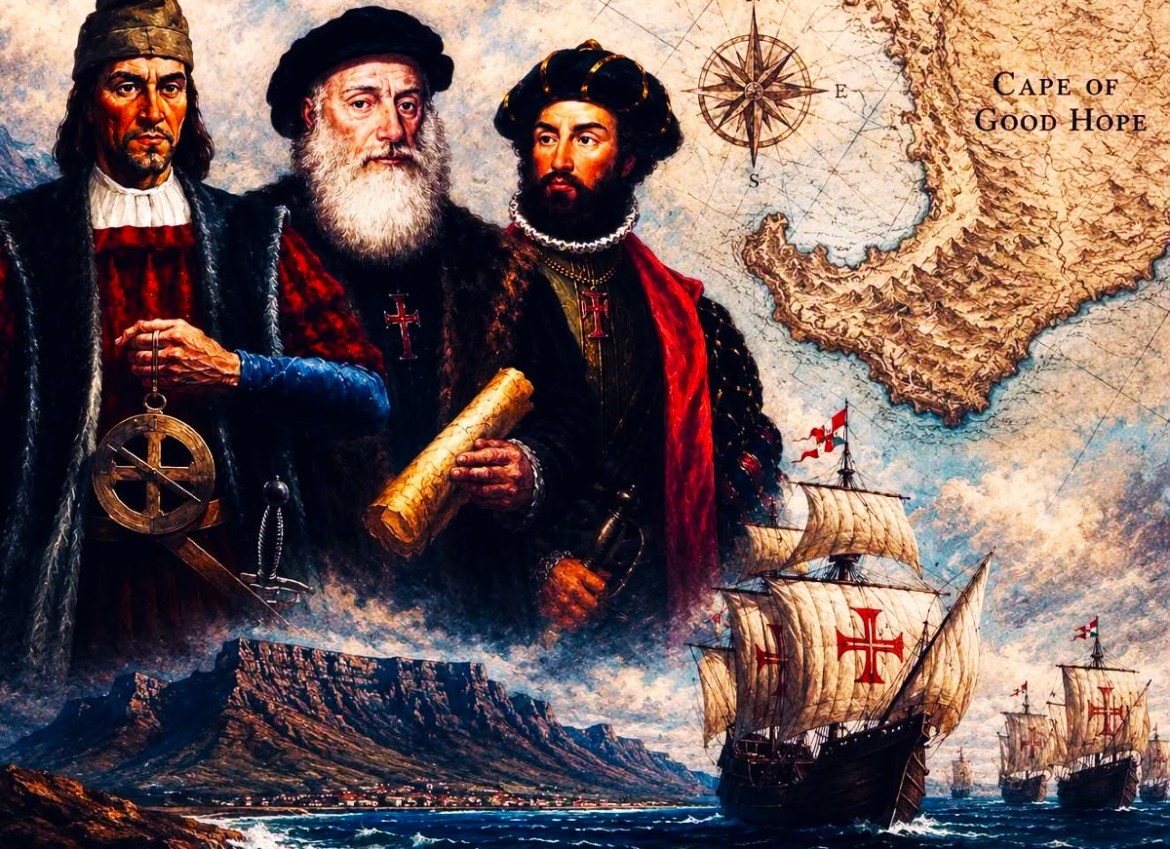
The story begins in 1488 when Bartolomeu Dias became the first European known to sail around the southern tip of the African Continent.
Bartolomeu Dias, (Also known as: Bartholomew Dias, Bartolomeu Dias de Novais and Bartolomeu Diaz) born around 1450 and died on May 29, 1500, at sea, near the Cape of Good Hope, was a Portuguese navigator and explorer
During his voyage he rounded what he called the Cape of Storms. Portugal’s king later renamed it the Cape of Good Hope because it offered a sea route to the riches of Asia.
A decade later, in 1497, Vasco da Gama followed Dias’s route around the Cape on his voyage to India.
His successful journey opened a direct trade route between Europe and Asia, allowing Portugal to build a vast maritime empire stretching from Africa to India and beyond.
Although Portuguese ships regularly stopped along the South African coast for fresh water and supplies, Portugal’s main interest was not settlement.
Its priority was controlling the profitable trade routes to the East. Rather than establish colonies at the Cape, the Portuguese focused on strategic ports such as Mozambique Island, Goa and Malacca.
One of the most important events in this story occurred in 1510.
The Portuguese viceroy of India, Francisco de Almeida, stopped at Table Bay while returning from India.
The Battle of Salt River
Relations between his men and the local Khoikhoi population quickly deteriorated after a dispute involving cattle and trade.
On the first day of March 1510, Almeida led about 150-armed Portuguese sailors ashore near present day Salt River to recover cattle that had been taken following earlier conflicts.
The Khoikhoi used the terrain to their advantage and launched a coordinated attack.
Armed mainly with assegais (Short spears) and stones, they overwhelmed the Portuguese force. Almeida and around sixty of his men were killed in what became known as the Battle of Salt River.
The Khoikhoi also used cattle, specifically trained oxen, in warfare as mounts for fast-moving cavalry and as moving shields during battles.
They rode these oxen into combat and frequently utilized them to physically screen warriors from enemy fire during fighting.
The defeat had a lasting impact.
It demonstrated that establishing a permanent settlement at the Cape would not be easy and reinforced Portugal’s preference for using the region as a stopping point rather than a colony.
For the next century and a half, Portuguese ships continued to sail past the Cape, but no serious attempt was made to settle it. By the mid-1600s, Portugal’s power was declining as rivals such as the Dutch and English challenged its dominance at sea.
Musa Bin Bique
In fact after their defeat in the Cape against the KhoiKhoi, the Portuguese reportedly decided to rather colonize Mozambique, which previously was under an Arab trader who was based in Zanzibar and his name was Mussa Bin Bique (which was later coined into Mozambique)
In 1652, the Dutch East India Company established a refreshment station at the Cape under Jan van Riebeeck.
The settlement was intended to supply Dutch ships travelling between Europe and Asia.
Unlike the Portuguese, the Dutch created a permanent colony, imported settlers and gradually expanded inland.
Portugal still controlled territories to the north, particularly in modern day Mozambique and Angola, but the Cape had already fallen into Dutch hands.
When the British later took control of the Cape in the early 19th century, any possibility of Portuguese rule in South Africa disappeared.
The defeat of Francisco de Almeida at Salt River, Portugal’s declining power and the arrival of the Dutch combined to ensure that the future South Africa would develop under Dutch and later British rule rather than Portuguese control.
The Portuguese, that it, Bartholomeus Diaz built settlements.
The first such settlement being in Mossel bay and its famous tree post office.
They also built the current Durban which they named Porto Natal (The Port of Natal).
The Portuguese established Brazil, Angola and Mozambique as Portuguese territories, as well as the Cape Verde Islands, Guinea, São Tomé plus Goa (India), Macau (China), and East Timor (Asia).
All these precincts are Portuguese speaking with Portuguese infrastructure built …
Historically, the Portuguese Empire also claimed and settled outposts in the following regions:
Uruguay
Coastal enclaves in Morocco, Ghana, and Equatorial Guinea.
Parts of Sri Lanka, Malaysia (Malacca), Indonesia (the Moluccas), and localized settlements in Iran, Oman, and Bahrain.
As well as Newfoundland and Labrador in Canada. …