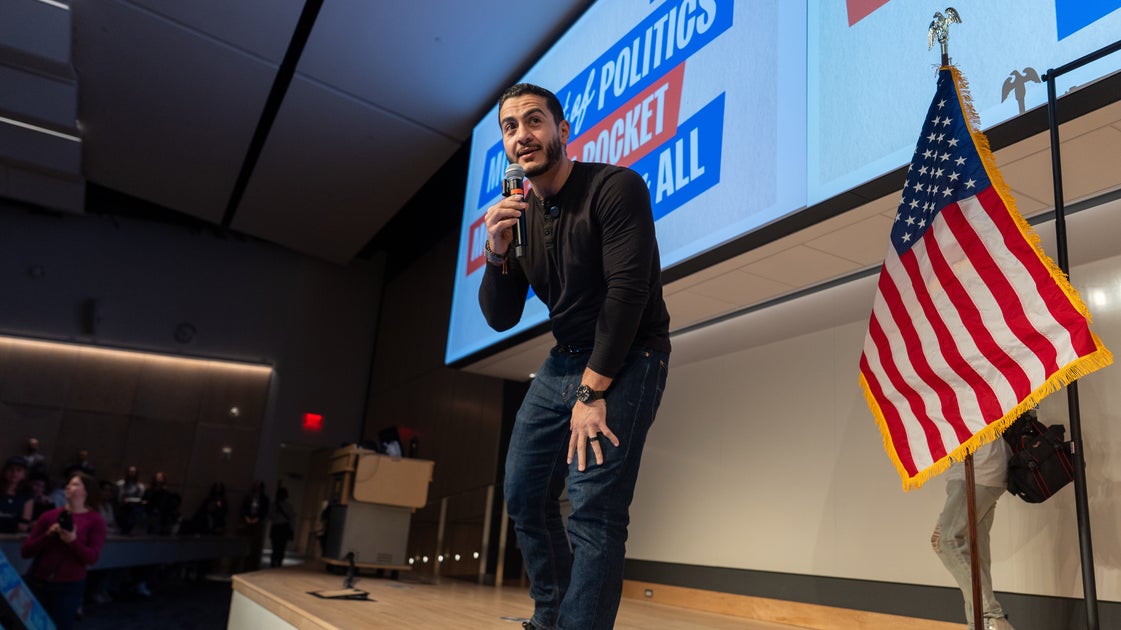
WASHINGTON – Abdul El-Sayed is very confident he can beat Republican Mike Rogers and win Michigan’s U.S. Senate seat in November.
“He generally has the charisma of a doorknob,” El-Sayed told HuffPost in a 45-minute interview last week. “He carries all the MAGA baggage, but he also has the aesthetic of the guy at a country club who sneers at you from his Lincoln. He’s not really hard to beat.”
“By the time I’m done with him, his golf buddies down in Florida are going to be calling him the names I call him,” he continued, referencing Rogers’ time living in the Sunshine State following his departure from Congress in 2015. “I hope that 20 years from now, he still thinks of me.”
But his bravado is still not shared by the party establishment in D.C. or in Michigan, who fear his progressive positions ― he’s a longtime ally of Sen. Bernie Sanders (I-Vt.) and backs Medicare-for-All, abolishing ICE and cutting off aid to Israel ― could cost the party support from moderate voters and ultimately hand the state’s Senate seat, which has been in Democratic hands since 1978, over to Rogers and the GOP.
Party leaders, however, don’t seem to be making much headway with their assertions that establishment-oriented Rep. Haley Stevens is actually the most electable pick for the Aug. 4 primary: El-Sayed has led the last seven publicly released polls of the race.
In the past, worries about electability have sunk many progressive candidacies before they could even begin. Before this cycle, the last time a progressive candidate defeated the Democratic Senatorial Campaign Committee’s pick in a primary was 2010.
Although Democratic voters are still hardwired to care far more about electability than their GOP counterparts, both progressive and moderate party strategists say primary voters no longer trust the party leaders’ judgment on who can win — not after establishment candidates lost to President Donald Trump in 2016, narrowly beat him in 2020 and lost again in 2024.
“The last people who have any right to lecture us about electability are the establishment who lost to Donald Trump twice,” Rep. Ro Khanna (D-Calif.) said while campaigning for El-Sayed last month. “If you were part of those campaigns, please sit down or exit stage left.”
The stakes for the race are high: Democrats’ relatively narrow path to winning the Senate essentially evaporates if Rogers wins in Michigan. A primary victory for El-Sayed, a Rhodes Scholar and former leader of Detroit’s public health department, would mean the party is counting on left-wing candidates to win in both Michigan and Maine in November. Failing to do so would dramatically undercut the progressive movement, which has gained momentum throughout this primary season.
If the Democratic establishment can’t make the case El-Sayed would be a general election loser, they hope GOP interference can do it for them. The National Republican Senatorial Committee recently began running digital ads that attack El-Sayed in ways designed to make him sound more appealing to Democratic primary voters.
The 30-second ad opens with a clip of El-Sayed promising to back the abolishment of Immigration and Customs Enforcement, before a narrator links him to two figures popular with progressives. “Abdul campaigned with anti-Israel, radical Hasan Piker,” the narrator says. “He called to abolish private health insurance, and he’s championing socialist tax hikes with Sen. Bernie Sanders.”
The NRSC and Rogers’ campaign did not respond to requests for comment. Stevens’ allies view the ad as powerful validation for their contention that El-Sayed can’t win.
“There are two candidates in this race rooting for Abdul El-Sayed to win the primary: Abdul El-Sayed and Mike Rogers,” said Arik Wolk, a spokesperson for Stevens’ campaign. “That’s why Republicans are spending money to boost Abdul and Republican senators admitted: Abdul ‘makes it even better’ for them to win in Michigan.”
Another pro-Stevens consultant was even blunter: “As much as Democrats hate AIPAC right now, they hate Republicans more,” said the consultant, who requested anonymity to speak frankly, referring to the pro-Israel lobbying group loathed by progressives whose affiliated super PACs are spending millions to attack El-Sayed and back the congresswoman.
Other operatives in both parties working in Michigan said it was clear at least some Democratic primary voters have concerns about El-Sayed’s electability, with some noting it’s driving the remaining support for state Sen. Mallory McMorrow, who has tried to split the ideological difference between El-Sayed and Stevens and has faded to third in recent polling.
El-Sayed downplayed the ad’s importance.
“I think they’re trying to get ahead of things because it’s a short campaign after the primary, and they see me coming,” he said. “If their intention really is to boost me, I’m gonna make them rue the day whatever dumbass consultant came up with that idea.”
At the same time, his campaign is clearly working to alleviate electability concerns. His schedule is sending him through counties full of voters who flipped from backing former President Barack Obama to Trump.
His first ad of the campaign features no fewer than 17 shots of the American flag, and ends with Sanders jokingly reassuring voters who may worry about whether the state would elect a Muslim: “Don’t worry about his name.”
Another problem establishment-aligned candidates keep running into this cycle when making electability pitches is a lack of polling backing up their assertions. Joe Biden famously went months without ever trailing Trump in a poll, while Sanders and Sen. Elizabeth Warren (D-Mass.) performed less consistently in surveys.
Gov. Janet Mills’ attempts to argue progressive oysterman Graham Platner’s scandals would render him unable to beat Sen. Susan Collins (R-Maine) failed in part because Platner consistently outperformed her in head-to-head matchups with Collins in public surveys. A similar problem is beginning to haunt Stevens: While she performed significantly better than El-Sayed against Rogers in surveys earlier in the campaign, several recent polls have shown El-Sayed doing better or performing equally well.
Without polling to cite, Stevens and her allies are now focused on what type of campaign they plan to run, arguing she has a track record of relieving swing voters’ concerns about the party being too liberal — she flipped a Republican-leaning seat in the 2018 midterm elections — and has a similar profile to Senate candidates who have succeeded in Michigan and elsewhere.
El-Sayed, of course, says that’s hogwash too. “Haley Stevens is not Elissa Slotkin, and the world has changed,” he said, referring to the moderate Democrat who defeated Rogers in 2024, narrowly outperforming Kamala Harris, who lost the state to Trump.
“We’ve only run one play, and it barely worked,” he said, arguing only centrists have won in Michigan because they are the only candidates who have been given a chance. “The answer is either that’s the only play that can work, which seems to be everybody’s conclusion, or there’s another play that could work better. I’m running the other play. I think it’ll work better.”
El-Sayed said his campaign would balance trying to win over voters who backed Trump and turning out Democratic voters who might otherwise stay at home, rather than copy past progressive efforts, which have narrowly focused on driving up turnout. He argues voters are ready for a campaign focused on how the proliferation of money in politics is “rigging the system against us.”
“It’s why you pay more for what you buy but get less for the work you do,” he said. “And watch as your tax dollars get misappropriated to do dumb things like drop bombs on other people instead of investing in you and your kids.”
Indeed, many parts of the Democratic establishment agree the old model of an electable candidate no longer applies, even if they aren’t quite sold on the full-fledged progressivism of a candidate like El-Sayed.
“It’s not a binary choice between overcautious, under-imaginative old guard types on the one hand, and folks who seem to think that any society could exist without law enforcement and borders on the other,” said Andrew Bates, who was a spokesperson for Biden’s 2020 campaign. “The people who win majority-making races create their own big tent that’s both true to themselves and fits their community; they don’t force themselves into a prepackaged box.”