Braun’s appeal is difficult to explain through his politics alone. Krzysztof Rudziński, who runs an online forum of Braun supporters, returns repeatedly to Braun’s character. He describes him as “a politician with a moral backbone” who does not “stab his own people in the back,” and who sticks to his principles rather than follow political fashion. Braun, he said, is willing to pursue what he sees as the truth, even when it provokes controversy.
“I’ve been following Braun for a long time,” Rudziński said. “He’s certainly a courageous person. The fact that he still hasn’t buckled under that kind of pressure – I really admire that. He must have the skin of a rhinoceros.”
For people like Rudziński, Braun is an exception, a stark contrast to the governing Civic Coalition and the opposition Law and Justice party, PiS, which he accused of corruption and serving foreign interests.
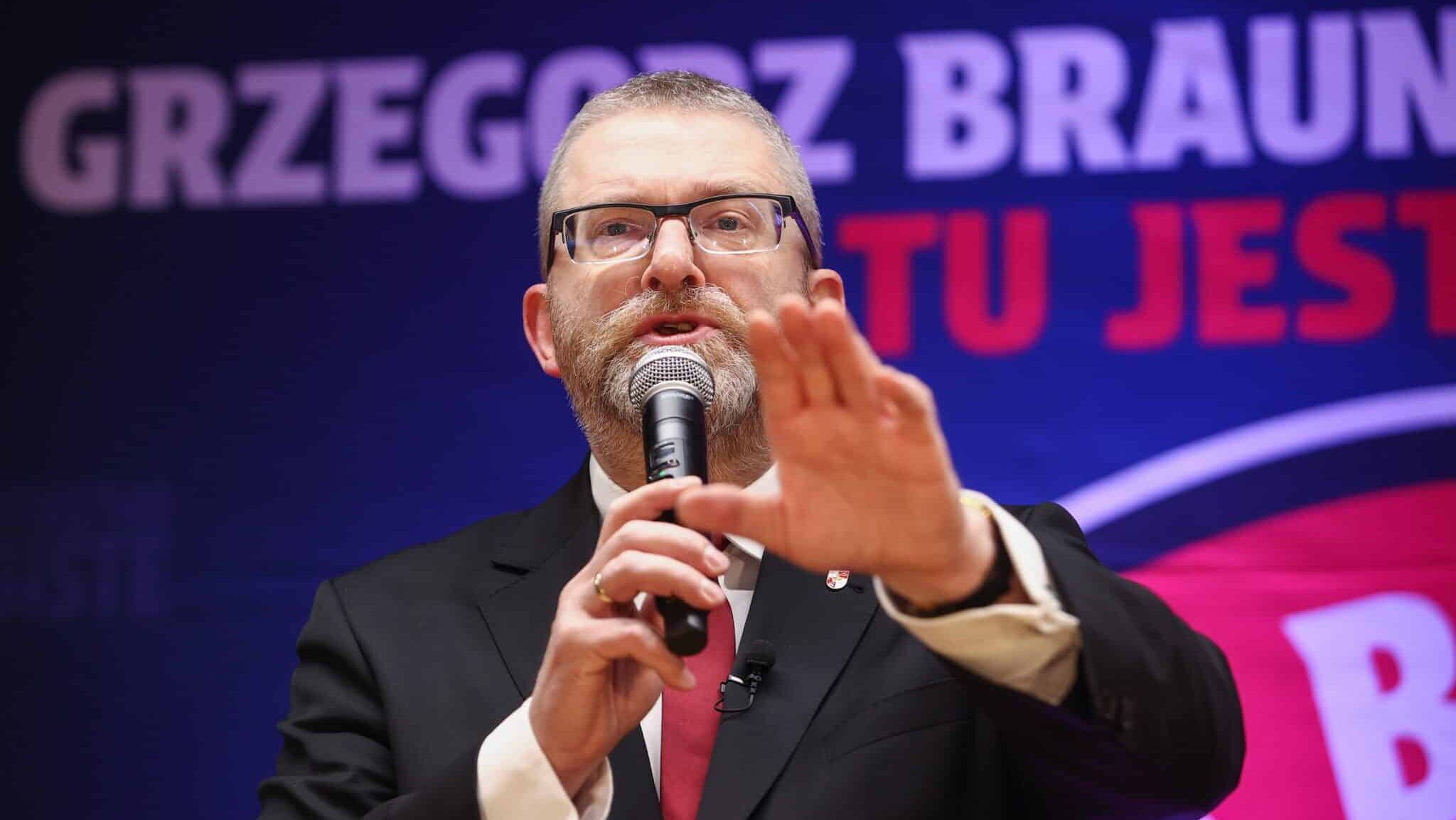
According to Sitnicka, Braun has consciously cultivated the image of a sage-like figure, operating outside the political order his voters associate with television and mainstream media. He wears an eye patch – the result of a retinal detachment – and speaks in a highly stylised, archaic Polish laced with historical and religious references.
“He’s a bit of a magician,” Sitnicka said. “People are won over almost immediately by the way he speaks.”
Cześnik, of SWPS University, said: “I’m not sure there are any boundaries to what Braun can say. The only obvious exception would be criticising the Catholic Church.”
Śmiszek said he struggles to identify any coherent ideology binding his supporters together.
“How do you reconcile visits to the Iranian embassy, admiration for Putin, Holocaust denial, antisemitism and flag burning?” he asked.
What they share, he argued, is less a worldview than an impulse: “They want someone who will blow up the system.”
Rudziński sees it differently. “I think what unites Braun’s supporters above all is a deep frustration with years of rule by both PiS and Civic Platform, coupled with a strong commitment to justice.”
He pointed to Braun’s opposition to COVID-era vaccine mandates and what he described as the “sanitary segregation” of vaccinated and unvaccinated people. Whether or not Braun himself was vaccinated, Rudziński said, was beside the point. What mattered was that he had defended individuals’ right to make their own medical decisions and protected doctor-patient confidentiality.
“I don’t see Braun as radical,” he added. “He’s simply someone who refuses to stand by when he believes something is wrong.”
Cześnik described Braun as a politician who has succeeded in bringing once-taboo subjects into the mainstream while cultivating a reputation for saying what others will not. Supporters may know he goes too far, but that excess is part of the point. “If he didn’t do it,” Cześnik said, paraphrasing how many supporters see him, “our entire moral order would collapse”. Crossing the line becomes “the price that has to be paid”.
He sees Braun’s appeal as part of a broader conservative backlash – secularisation and social liberalisation, he argued, have moved faster than many voters’ values, and Braun has entered that gap as a theatrical defender of a threatened moral order.
“I’m not a fanatic,” Rudziński said. If Braun were to “mess up” or “lose his honour”, he said, he would go back to voting for what he saw as “the lesser evil” – probably the original Confederation. “What other choice do I have? The left wants to turn Poland into another France, where I’d be afraid to let my wife and child go outside.”