“I hope for nothing. I fear nothing. I am free.”
This is the inscription on the grave of Greek writer Nikos Kazantzakis that has inspired debut author Nick Aridas since he was a young man, enough so that the title of his first book is a subtle homage to him.
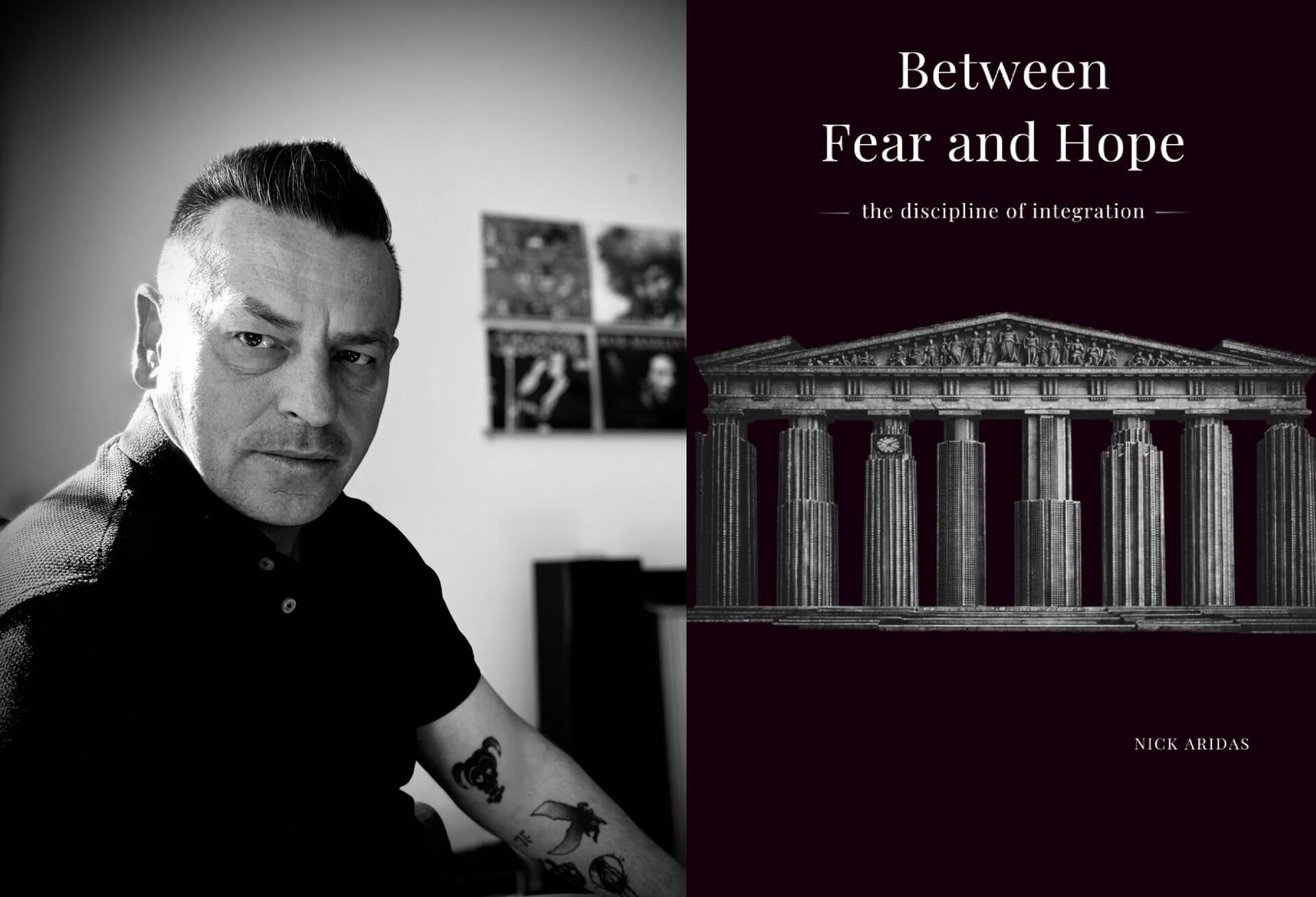
Between Fear and Hope: The Discipline of Integration was published back in May and explores philosophy, identity, and the tension between opposing forces within the human experience.
The book focuses on the discipline of integration-bringing together fear and hope, power and restraint, to better understand how we live.
“What’s written on his grave is something that has stayed with me forever since the day I learned that’s what it said,” Aridas told Neos Kosmos.
“I agree with that, so one day, when I’m wise enough and enlightened enough, I will be beyond fear, and I will be beyond hope, and I will be free.
“In the meantime, we have to learn how to live between those opposing forces. We have to learn how to live between fear and hope, how to live between those tensions that define us, how to live between anger and forgiveness, how to live between freedom and responsibility.”
The book is off the back of a promise he made himself at 25 that one day he would write a book that mattered but before that he wanted to answer a more pressing question of ‘what would I like to leave behind?’.
Nikos Kazantzakis grave, which has inscribed on it – “I hope for nothing. I fear nothing. I am free.”
“I started writing a series of letters to my children, to my wife, to my parents, to my ancestors, to grandkids I hadn’t quite met yet, thinking that one day when I’m not there that will be for them, for whoever’s left behind,” he said.
“That resonated really strongly with my wife, and she said ‘this needs to be more than just letters that aren’t going to be opened until after you’re gone, you should seriously think about turning this into your first book. I know it’s been a dream of yours’.”
That’s exactly what he did. What started off as a series of deeply personal letters turned into something a lot more than that. It turned into a philosophical and literary work, exploring the themes that are really important to him.
But what makes this book a little more unique is the first half explores his inner world.
You meet the man Nick Aridas, what shaped his, from his heritage, his experience in Australia, his relationships with family and friends, and enemies.
The second half delves more into his philosophies.
“Most philosophy books start with ideas – this one starts with scars,” Aridas said.
“It starts with scars and it starts with lessons and it continues that way. It’s lived experience written in a way where you would speak to someone about these ideas in a pub or over dinner.
“The themes are very deep, but it’s written in a very deliberately accessible and simplistic way.”
Head in the ‘Olympian’ clouds
Aridas was born to Dimitrios and Maria Aridas in the village Livadero, a former community in the Kozani regional unit, West Macedonia, Greece. It is now part of the municipality Servia.
The village is high up in the mountains and according to Aridas, one can see Mount Olympus from his grandfather’s house on a clear day.
His family moved to Australia when he was three years old, and while he grew up here, he’s “always felt fundamentally Greek”.
“Greek was my first language, and I literally thought and dreamed in Greek until I was 14 years old,” he said.
“During my childhood… my head was in ancient Greek history. My head in the Olympian clouds with all the myths and the legends.”
This fascination was enough so that he named his sons Alexander and Ajax, two heroes of his from ancient Greece and Greek mythology.
And in the book, you’ll see strong themes of Homer and references to the Odyssey as well as thinkers who have influenced him like Aristotle and Plato.
But there’s also modern non-Greek references like American writer and civil rights activist James Baldwin, German philosopher Friedrich Nietzsche and modern cultural references like musicians Nick Cave and Bruce Springsteen.
Nick Aridas was born in the village of Livadero.
‘You are a Greek’
Between Fear and Hope: The Discipline of Integration includes English, Greek, and Greek English bilingual editions, with German, French, Spanish, and Italian editions also completed and preparing for release.
Having it written in Greek was important for Aridas, given how much his heritage has shaped him.
He says makes this project especially meaningful is that the Greek translation was shaped with the help of his father-in-law Athanasios Kleftouris or Kiriye Kleftouri, as many of his former students may remember him by.
He’s a longstanding and respected member of Melbourne’s Greek community, former Vice Principal of Oakleigh Grammar (in its St Anargyri days) and Greek school teacher.
“I really wanted the book to return to its native language, and the funny thing is my father-in-law… he said to me ‘this book reads so much better in Greek because you think in Greek, you argue in Greek, you are Greek’,” Aridas said.
When the bilingual edition was finally published, Aridas posted in his village’s Facebook group of 2500 members that he’ll send 30 copies back to the village so his uncle can put some in the local library, give some out to a few of the students that were interested and to lecturers at universities to read and review.
“That what the book’s really about. Legacy, continuity and inheritance of what we have as Greeks and what we continue to fight for both in Greece and abroad,” he said.
“Our identity and preserving it and continuing to build on the amazing history that is part of all our inheritance.
“I feel it’s our sacred duty to try and extend that, to build on that and extend that as best we can.”
All editions of Between Fear and Hope: the discipline of integration are available on Amazon.