by Stephen Martin, Oklahoma Watch
June 26, 2026
Amid the farm fields of northwest Oklahoma City, a place where high-voltage power lines converge has attracted interest from two data center developers, each seeking to build at the western terminus of a new $72 million transmission project.
The Mathewson Substation, a nondescript complex of power lines and equipment on NW 248th Street near Piedmont in southeastern Kingfisher County, has become a highly sought-after location to tap into Oklahoma’s power grid.
“That’s one of the strongest points on the electrical grid in the state of Oklahoma,” said Aaron Bilyeu, chief development officer with Houston-based Cloverleaf Infrastructure, one of the companies seeking to build a large-scale data center for artificial intelligence in Piedmont.
For years, electrical grid planners worried about a problem most Oklahomans never knew existed. Power flowing into the western side of the Oklahoma City metro area could become congested during periods of heavy demand or when transmission resources are unavailable.
The solution identified by planners at the Southwest Power Pool, the regional organization responsible for coordinating the electric grid across a 14-state region that includes Oklahoma, was a new 345-kilovolt transmission line connecting the Mathewson Substation with the Redbud Energy Facility near Luther.
Today, that corridor and the adjacent areas are attracting the attention of a different group entirely.
In addition to Cloverleaf, Atlanta-based Beltline Energy, a renewable energy and industrial development company, has proposed data center projects in multiple communities, including Piedmont, Yukon, Oklahoma City and Luther. Company materials describe Beltline as a developer with expertise in utility-scale energy projects, including industrial real estate and electrical transmission analysis.
While Cloverleaf executives agreed to interviews for this story, Beltline Energy declined repeated opportunities to discuss its Oklahoma plans. Requests for comment sent to the company and its legal representatives were not returned.
Each proposal has generated its own local debate, and the clustering of the projects has raised a broader question: Why are multiple developers interested in the same part of Oklahoma?
The answer appears to be rooted in the electrical grid. In some places, the connections are better than in others.
Bilyeu described his company’s approach to that of a shopping center developer. The company looks for a location to build and will later find someone to occupy the facility once it is constructed. The ultimate user could be a company like Google, Meta or Microsoft. Or it could be someone else entirely. But just like a developer of retail space, Bilyeu knows the key to success is location.
“And from an electrical engineering perspective, that really is a great place for a data center,” Bilyeu said. “Which is why we’ve optioned the land that we have directly adjacent to it.”
Data centers have always required large amounts of electricity, but artificial intelligence is changing the scale.
The newest generation of AI-focused facilities can consume hundreds of megawatts of power. The largest projects can require as much electricity as a small city.
“There’s not many locations on the grid that can actually serve them without triggering massive transmission upgrades,” said Jonathan Abebe, chief technical officer with Cloverleaf.
Abebe said companies first look for locations connected to robust high-voltage transmission systems capable of supporting large electrical loads. New transmission projects can take years to permit and build, making existing infrastructure especially valuable.
For Cloverleaf, the search for a place that met all their requirements led to the Mathewson Substation.
Multiple 345-kilovolt lines converge at the site, creating a major node on the regional grid. To developers searching for large amounts of reliable power, those connections can be as important as highways, rail lines or waterways were to earlier generations of industrial development.
The transmission infrastructure drawing developers today was not originally designed for them.
Seth Blomeley, senior communications strategist for Southwest Power Pool, said the Mathewson-Redbud project emerged from the organization’s transmission-planning process years before data centers became a major factor in their planning.
“This line will provide a path for load to also be served from the east,” Blomeley said. “That additional transmission source will greatly benefit the customers in the area, especially during times of stress in the system.”
In May 2025, SPP selected Transource Oklahoma to construct the approximately 38-mile, 345-kilovolt transmission line. The project is expected to enter service in 2027.
Michael Harris, a Transource Oklahoma outreach specialist, said relieving congestion effectively gives grid operators more options to move electricity around the system when demand spikes, equipment fails or severe weather disrupts normal operations.
“By adding capacity and improving network resiliency, projects like Mathewson-Redbud give the grid more flexibility to serve growth while maintaining reliable electric service,” Harris said in a written response.
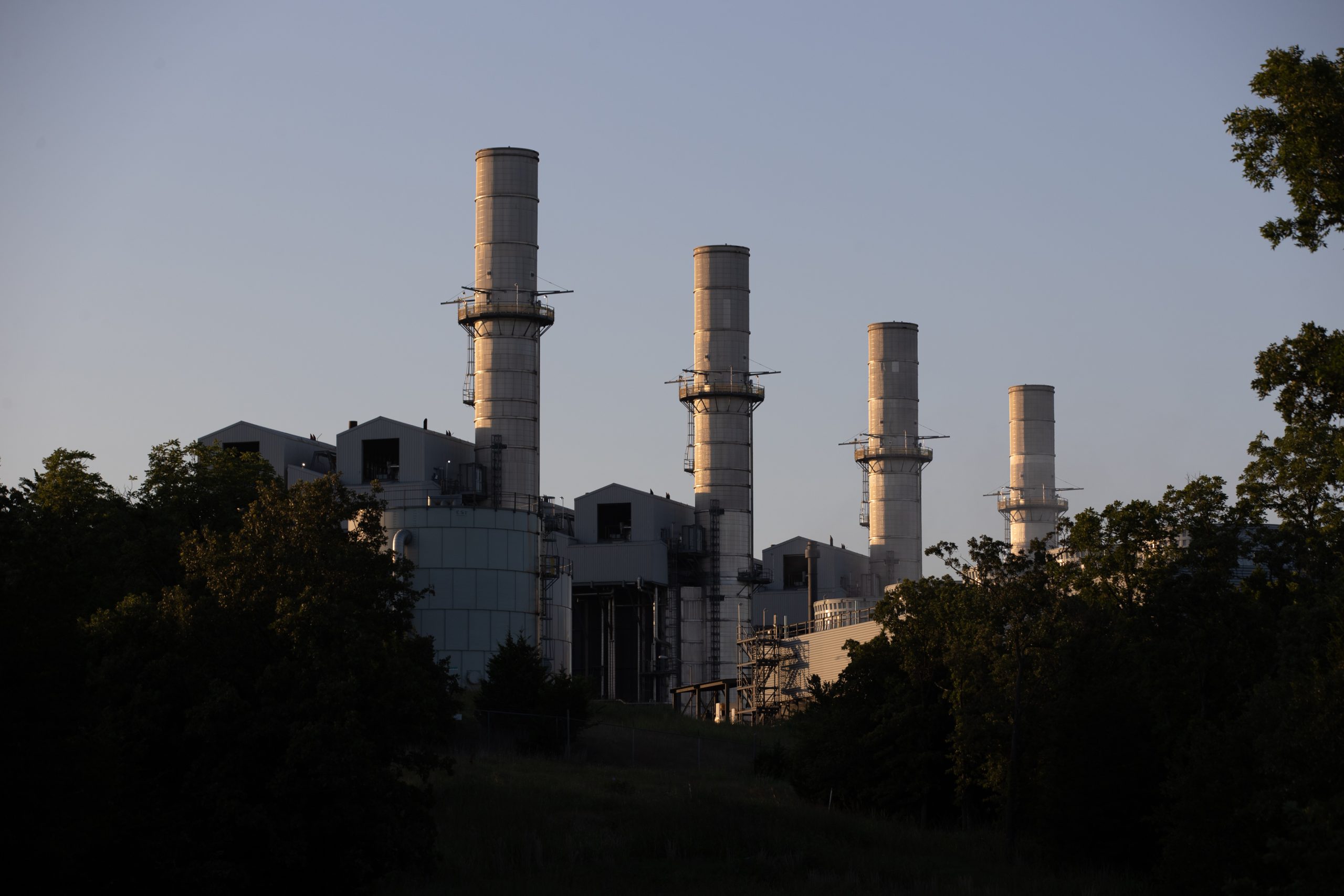
The Matthewson substation in Piedmont. (Brent Fuchs/Oklahoma Watch)
While projects such as Mathewson-Redbud are planned primarily to meet reliability needs, Harris acknowledged that stronger transmission infrastructure can also affect economic development decisions. Reliable transmission service is an important consideration for large industrial and technology projects with significant electricity requirements, he said.
The relationship between transmission investment and economic development can be difficult to separate.
Oklahoma State University industrial engineering professor Sunderesh Heragu compared the phenomenon to building a new highway, where new infrastructure often attracts additional activity and investment.
“It is very likely that new transmission corridors will attract more customers requiring more energy, until the supply-demand finds an equilibrium,” Heragu said.
Abebe said transmission planners generally anticipate that growth when designing major projects. Utilities and regional grid operators evaluate projected demand as part of the planning process, he said, helping to ensure new infrastructure continues to serve its intended purpose even as additional customers arrive.
The story unfolding between Piedmont and Luther is part of a much larger shift occurring across the central United States.
In its 2025 Integrated Transmission Planning Assessment, Southwest Power Pool identified accelerating load growth as the largest driver of future transmission needs across its 14-state service area.
For decades, annual growth in electricity demand was relatively modest. Then came a wave of new large-load customers.
Projects that replace older systems with electric ones, new manufacturing facilities, and data centers began seeking service at a pace that outstripped the traditional timeline for building transmission infrastructure.
The surge in demand is also changing how planners think about the transmission grid itself.
For nearly two decades, Southwest Power Pool expanded a regional network built around 345-kilovolt transmission lines, creating a backbone that today serves Oklahoma and a region that stretches from Montana to portions of New Mexico and Arkansas. But planners now argue that projected growth is large enough to require another leap forward.
The latest planning assessment concludes that continuing to rely primarily on 345-kilovolt construction would be increasingly costly and inefficient as demand accelerates.
“Continuing down the path of building only 345 kV transmission would require four to seven times more infrastructure to deliver the same capacity as 765 kV,” the report states.
SPP compares local transmission lines to city streets, while higher voltage lines, such as the 345-kilovolt lines that intersect at the Mathewson Substation, are like highways. The proposed 765-kilovolt system would serve as an interstate network capable of moving much larger amounts of electricity over long distances. As demand rises, planners argue, simply adding more lower-voltage lines would be akin to widening local roads when an entirely new interstate highway is needed.
“The best path forward to address the challenges the SPP members are facing is to invest in new extra-high-voltage ‘expressways’ — a 765 kV backbone capable of carrying large amounts of power quickly and reliably across the footprint,” the report states.
Without those investments, SPP warns that growing electrical demand could lead to increasing congestion, reliability concerns and higher costs for consumers.
SPP projects demand within its region will nearly double over the next decade. National forecasts point in the same direction. Earlier this month, the U.S. Energy Information Administration projected that electricity consumption would continue rising through 2027, driven largely by AI-related data centers and broader electrification trends.
The result is a scramble for locations that already possess the infrastructure necessary to support major electrical loads.
Oklahoma officials said access to electricity has become one of the state’s strongest selling points as communities compete for data center investment.
Jay Shidler, director of business recruitment for the Oklahoma Department of Commerce, said power availability is often the single most important factor in site selection decisions.
“Electricity is number one,” Shidler said. “It’s the driver. The availability of power and the 345-kilovolt lines are the driver in the site selection process.”
Shidler said companies typically evaluate electricity first, followed by land availability and workforce considerations.
“It drives economic demand, not only in just the data center industry, but multiple industries: manufacturing, aerospace, and defense.”
He said Oklahoma’s competitive advantages include relatively low electricity costs, available generating capacity and a regulatory environment that allows companies to scale their power needs over time.
Electrical infrastructure is not the only factor developers consider.
Heragu said developers typically evaluate power availability, water resources, telecommunications connectivity and land.
“All are necessary conditions,” he said. “None by itself is sufficient.”
Telecommunications infrastructure also factors into site-selection decisions. Information provided by Lumen Technologies described fiber networks as foundational infrastructure for AI data centers, alongside power and land. The company said AI workloads require unprecedented volumes of data movement between cloud regions, data centers and computing clusters, increasing demand for high-capacity fiber connectivity.
However, fiber can be laid relatively quickly while electrical transmission capacity can take years to develop, making existing grid infrastructure particularly valuable and helping explain why multiple developers can independently arrive at similar conclusions about where to build.
Not everyone views the prospect of large-scale data center development as an opportunity.
Residents in several communities along the corridor have raised concerns about the size of proposed projects, their potential impact on water resources, noise, traffic and local character. Public meetings in Piedmont, Yukon and Luther have drawn residents seeking more information about developments that could consume hundreds of megawatts of electricity and occupy hundreds of acres.
In both Luther and Yukon, disputes over transparency became part of the debate. Residents in Luther criticized city officials for signing a nondisclosure agreement with a developer during preliminary discussions about a proposed project. In Yukon, residents questioned city leaders after Mayor Brian Pillmore confirmed the city’s former manager signed a nondisclosure agreement with Beltline before the project was publicly disclosed. Some residents characterized the process as a “backroom agreement” and said too much information had been withheld from the public.
Others questioned whether communities were prepared for projects on that scale and whether sufficient information had been provided about potential impacts on water use, electrical demand and future development.
“There’s not many locations on the grid that can actually serve them without triggering massive transmission upgrades.”
Jonathan Abebe, chief technical officer, Cloverleaf Infrastructure
Meanwhile, landowners along the proposed Mathewson-Redbud transmission route have expressed concerns about the 110-foot transmission structures planned for the project and the impact new easements could have on their property.
State and local officials have also begun examining how existing regulations apply to data centers. Oklahoma City and Edmond both recently adopted a temporary moratorium on certain new data center applications while city staff review potential zoning and development standards. Piedmont officials have likewise wrestled with questions about where such facilities should be located and what conditions should apply.
The prospect of increasingly large electrical loads has also attracted the attention of state policymakers.
Rep. Brad Boles, R-Marlow, said lawmakers approved House Bill 2992, the Data Center Consumer Ratepayer Protection Act, to ensure that large-load customers such as data centers pay the infrastructure costs associated with serving their projects rather than shifting those costs onto residential customers.
“We’re not trying to stop economic development,” Boles said. “What we do want is to make sure that Oklahoma consumers and families aren’t bearing the cost.”
HB 2992 is intended to protect residential and small-business utility customers from bearing the costs of electrical infrastructure built to serve large-load users, such as data centers and cryptocurrency mining operations. The measure requires those customers to pay their share of generation, transmission and other infrastructure costs and directs regulators to ensure those expenses are not shifted to other ratepayers. It also requires advance public notice and community meetings before certain large-load developments acquire property for proposed projects.
The law also requires financial assurances if those costs are recovered over time, so that utility customers are protected if the user defaults before the costs are fully recovered.
“It was considered probably the most aggressive ratepayer protection bill in the country this year, and Oklahoma’s leading the way on that,” Boles said.
Boles said lawmakers were responding to voters worried that utility bills could increase if the costs of serving large data centers were spread across the broader consumer base.
“All the members in the legislature, they’re hearing from their constituents and they’re hearing the same concerns,” Boles said.
The measure was one of two passed in recent legislative sessions to address concerns over data centers and other large energy users.
In 2025, lawmakers approved Senate Bill 480, known as the “Behind the Meter” law, allowing businesses to develop and operate their own electric generation and power facilities. Supporters said it would encourage investment by large manufacturers, data centers and artificial intelligence facilities while reducing pressure on the electric grid by allowing some projects to generate their own power.
The Mathewson-Redbud transmission line was designed to solve a reliability problem.
However, before construction is complete, it has already helped transform the area into one of the most sought-after locations for data center development in Oklahoma.
Although it’s unknown if all the proposed projects will ultimately move forward, it is clear that access to electrical infrastructure has become a deciding factor in the competition for AI investment.
For developers, planners and policymakers alike, the future of economic development increasingly runs through the power grid.
This <a target=”_blank” href=”https://oklahomawatch.org/2026/06/26/a-transmission-line-built-to-fix-grid-congestion-has-become-oklahomas-hottest-data-center-address/”>article</a> first appeared on <a target=”_blank” href=”https://oklahomawatch.org”>Oklahoma Watch</a> and is republished here under a <a target=”_blank” href=”https://creativecommons.org/licenses/by-nd/4.0/”>Creative Commons Attribution-NoDerivatives 4.0 International License</a>.<img src=”https://i0.wp.com/oklahomawatch.org/wp-content/uploads/2019/10/okwatch-icon.png?fit=150%2C150&ssl=1″ style=”width:1em;height:1em;margin-left:10px;”>
<img id=”republication-tracker-tool-source” src=”https://oklahomawatch.org/?republication-pixel=true&post=760302&ga4=G-6G6K9FYSH8″ style=”width:1px;height:1px;”><script> PARSELY = { autotrack: false, onload: function() { PARSELY.beacon.trackPageView({ url: “https://oklahomawatch.org/2026/06/26/a-transmission-line-built-to-fix-grid-congestion-has-become-oklahomas-hottest-data-center-address/”, urlref: window.location.href }); } } </script> <script id=”parsely-cfg” src=”//cdn.parsely.com/keys/oklahomawatch.org/p.js”></script>