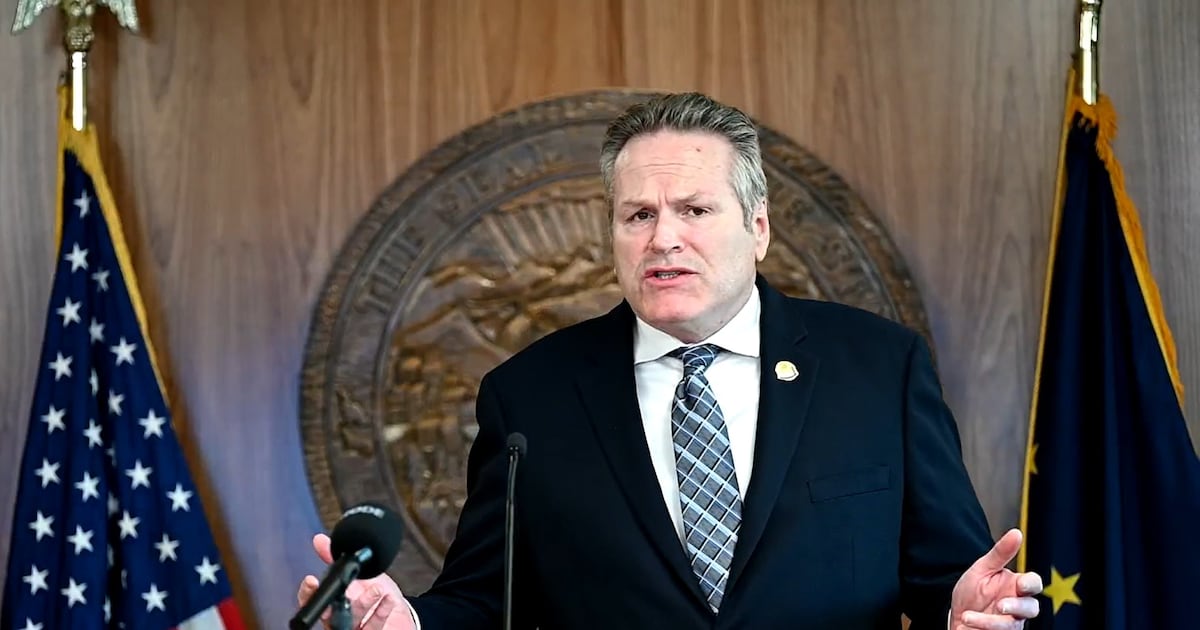
Gov. Mike Dunleavy speaks about proposed Alaska LNG tax break legislation at a press conference Friday, June 19, 2026, the last day of a legislative special session in Juneau. (Screengrab from Gov. Dunleavy’s Facebook livestream)
Gov. Mike Dunleavy vetoed close to $90 million on Wednesday from the state budget adopted by lawmakers last month.
Dunleavy signed the budget bills for the fiscal year that begins July 1, but not before nixing funding intended for an array of programs, including early intervention and infant learning, teacher incentive payments, Head Start grants, early education recruitment and retention, higher reimbursement rates for some Medicaid services, and a study on public education spending adequacy.
The largest budget item deleted by the governor was a plan to share $20 million in unexpected oil revenue with city and borough governments as they contend with the impacts of war-driven energy prices.
However, Dunleavy left intact most of the nearly $300 million in one-time funding that lawmakers had approved for Alaska’s K-12 schools.
Dunleavy said the budget “makes targeted, responsible use of a temporary revenue increase to stabilize school facilities and address energy costs.”
Senate Majority Leader Cathy Giessel, an Anchorage Republican, said that Dunleavy’s vetoes extend the governor’s eight-year “focus on cutting services for children and families.”
The budget signing comes as lawmakers are expected to reconvene in Juneau next week to vote on Dunleavy’s proposed tax breaks for developers of a long-sought natural gas pipeline.
The budget, which had been negotiated between House and Senate leaders, totals $15.6 billion in spending, including $6.4 billion in federal funding.
The final version of the spending plan was adopted by lawmakers on the last day of the regular session. The operating budget bill passed in the House 21-19 along caucus lines. In the Senate, it passed in a 17-3 vote, with three minority members joining all majority members to support the bill.
Members of the bipartisan Senate and House majority caucuses last month celebrated the investments they approved in some of the programs that Dunleavy nixed on Wednesday.
“From our teachers and students looking for adequate public school funding to those impacted by high fuel costs and disastrous weather events, victims of crime, and citizens who want to be safe, and those who are our most vulnerable. We hear you, and we deliver,” Rep. Andy Josephson, an Anchorage Democrat who oversaw the operating budget in the House, said last month.
Josephson said Wednesday that after eight years of Dunleavy’s vetoes, he was “desensitized” to the cuts to programs he had advocated for.
Many of the budget vetoes were accompanied by a one-line explanation from the governor’s office stating they were intended to “preserve general fund resources to support long-term fiscal stability.”
Dunleavy in December called on lawmakers to draw more than $1.5 billion from savings to pay a $3,800 Permanent Fund dividend per eligible Alaskans, based on a statutory calculation that has not been followed for a decade. Lawmakers broadly rejected Dunleavy’s plan, saying it would drain the state’s already-depleted state savings. They instead approved $1,200 payments to eligible dividend recipients.
The budget approved by lawmakers was expected to remain balanced as long as the price per barrel of North Slope crude averages $74 or higher during the fiscal year that begins in July.
The price was just under $88 per barrel on Monday, as prices continued to decline after the announcement earlier this month of an agreement to end the fighting between the U.S. and Iran.
The budget process this year was shaped by the war in Iran, which began in late February. The price of North Slope crude averaged $67 per barrel during the first eight months of the fiscal year. It then remained above $100 per barrel between mid-March and earlier this month.
That increase in oil prices put new burdens on Alaskans in the form of higher gas and fuel costs. But it also yielded a windfall to the state treasury.
Majority lawmakers directed a large part of that toward education funding, including $144 million in one-time funding for K-12 school operations. The capital budget for the coming fiscal year, which covers maintenance and construction, also includes nearly $150 million for school building repairs and construction.
Dunleavy let that funding remain in the budget, diverging from previous years, when he regularly cut additions intended for school operations and maintenance.
In a press release, Dunleavy said his “administration and the Legislature chose to direct a portion of the state’s one-time revenue toward addressing energy-related costs and overdue capital needs in schools across Alaska.”
In total, Dunleavy has vetoed more than $1.6 billion in spending from Legislature-approved state budget bills during his eight-year tenure.
Last year, Dunleavy vetoed $51 million in school funding from the spending plan, only to have lawmakers override the veto during a special session in August. It was the first time lawmakers had overridden a budget veto since 2009.
Legislators said earlier this week that vetoes of major items from the budget would compel them to enter a joint session next week to vote on again overriding the governor. Lawmakers are expected to gather in Juneau on July 1 to consider tax breaks for the Alaska LNG project developers.
Legislative leaders did not immediately say whether their caucuses supported a joint session after the governor’s vetoes were announced.
In 2024, Dunleavy vetoed more than $230 million from the operating and capital budgets. In 2023, Dunleavy vetoed more than $87 million from the budget. In 2022, Dunleavy vetoed $400 million. In 2021, Dunleavy vetoed $215 million in spending. In 2020, Dunleavy vetoed $261 million meant for operations and construction projects. In 2019, his first year in office, Dunleavy vetoed $444 million from the operating budget.
Here are some of the items Dunleavy vetoed from this year’s budget:
• $20 million for Community Assistance Payments
• $6.4 million for early education workforce recruitment and retention funds
• $6.25 million to increase Medicaid reimbursement rates for in-home caregivers.
• $5 million to increase Medicaid reimbursement rates for direct support professionals, who assistant individuals with intellectual, developmental and physical disabilities.
• $4.2 million for behavioral health grants
• $3.7 million for Head Start grants ($16.8 million remains in the budget for Head Start grants)
• $3 million to expand early intervention and infant learning programs (Dunleavy said $12.3 million remains in the budget for the program)
• $750,000 for a 30-day special session
• $490,000 for the Alaska Educator Retention and Recruitment Center
• $450,000 for teacher incentive payments and reimbursements for national board certification
• $400,000 for a public school funding adequacy study
• $260,000 in inventive pay for front-line social workers in the Department of Family and Community Services
• $355,000 for Parents as Teachers ($830,000 remains in the budget for the program)
• $123,000 for a new maintenance position at Mt. Edgecumbe High School.
• $5.3 million to expand programs at the Alaska Vocational Technical Center (AVTEC)
• $5.2 million for the Alaska Teamsters construction driver training center
• $4 million for the Fairbanks Pipeline Training Center to expand training equipment
• $3 million for Alaska tourism marketing
• $2 million to market Alaska seafood to domestic and international markets
• $1.7 million for the Kenai Instructional Service Center
• $450,000 for the Alaska Municipal League for the Alaska Federal Infrastructure Implementation & Sustainability Initiative.