For many children growing up in the Helsinki region, a visit to the Finnish Museum of Natural History leaves a lasting impression – especially because of the huge dinosaur skeletons up on the third floor.
So it was also with Iida Turpeinen, who remembers visiting the museum before she had reached school age.
“As a child, I wanted to become either a writer or a zoologist,” says Turpeinen.
The dinosaurs might have gotten all the attention back then, but years later, another museum exhibit caught her eye – a skeleton of Steller’s sea cow, an enormous aquatic mammal discovered in 1741 and hunted to extinction only 27 years later.
The story of the animal’s brief and tragic contact with humans perplexed Turpeinen. How could a species be wiped from the face of the earth in such a short time? Moreover, how did the skeleton, which was found on a remote island in the Bering Sea, end up in Helsinki?
By this time, Turpeinen had made her career choice, studying comparative literature at the University of Helsinki. She crafted her debut novel based on what she discovered as she searched for answers to her questions.
Recommended by the New York Times
The skeleton of Steller’s sea cow, and the story of how it ended up in the Finnish Museum of Natural History, inspired Iida Turpeinen’s debut novel.
Beasts of the Sea was published in Finnish in 2023. On one level, the book tells the curious stories of a few individuals whose lives become intertwined with Steller’s sea cow (or its skeleton) in one way or another. There is also a strong ecological undercurrent in the narrative: the extinction of one species acts as a concrete example of humanity’s devastating effect on nature.
“Writing fiction is a good way to address a phenomenon such as biodiversity loss,” says Turpeinen. “It is a slow catastrophe that is difficult to pinpoint. But literature has the ability to create an emotional attachment to such an abstract issue.”
The collections of the Finnish Museum of Natural History include one of the world’s only skeletons of the extinct Steller’s sea cow.
The book turned out to be an instant success. It won the Helsingin Sanomat Literature Prize, awarded by the country’s largest daily to the best debut work in Finland. A couple years later, the book appeared in English and topped a New York Times recommendation list called “Sumptuous New Historical Fiction.”
The book’s success has kept Turpeinen busy, as she has been visiting book fairs, giving interviews and advising translators – so busy that she struggles to find the time to work on her next book. “I should be working on my second novel,” she says. “But most of my time is still being spent with Beasts of the Sea.”
She adds with a laugh, “Funnily enough, now that I’m an established writer, I seem to have less time for writing than ever before.”
Once she finds the time, her upcoming book will deal with one of history’s most famous scientific hoaxes, she says, but she won’t reveal more at this point.
Challenges of translation
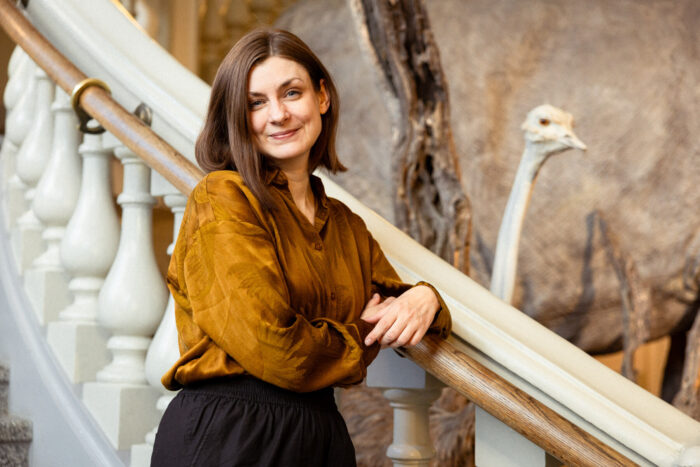
Iida Turpeinen enjoys working at the Finnish Museum of Natural History, where she learns something new every day from her colleagues.
At the time of writing, translation rights have been sold for 29 languages. If editions are published in all of them, the novel could rank among the ten most translated Finnish-language books for adults.
The original Finnish name of the book, Elolliset, translates roughly to “the living things.” It is an ambiguous and somewhat poetic name, whereas the English title, Beasts of the Sea, could be the name of a science fiction, horror or war adventure story. Other translations also have a taste of their own.
Turpeinen is amused by the different connotations, but she points out that the English name is appropriate, after all: Georg Wilhelm Steller, who discovered the species, described it in a treatise called De Bestiis Marinis – “beasts of the sea” in Latin.
The book is apparently a challenging one to translate. To help the translators, Turpeinen has put together an FAQ file, which is now 111 pages long.
Writer and part-time museum guide
Iida Turpeinen is working on her second novel. Her first took seven years to write.
Currently, Turpeinen enjoys a rather special arrangement: she is the writer-in-residence at the Museum of Natural History – a unique case of an artist sharing a working space with the museum’s researchers.
“This is an inspiring place to work for a representative of the humanities like myself,” she says. “Each time I take a coffee break, I learn new and fun things from my colleagues.”
While her main job is quite simply creating a new book, she has also taken on duties as part of the museum’s public engagement team. She joins some of the guided tours, enlightening the visitors with stories about certain exhibits.
“There is a vast cultural history behind the museum’s collections – how they were collected, what kind of philosophical thinking was involved, and so forth.”
Bridging the gap of childhood dreams
Iida Turpeinen stands outside the Finnish Museum of Natural History next to a bronze moose statue created by sculptor Jussi Mäntynen in the 1920s.
Thinking back on her childhood dreams, while Turpeinen is happy about her career choice, she says she always felt a certain sadness for having closed the door to the world of natural sciences.
But by ending up as a writer within the Museum of Natural History, writing stories rich with scientific history, Turpeinen has come full circle, in a way.
“As a writer of fiction, I don’t have to make the choice between science and literature. I can wander freely in both of these worlds.”
By Juha Mäkinen, June 2026
Photos by Emilia Kangasluoma