Let us read it for you. Listen now.
Your browser does not support the audio element.
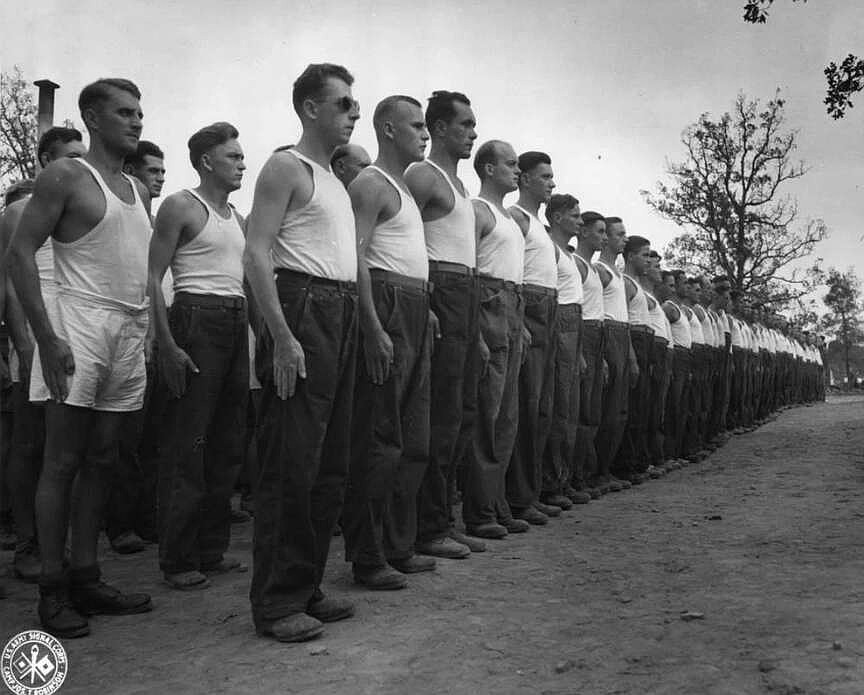
During World War II, the United States established prisoner of war (POW) camps on its soil for the first time since the Civil War. By 1943, Arkansas had received the first of 23,000 German and Italian prisoners of war, who would live and work at military installations and branch camps throughout the state.
The presence of POW camps in the United States was due in part to a British request to alleviate the POW housing problems in Great Britain. Initially, the U.S. government resisted the idea of POW camps on its soil. The huge numbers of German and Italian POWs expected to occupy the camps created many problems for the federal government and the military. The military did not have the experience or manpower to maintain camps with large POW populations. Most of the skilled military personnel fluent in German and Italian were fighting overseas. Government officials feared that housing so many prisoners could create security problems and heighten fears among Americans at home.
Establishing and managing POW camps in the United States was challenging on many levels, but organizing prison camps overseas created problems of its own. Supervising large groups of prisoners in Europe while adhering to the POW treatment policies established by the Geneva Conventions diverted food, transportation and medical resources from the American war effort overseas. Eventually, the United States reasoned that keeping prisoners of war in the United States would be an efficient use of military resources.
German POWs attending a religious service at Camp Robinson in North Little Rock; circa 1943 (From the Pulaski County military affairs photograph collection, Courtesy of the Butler Center for Arkansas Studies, Central Arkansas Library System)
To alleviate some of the security concerns in metropolitan areas and calm citizens’ fears, the United States housed prisoners in military installations and federal facilities throughout the South and Southwest. About 425,000 captured Axis troops were sent to the United States for internment in more than 500 camps. Nearly 23,000 captured troops, mostly Germans and Italians from Erwin Rommel’s Afrika Korps, were sent to POW camps in Arkansas. Camp Robinson in North Little Rock, Camp Chaffee in Fort Smith and Camp Dermott in Dermott were the state’s primary centers for Germans.
The remote locality of Camp Dermott in southeastern Arkansas, previously the Jerome Relocation Center for Japanese Americans, made it the perfect site to house German officers, while Camp Monticello in Drew County housed Italians, as did a branch camp in the Magnolia area. The Stuttgart Army Air Field in hosted German and Italian POWs.
Envelope sent by German POW from Fort Chaffee in Fort Smith; 1943 (From the German POW collection, courtesy of the Butler Center for Arkansas Studies, Central Arkansas Library System)
Camp Robinson was regarded nationally as a model camp. Living conditions in the camps were pleasant under the circumstances and included barracks housing, recreational activities, and creative and educational opportunities. Soccer was a popular sport among prisoners. POWs also performed theatrical plays and musical concerts. But it was not all fun and games. The POWs were required to work in and around the camp, earning 80 cents a day for their labor. Their duties included working in the camp cafeteria, on grounds maintenance and on local construction projects. POWs could use their wages in the camp store to buy toiletries, candy, cigarettes and even beer.
Many young men left Arkansas during World War II to serve in the military or find jobs in defense-related industries. Consequently, a labor shortage occurred in the farming and timber industries. To alleviate these shortages, prisoners supplemented the farm and labor forces at branch camps throughout Arkansas, mostly in the Delta and southern regions. In many cases, facilities from the Civilian Conservation Corps (CCC) served as barracks for the POWs at the branch camps. Each day, truckloads of prisoners were transported to farms and timber sites to chop cotton, cut wood and perform other chores to help stabilize the economy. Prisoners at Camp Hot Springs, for example, worked in local hotels and built structures at Lake Catherine State Park, among other assignments.
German prisoners of war (POWs) sitting in the mess hall of Camp Robinson in North Little Rock; circa 1944 (From the Pulaski County military affairs photograph collection, Courtesy of the Butler Center for Arkansas Studies, Central Arkansas Library System)
There were few escape attempts because of the remote location of the state. Most POWs resigned themselves to a relatively comfortable existence in the camps. This lifestyle caused many citizens to accuse the military of coddling the enemy. Americans were subject to rationing of food and other items, while POWs were provided a steady diet of good food and access to many name-brand items, such as cigarettes, that were unavailable to the general population. Additionally, many Americans whose relatives were killed or captured overseas were hostile to the prisoners.
To ease the transition between the period of civilian labor shortage and the return of U.S. soldiers, several POW camps remained in operation for a year after the war. Eventually, the camps were dismantled around the summer of 1946, and the prisoners were allowed to return to Europe. The fair and kind treatment experienced by German and Italian prisoners had a lasting impact on them. After repatriation, many former prisoners returned to the United States to launch professional careers or to renew acquaintances with their former captors. — Michael Bowman
This story is taken from the online Encyclopedia of Arkansas, a project of the Central Arkansas Library System. Visit the site at encyclopediaofarkansas.net.
Helaine Williams
hwilliams@adgnewsroom.com
Helaine R. Williams is the Arkansas Democrat-Gazette’s Sunday Style editor, where her wit-and-wisdom column, Let’s Talk, can be found. She also lends her feature writing and photography skills to the High Profile section and, on occasion, other style sections. Her journalism career with the newspaper spans more than four decades.