EVIAN-LES-BAINS, France ― Donald Trump has been disparaging America’s allies from afar for refusing to take part in the war he launched against Iran. On Monday afternoon, he will get a chance to do so to their faces.
That’s when the president is to arrive at the Group of Seven summit, the annual forum of the world’s largest democratic economies, whose other six members have been on the receiving end of Trump’s insults for not sending ships and planes to the Persian Gulf to help reopen the Strait of Hormuz to oil tanker traffic and resolve the global energy crisis that his war created.
And while Trump is known for generating conflict even in calm times, this meeting will feature national leaders likely as irritated with Trump as he is with them for creating a mess that has made life for their citizens even more difficult than Trump has made it for Americans. Running the program, in fact, is French President Emmanuel Macron, who has been open with his criticism of Trump’s war.
“President Trump will be there, and President Macron will be the host,” said Ian Lesser, a foreign policy expert with the German Marshall Fund. “Normally these things are not unpredictable events. This could be quite different.”
The meeting runs through Wednesday and will be followed next month with Turkey hosting the summit for NATO, the 77-year-old alliance that Trump repeatedly threatened to pull out of long before its members also declined to participate in the war Trump and Israeli Prime Minister Benjamin Netanyahu began on Feb. 28.
Trump on Sunday, yet again, announced a deal to end the war, although thus far it appears to be another ceasefire with an agreement to hold further discussions on key points of dispute.
Doug Lute, a retired Army general who served as the U.S. ambassador to NATO under former President Barack Obama, said that allies who once thought of Americans as reliable partners are trying to “de-risk” the annual summits while rethinking their assumption that they can count on the U.S. in a crisis.
“They’re going to move on from us,” he said. “The U.S. is walking away from international groups that have served other presidents of both parties well for several generations.”
Creon Butler, a top architect of the British government’s G7 participation during Trump’s first term, uses the phrase “the Trump Shock” to describe the thinking by America’s traditional allies going forward.
“There’s a kind of an understanding among G7 partners that there is a shift in the U.S.,” he said. “Things are not going to go back where they were.”
The adults are gone
While Trump’s profound ignorance of history and international trade generated friction during his first term as well, it was attenuated by his top aides and key Cabinet members, who worked to assuage allies that the United States was not abandoning its long-standing commitments.
Then-Vice President Mike Pence and national security adviser H.R. McMaster both met with European leaders behind the scenes to counteract Trump’s impulsive statements. Former Defense Secretary James Mattis used to joke that when meeting with his counterparts from U.S. allies, his actual role was the “Secretary of Reassurance.”
In this second term, those voices of normalcy are gone, and in their stead are Vice President JD Vance and Defense Secretary Pete Hegseth, both of whom are even more antagonistic than Trump. Hegseth, during a visit to Normandy for the commemoration of D-Day earlier this month, for example, managed to liken the Allied storming of those beaches in 1944 to the arrival of migrants on the shores of Europe today.

Thomas Padilla via Associated Press
Jim Townsend, a former Pentagon official who also worked at NATO, said that if the past is prologue, Trump will absolutely say or do things designed for maximum disruption and attention-grabbing.
“When he goes to these things, he likes to say things to ‘own the libs,’ as it were,” Townsend said. “He likes being the enfant terrible.”
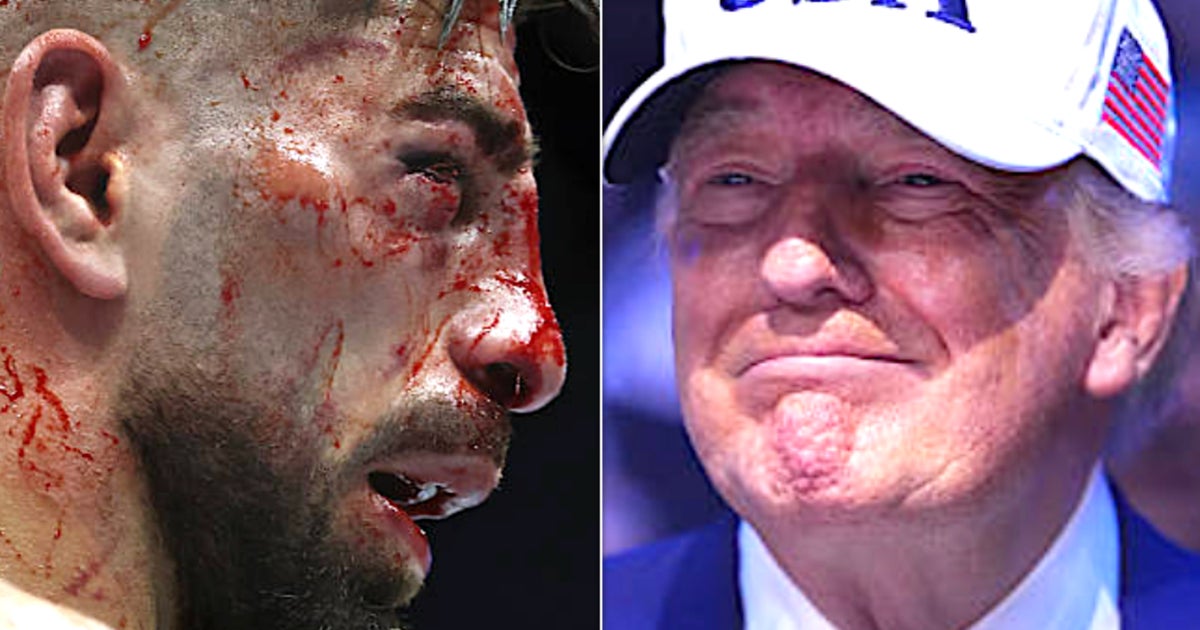
Trump thus far has said little about his goals for the G7, other than announcing he would attend right after the mixed-martial-arts bouts he hosted at the White House for the for-profit Ultimate Fighting Championship for his 80th birthday.
“I’ll be going to the G7, in France, immediately following what will be one of the Most Entertaining Nights in American History, the UFC World Championship Fights on the South Lawn of the White House,” he wrote on Truth Social.
If Trump does choose to make a scene about Iran or anything else, though, there may be no one in a position to de-escalate. Two months ago, Macron, the G7’s host this year, publicly lashed out at Trump while talking to reporters during a visit to South Korea.
“Ce n’est pas un spectacle!” ― This is not a show ― he said, and then added that war is a serious matter, and to be serious, one did not say something one day and then the exact opposite the next. He also questioned the purpose of the war at all, given that Trump had claimed to have “obliterated” Iran’s nuclear program a year ago. He closed with the advice: “Il faut peut-être pas parler tous les jours” ― it’s maybe not necessary to speak every day.
It’s unclear whether Trump learned of Macron’s remarks. White House officials did not respond to HuffPost queries on the matter.
What is clear is that if Trump did learn of Macron’s advice, he did not pay it any mind. Just five days later, he posted on social media that Iran’s entire civilization “will die tonight, never to be brought back again.”
Threatening an ally
Macron’s comments, which foreign policy experts say reflect what most European leaders and the European public more broadly believe about Trump, were triggered by the then-month-old war, but the consensus that Trump was not a serious person and could not be counted upon gelled some months earlier.
While Trump was prone to bizarre and uninformed comments during his-term conclaves with U.S. allies ― in Biarritz in 2019, he justified Russia’s annexation of Crimea on the grounds that its dictator, Vladimir Putin, had built important submarine bases there ― the real breaking point came in the final months of last year.
That was when Trump began claiming a right to take control of Greenland, which has been a territory of Denmark for centuries. That Denmark is a member of both the European Union and NATO did not appear to matter to Trump, who even sent his political ally, Louisiana Gov. Jeff Landry, to Greenland as his special envoy.
For weeks, Trump even refused to rule out using military force, which resulted in America’s traditional allies scrambling to counter Trump. As a show of solidarity, five NATO nations in addition to Denmark staged joint military exercises in Greenland early this year, without the United States.
Townsend said he at first assumed everyone else around the world understood by now not to take Trump’s words seriously. At a recent conference in Paris, he tried to explain that Americans place little value in much of what Trump says and posts on social media.
“That’s just Trump’s crazy talk,” he said. “But that’s not how it’s looked on here, at all.”
Trump finally flew to the World Economic Forum meeting in Davos on Jan. 21 and declared that he would not use the U.S. military to seize Greenland, while making clear his irritation that Denmark was not simply handing it over to him.
“How ungrateful are they now?” he said. “We never asked for anything and we never got anything. We probably won’t get anything unless I decide to use excessive strength and force where we would be frankly unstoppable. But I won’t do that, OK?”
That crisis barely had time to cool off before Trump created a new one with his launch of a major air war against Iran, which prompted the Iranians to effectively close off the entrance to the Persian Gulf through which a fifth of the world’s crude oil supply ordinarily passes. Oil, gasoline and diesel prices spiked worldwide, and particularly in countries with little or no domestic production.
None of the G7 partner nations ― five of the other six, Canada, France, Germany, Italy and the United Kingdom, are also members of NATO; only Japan is not ― had been consulted about it in advance, but Trump was soon insisting that they and other U.S. allies pitch in with troops, planes and ships.
None volunteered such assistance while the armed conflict continues, and Trump reacted predictably.
“All of those countries that can’t get jet fuel because of the Strait of Hormuz, like the United Kingdom, which refused to get involved in the decapitation of Iran, I have a suggestion for you: Number 1, buy from the U.S., we have plenty, and Number 2, build up some delayed courage, go to the Strait, and just TAKE IT,” Trump wrote on March 31. “Go get your own oil!”
He added a few minutes later, “France has been VERY UNHELPFUL with respect to the ‘Butcher of Iran,’ who has been successfully eliminated! The U.S.A. will REMEMBER!!!”
Re-thinking decades of alliances
Even as he began his first term, Trump was never in synch with the sorts of goals that G7 summits aspire to. Macron’s agenda for this one, for example, seeks the “reduction in global inequalities” and hopes to promote and protect “the rights of LGBT people.” Trump has never shown an interest in the first and, particularly in his second term, has actively worked against the second.
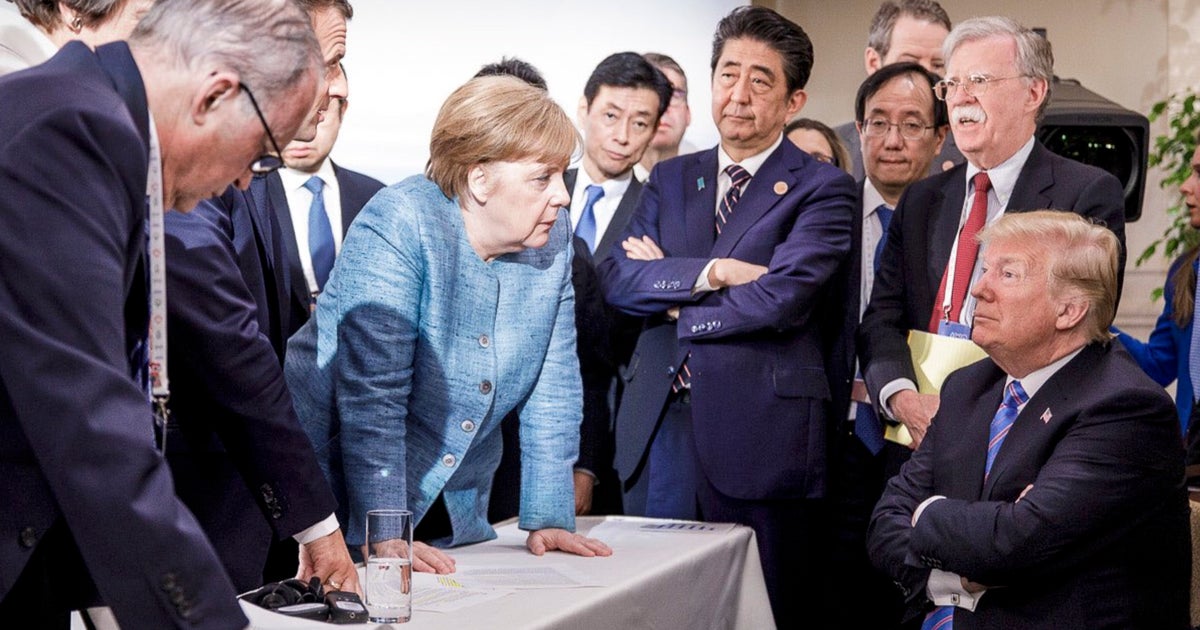
At his first G7 meeting in Taormina, Italy, when his fellow leaders all walked together to a spot overlooking the Mediterranean Sea for a group photo, Trump instead followed in a golf cart. A year later, Trump refused to sign a joint communiqué, the consensus statement traditionally released at the end of these meetings as a show of unity, while an iconic photo showed Trump sitting with his arms crossed at a desk, with the others leaning over him. In 2019, Trump blew up the leaders’ dinner by insisting that Russia, which had been expelled from the group after it invaded Ukraine’s Crimean Peninsula in 2014, be readmitted.

Jesco Denzel/German Federal Government via Associated Press
Last year, in the one G7 thus far in his second term, Trump left early, avoiding an appearance by Ukrainian President Volodymyr Zelenskyy, to focus on his air attack on Iran’s nuclear research sites.
In those previous and related encounters at NATO summits and larger G20 meetings, Trump ruffled feathers because of his refusal to make an effort to combat climate change, his international trade-damaging tariffs and his false accusations that other countries were not paying the U.S. “dues” for their NATO participation. The other leaders tried and largely failed to get him to change his mind.
This time, though, it is Trump who is likely to be the one with requests, in particular helping end the war with Iran and reopen the Strait of Hormuz to navigation.
Which means the strategy that leaders of allied nations appeared to settle on last year ― praising Trump effusively, as one might a toddler prone to tantrums ― likely cannot work this time around.
Analysts said Macron and others have instead decided the best way to deal with Trump is to “de-risk” their encounters to minimize opportunities for him to toss monkey wrenches. Meeting planners this year will not even attempt to craft a joint communiqué. Instead, they will produce less ambitious statements on specific topics. However, Macron, perhaps in an attempt to take advantage of Trump’s love of over-the-top interior design, has invited Trump to dinner at the famous palace in Versailles, just outside Paris, after the summit.
“They will not aim for any sort of joint communiqué. Because it’s impossible, with this guy. NATO will do the same thing,” Lute said. “They’re down to damage limitation: ‘Let’s just try to get through this.’”
Even that, though, might not be enough. If Trump cannot get others to help him in his war, he may decide to generate content for his fanbase, Townsend said, which will accelerate the efforts by Europe, Japan, South Korea and others to decouple their futures from that of the U.S.
“They don’t want to be connected at the hip with someone who is irrational and unpredictable,” Townsend added. “People from abroad are shaking their heads and asking, ‘What is wrong with you all?’”