From Makarios to 1974: an island-based artist is using tiny figures to keep stories alive
Cypriot history on a scale so small that it fits in the palm of a hand is lovingly created by French artist Yves Kervella in a busy and intriguing looking island workstation illuminated by magnification lamps and photogrammetry equipment.
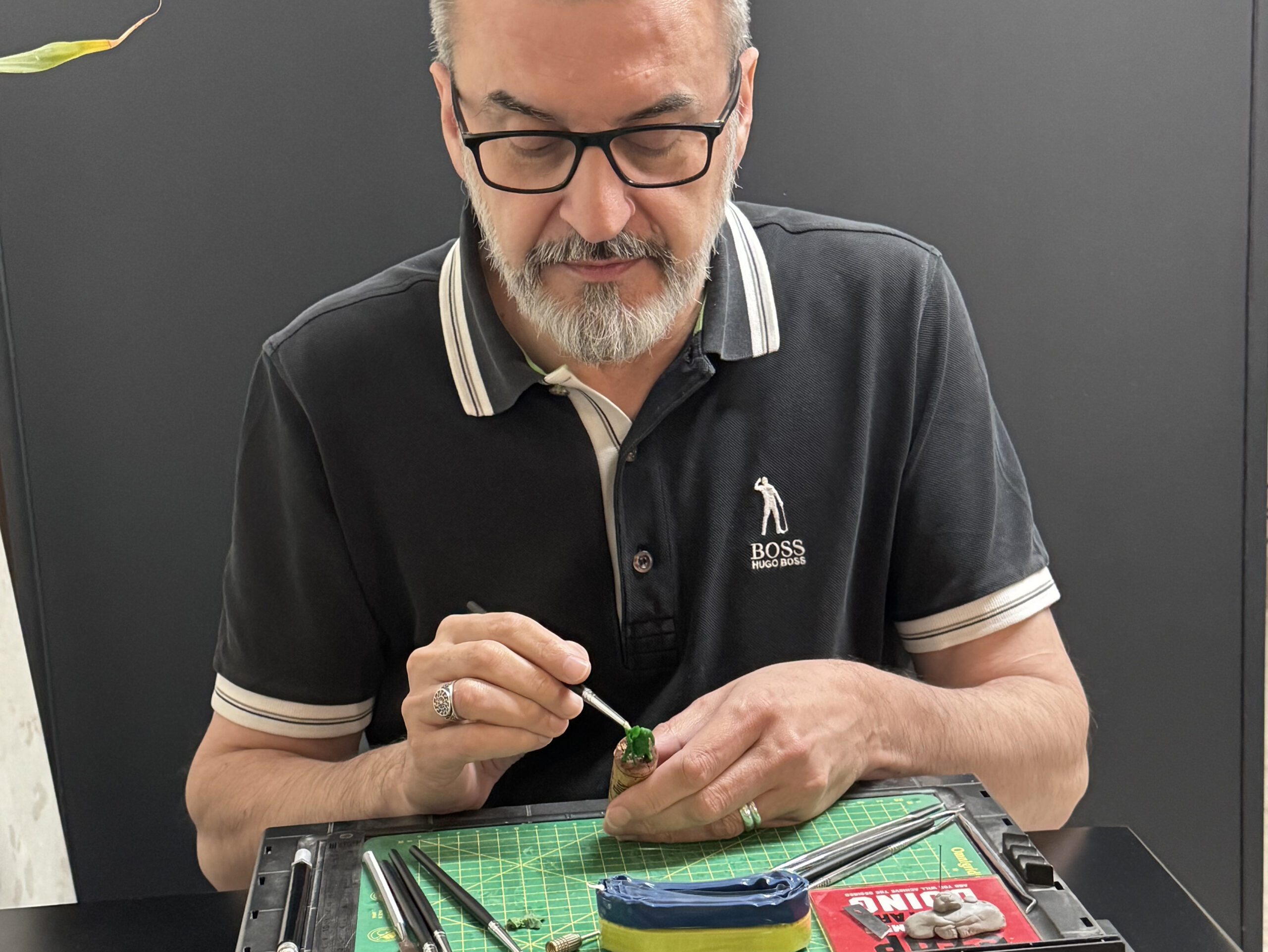
Spread across a green cutting mat are silicone tipped brushes, metal sculpting tools and epoxy putty. Besides them stand miniature figures of Makarios III, Glafcos Clerides and Georgios Grivas, historical figures reduced to a few centimeters in height but sculpted with incredible precision.
“A miniature may be tiny in size, but it can tell a very powerful story,” Kervella says.
Originally from France, the artist built his artistic career around historical miniatures. Moving to Cyprus introduced him to a new source of inspiration, leading him to explore the island’s history and notable personalities through his work.
Each figurine starts with a historical study. “I spend many hours studying archives, books, historical documents and photographs before starting a project,” he says. “Accuracy is extremely important to me.”
He continues his work in his Lofou studio, where the silicone tipped brushes, sculpting tools, and polymer clay are neatly arranged on a cutting mat. Some tools assist with smoothing out details, while others define expressions and clothing folds. A cork stopper nearby supports the miniature figures as he sculpts.
Kervella mainly uses Super Sculpey polymer clay for detailed sculpting, along with “Green Stuff,” a two-part epoxy putty popular in miniature work. The material begins as separate strips of yellow resin and blue hardener. Once combined, it turns green and gradually cures, giving the artist a limited window in which to shape and refine the details.
He shapes each figure by hand with engraving tools, needles, and fine brushes, then reproduces them in different sizes using photogrammetry technology. Photogrammetry is a process used to create measurements, maps, or 3D models from photographs. It involves analyzing multiple overlapping pictures of objects, buildings, landscapes, or scenes to determine their shape and spatial geometry.
“The greatest challenge is balance between detail and proportion,” he says. “At such a small scale, even a tiny mistake becomes very visible”.
Alongside his careful handiwork, Kervella also relies on modern technology. He uses photogrammetry to create his figurines in different sizes, such as 24mm, 28mm, and 1/35. This way the same figure can suit various collectors and displays. “Thanks to this old technology, I can transfer and reproduce my figurines at different scales”.
Yet for Kervella, this technique merely acts as an instrument. What really matters are the stories behind the figures themselves. Moving to Cyprus he became increasingly interested in the island’s history, and the stories he felt could be expressed through miniature art.
“Cyprus has a very rich and emotional history, and I became deeply interested in the island’s identity, historical struggles and important personalities,” he says. “I felt there were many stories here that could be expressed through miniature art”.
Even with the technical precision that is involved, Kervella depicts the work as deeply emotional, especially when creating figures connected to Cyprus’ history.
“One of the most significant works for me was creating figures related to the events of 1974,” he says. “It wasn’t simply an artistic project; it became for me as an artist, a profoundly human and emotional experience”.
For Kervella, figures like Makarios III and Glafcos Clerides, and Grivas are not merely historical subjects but rather part of a tale that he believes continues to resonate through the island today.
His connection to Cyprus has grown stronger since moving from Limassol to Lofou, a place he says has changed him personally and creatively.
“Living in Cyprus changed my rhythm of life completely”, he says. “And moving to the beautiful village of Lofou brought even more peace and inspiration into my daily routine.”
“The calm atmosphere, traditional architecture and natural surroundings help me concentrate and create in a much deeper way. My wife and I truly enjoy the quiet and harmonious life there”.
Although miniature art remains a niche field, Kervella, who works under the trade name 3D Historic Miniature, is confident that it can contribute a great deal in preserving cultural heritage as well as introducing historical events to new audiences. In this regard, he would like to cooperate with the museums and cultural institutions on the island and is currently discussing possible collaborations with Kyriakou Bookshop in Limassol about displaying some of this work.
“I believe miniature art can also have educational value, especially for younger generations,” he says. Kervella says the response to his Cypriot-themed work has been encouraging. “Many people are surprised to see Cypriot historical subjects represented in miniature form,” he says. “I feel there is genuine curiosity and appreciation, especially among collectors, history enthusiasts, and people interested in cultural heritage.”
With increased interest, Kervella hopes his project will inspire others to take part in a new form of engagement with the history of Cyprus by integrating art, narratives and history.
He hopes to build on that interest through future collaborations and exhibitions. “I would love to become more connected with the Cypriot cultural and artistic community,” he says. “Organising exhibitions, collaborating with museums or cultural institutions, and perhaps creating educational historical collections would be very meaningful to me.”
According to Kervella, the statutes are much more than just scale models and craftsmanship. They serve as a way of preserving individuals, narratives and moments that would otherwise have been lost in time.
“A figure can preserve emotions, identities, and stories that might otherwise disappear… a figurine is like a painting; history remains frozen and immortal.”