00:30 | Luya (Amazonas region), Jun. 14.
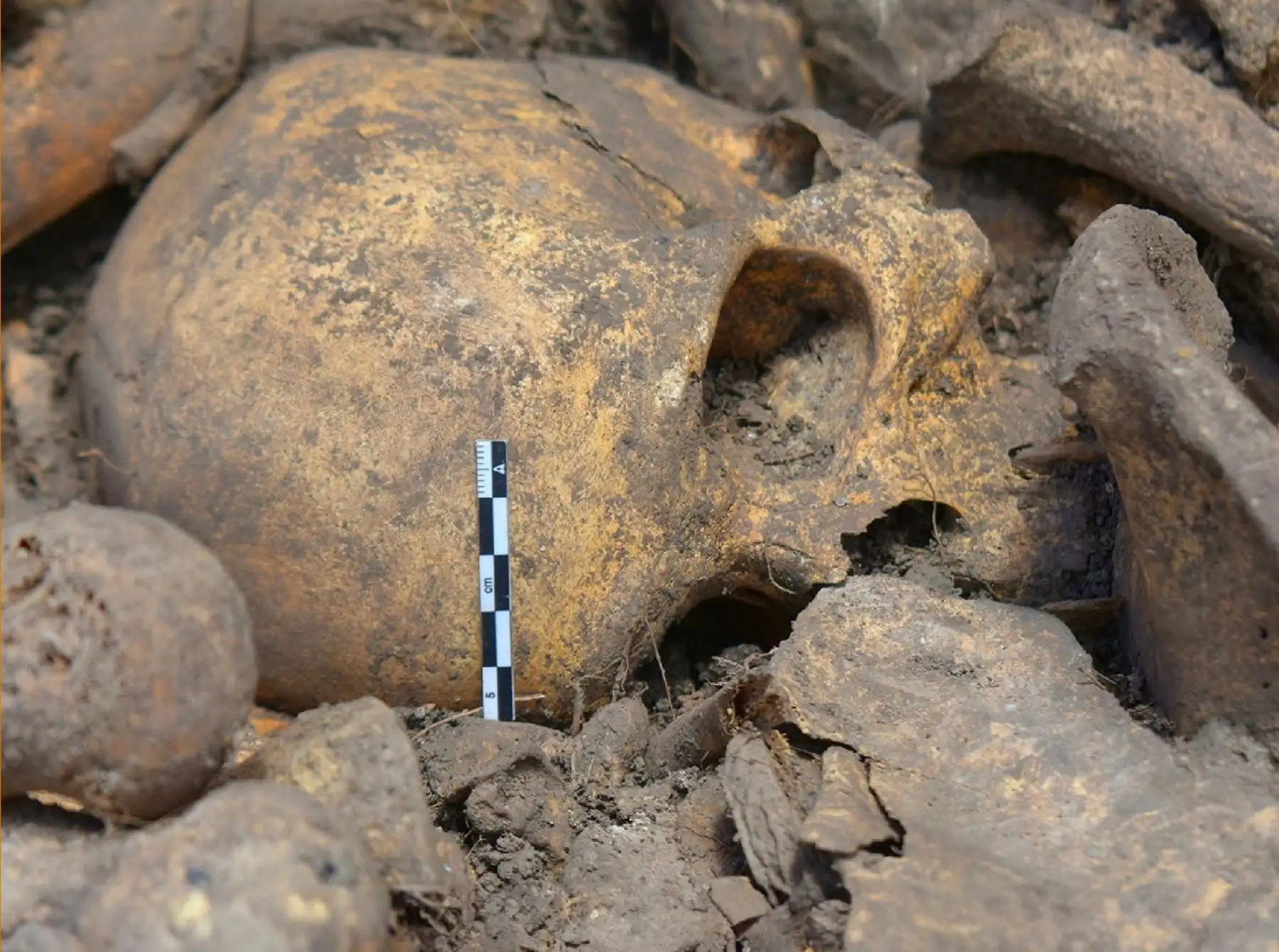
In mid-May, a funerary structure containing skeletal remains of five individuals and ceremonial objects was discovered at the Kuelap Archaeological Complex in Amazonas region.
It is the first structure of its kind to be found, shedding light on the high cultural development achieved by the Chachapoya civilization during the Late Intermediate Period.
Andina News Agency spoke with Rocio Sanchez, Chief of the Decentralized Directorate of Culture (DDC) in Amazonas.
She revealed details of this significant archaeological discovery—including the remains of five individuals, a phytomorphic paccha in the Inca style, Spondylus fragments, and carved figures in Area 12—whose location within the Kuelap monument, at the junction of its two main access routes, underscores its importance.
The funerary structure was discovered by archaeologists from the Kuelap Archaeological and Interdisciplinary Research Program (PRIAK).
They conducted their work in Area 12, at the junction of Kuelap’s Accesses 1 and 2, a strategic sector of the so-called “Pueblo Bajo” (Lower Town) that had never previously been the subject of systematic studies.
A sacred place in plain sight
The DDC head told Andina News Agency that the discovery’s significance lies not only in the objects unearthed, but also in the precise location where they were found.
“The importance of this discovery lies in the area where it is located. It is in the lower section, in the Lower Town, in the central part, at the junction of Kuelap’s two most important entrances,” she noted.
According to Sanchez, one of those access routes is located to the west and the other to the east, and they had never previously been studied together.
“The discovery of this funerary context indicates that this location was, in some way, very important and sacred to them, and it was in plain sight of everyone,” she stated.
The funerary structure is made of stone and features a horseshoe-shaped—or U-shaped—layout, built on a platform that is accessed by climbing two steps.
Its design made it visible from both access routes to the complex, reinforcing its likely ceremonial function and public role within Kuelap’s spatial organization.
Five Individuals and a possible second phase of use
Inside the structure, archaeologists recovered the skeletal remains of five individuals: four adults and one infant.
One of them was found in a seated position, deposited above the other remains, which has given rise to a preliminary hypothesis regarding a second period of use of the same funerary structure.
“What has proven particularly interesting is the position of one individual, who was placed in a seated position and deposited above other skeletal remains, which could indicate a second period of use of this funerary structure,” Sanchez explained.
The director added that the skeletal remains found within the structure show signs of disturbance, which would confirm that it was not a single burial event.
The structure functioned as a kind of seat visible from the outside.
“That seat where this material was placed was on the exterior, it was visible, and anyone entering either from the west or from the east could see it,” the official detailed.
“That indicates it was an important place, an interesting place, a place where homage was perhaps paid,” she said.
Offerings: An Inca paccha, spondylus, and carved figures
Among the objects recovered from the funerary context were a complete phytomorphic paccha in the Regional Inca style depicting the pacay fruit, found intact, as well as Spondylus fragments and carved figures.
According to PRIAK specialists, these materials date to the Late Horizon, a period spanning approximately from A.D. 1470 to 1532, when the Inca Empire was at the height of its expansion.
Sanchez emphasized that the presence of Spondylus—a marine mollusk from the coast of Ecuador—demonstrates that Kuelap was not an isolated society.
“It demonstrates that it was a society that was indeed connected, that it did engage in trade with other areas,” she said, noting that previous excavations at the site have also uncovered Cajamarca, Chimu, and Inca ceramics.
The paccha discovered at the site will be the subject of a specialized publication in the near future.
“We will soon publish another study dedicated exclusively to the paccha,” the director announced, indicating that the artifact has already been transferred to the laboratory for detailed analysis by specialists.
Superimposed structures and walls with secondary burials
The discovery in Area 12 forms part of a broader pattern that PRIAK archaeologists have been documenting since 2023 in different sectors of Kuelap: superimposed circular structures that provide evidence of successive occupations at the site.
“There was an initial circular house, and then another was built on top of it, though not directly over the same structure; rather, the circular houses overlapped one another,” Sanchez explained.
Another recurring discovery is that of secondary burials within the walls and defensive structures themselves.
The director cited the case of the Upper Town wall, where the dismantling of a deteriorated structure led to the discovery of the remains of 121 individuals deposited inside it.
“The presence of these individuals within the walls inevitably created structural voids, and they addressed these structural problems in the walls as they arose,” she explained.
Researchers have also observed that the entrances to the complex were progressively narrowed over time.
“It has been observed that this was gradually reduced over time. It was not this narrow from the beginning; rather, they gradually reduced the space over time,” Sanchez pointed out.
Inca influence and abundant ceramics
Inca presence at Kuelap is another focus of PRIAK’s research. Four rectangular buildings identified at the site—in contrast to the ubiquitous circular Chachapoya structures—provide evidence of that influence.
“Perhaps that sought to demonstrate that they were aiming to dominate Chachapoya society at Kuelap,” the director reflected.
Large quantities of pottery have also been discovered in recent weeks, although the pieces were found in a fragmented state.
“Pottery has been found in abundance—in very large quantities—but everything was broken into fragments,” Sanchez said, acknowledging that archaeologists are still working on interpreting the material.
The official noted that research in Area 12 remains actively underway, adding that new publications will be released in the coming days.
“When we released this news, we indicated that publications would continue in the coming days and weeks, precisely because we are still developing the research process,” she confirmed.
Kuelap, a heritage site for all Peruvians
Sanchez highlighted the identity value of the complex beyond its scientific significance.
The site—considered the most important archaeological complex in northeastern Peru—has established itself as a tourist destination of national and international significance, with the support of Amazonas Regional Government.
“Domestic tourists are the ones who visit Kuelap most frequently, so as Peruvians, it is also a site that is increasingly being valued,” Sanchez stated.
“By attracting visitors, especially Peruvians, it also fosters identity and a sense of belonging—the feeling that it is ours, that it belongs to all Peruvians, because heritage belongs to all Peruvians,” she concluded.
(END) MAO/MVB
Publicado: 14/6/2026