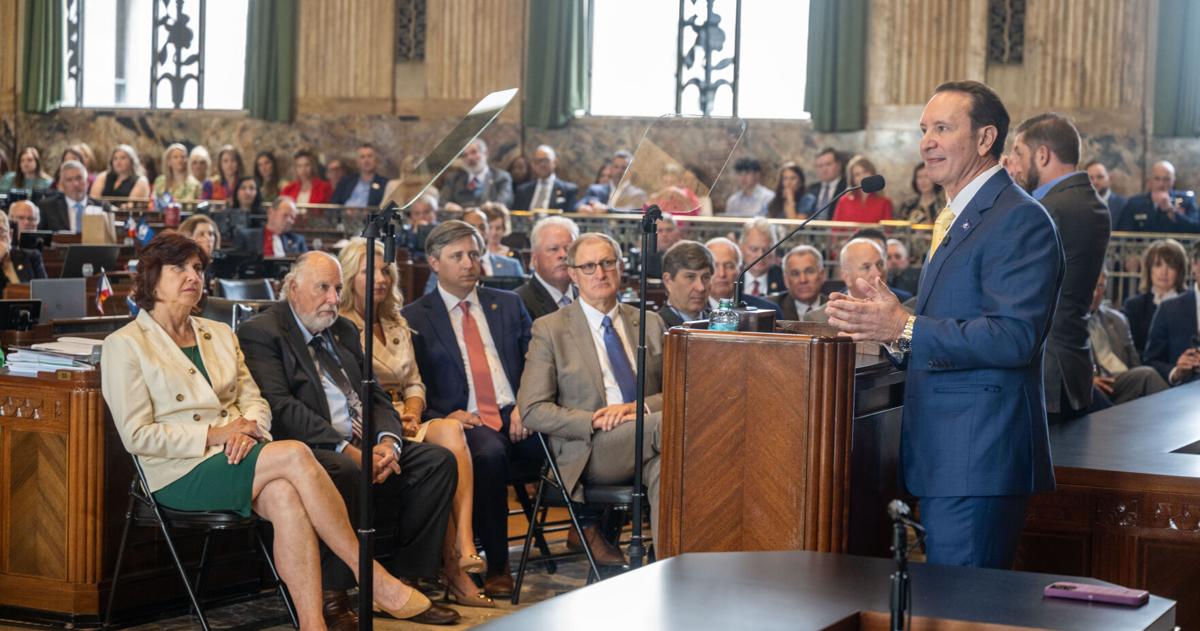
Back when Gov. Jeff Landry opened the legislative session in March, I started thinking of the 2026 session as the “year of the inspection sticker.” That the governor used his big speech to promote eliminating the pesky but hardly consequential mandate seemed, at the time, a signal that this would be a low-temperature session, certainly compared to Landry’s action-packed first two years in office.
Hardly.
In fact, much of what the Legislature did in Baton Rouge was high stakes, often unanticipated and in some cases truly shocking.
And so any list of winners and losers — definitely mine — has to start and end with all the drama, and grapple with just what was truly lost, and won.
Let’s start with the losers, because some of these losses were deeply felt.
New Orleans: Lawmakers who make up the Republican supermajority seemed to paint a big bullseye on the city, in ways that at times came off as downright vindictive.
Their first target was Calvin Duncan, an exonerated former state inmate who was overwhelmingly elected last fall to become clerk of Criminal District Court. Duncan was supposed to be sworn in May 4, but before that could happen, the Legislature raced to eliminate the office — even though there was no firm plan or data on potential savings.
Lawmakers subsequently eliminated nine judgeships from various courts, abandoning plans to eliminate only the most junior Criminal Court judges in conference committee without explanation. They also rewrote a bill aimed at adding prosecutors in understaffed district attorney offices around the state to nonsensically cut support for prosecutors in New Orleans, where the state has invested ample resources and seen considerable success in tackling crime.
Columnist Stephanie Grace
It is entirely fair to gather the data, consult local officials, hear the arguments and evaluate whether New Orleans has the right number of people in all of these positions in a systematic way, certainly without overriding the voters’ will. What happened during the session, though, reeked of politics and oozed with disrespect.
Black voters: The U.S. Supreme Court’s late April decision in Louisiana v. Callais didn’t end the Voting Rights Act, but it seriously undermined the protections it has long offered. The Legislature’s mad dash to eliminate one of the state’s two majority Black congressional districts, in the midst of a nationwide rush to redraw maps mid-decade ahead of the fall midterm elections, added insult to injury.
Not only did lawmakers create five majority White, Republican districts and one majority Black Democratic one — even though about a third of Louisianans are Black — but they rudely ignored heartfelt testimony about the long struggle to attain proportional representation in the halls of power. Anyone looking for evidence that the battle for equal representation is not yet won could easily find it in Baton Rouge this session.
Carbon capture critics: Grassroots opponents of the move to inject carbon deep underground in the state — an unusual coalition of environmentalists and rural conservatives — were no match for the industrial interests betting big, with state backing, on the technology. Among the bills that died were measures to create local options or prohibit the use of eminent domain for these projects.
Homeless people: House Bill 221, passed by the Legislature and awaiting Landry’s signature, purports to help people experiencing homelessness by connecting them with services. That’s a worthy goal, but the bill’s mechanism — to declare unauthorized camping in public a crime carrying prison time unless they complete a treatment program — is a cruel and potentially counterproductive policy that creates an additional stigma for people who are experiencing mental health challenges, drug addiction or simply hard times.
Compassion for those facing struggles is too often in short supply in the Capitol. This was just one example.
The spirit of bipartisanship: Unlike Congress and many state legislatures, the Louisiana Legislature is historically nonpartisan — meaning it’s not formally organized around which party holds the majority. Historically, that’s created a culture in which coalitions are at least sometimes fluid, not hardened, and individual relationships across party lines can flourish. In recent years, though, that spirit has often been tested as the toxic partisan politics of the nation’s capital increasingly filtered down into state matters. This year, high-profile legislation, such as the fight over congressional districts, exacerbated the trend.
Does anyone really look to Washington these days and think they do it better there?
And now, the winners:
Jeff Landry: If getting what you want makes you a winner, then the governor earned a spot on this list. He spent part of that session-opening speech railing against the courts in New Orleans, and by the time lawmakers headed home, various judicial entities were seriously downsized. He called off an ongoing congressional election to give fellow Republicans another safe seat. He championed some breaks aimed at attracting even more big investments. And he even got that inspection sticker bill through.
That doesn’t mean there isn’t trouble on the horizon. For the second year in a row, voters rejected a full slate of constitutional amendments, including several Landry championed. There’s even a recall petition in response to his heavy-handed political plays; while unlikely to succeed, it concerned someone in his circle enough to develop a PR campaign to counter it.
Helena Moreno: It may seem strange to call New Orleans’ new mayor a winner when the city endured what she called a “very, very rough” session. But if you judge Moreno’s efforts by how much of her own agenda passed, you’ve got to call them a success. Moreno, a former member of the state House, got lawmakers to close a loophole in the state police pension system that would have cost the city $41 million, to contribute to major projects such as the restoration of the long-vacant Municipal Auditorium and to give the city far more control over the troubled Sewerage & Water Board’s operations.
Moreno is a Democrat contending with a Republican supermajority in the Legislature, but as Senate President Cameron Henry put it: “Everyone knows she’s trying, and she’s actually doing things. She’s moving in the right direction.”
Jay Morris: When your name is on some of the session’s highest-profile legislation, you earn a place in the winners’ circle. The Republican state senator from West Monroe authored the bill to block Duncan from taking office by merging his job into the clerk of Civil District Court’s office, to reduce the number of judges in New Orleans and to draw the new congressional district map that eliminated one of Louisiana’s two majority Black districts.
Still, it’s reasonable to ask how these measures serve his own constituents way up in the northeastern part of the state, hundreds of miles away from New Orleans. It’s also fair to wonder just how history will judge Morris’ big wins.
Teachers: Yes, voters rejected a constitutional amendment that would have finally given Louisiana’s underpaid educators a modest annual raise instead of the one-time stipends they have received in recent years — most likely due to other parts of the proposal or just a general pique with government.
But after lawmakers at first said the amendment was their only chance, Landry put his finger to the wind and announced strong support for another solution. The new plan, which initially involves shifting state money from other education purposes, is proving potentially problematic. But at least the people at the highest levels of government are belatedly acknowledging how much public school teachers have contributed to the overall student gains they all celebrate.
Crime victims — and the embers of bipartisanship: The overall mood during the session was certainly confrontational, so it was nice to see that politicians who approach public policy from vastly different perspectives can still find common cause. An example this year was House Bill 251, authored by state Rep. Mandie Landry of New Orleans and supported by Attorney General Liz Murrill. Landry’s politics are as far to the left as Murrill’s are to the right, but these two worked together to give victims the right to be notified and to speak before a conviction is vacated or sentence reduced.
More of this and less of the zero-sum legislating, please.