By Vuk Jeremić
The greatest paradox of the current political moment is that everything revolves around snap elections, despite there being no clear indication of when those elections might actually be called.
The confusion is further deepened by Serbian President Aleksandar Vučić, who over the past year has repeatedly floated different dates for potential elections, while leaving open the question of whether presidential and parliamentary elections would be held simultaneously.
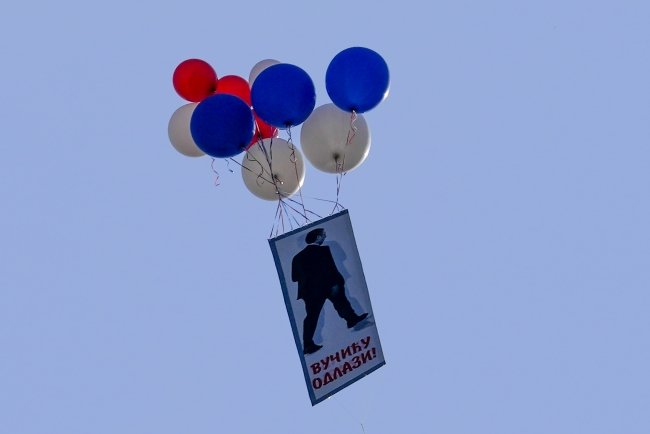
The latest statement in this vein came yesterday, when he said that he would resign within the next few months and had already begun packing up his books at the Presidency.
During an appearance on Radio Belgrade, speaking about possible dates for snap elections, he said that it “would not come as a surprise to anyone” and that he would not say he was “cutting short his term”, but rather that he was “resigning”.
“I have started packing up my books at the Presidency. I asked friends who could take 500 books. I will donate 1,200 books that I received during my term of office to an institution, although I am still deciding which one,” Vučić said. He also added that every day he thinks about his own potential candidacy for Prime Minister, as well as about a new presidential candidate for the current ruling bloc.
Vučić’s latest announcement of snap elections is merely a continuation of a series of similar statements he has made since May last year, when students participating in university blockades formally demanded the dissolution of the Government and new elections.
In those statements, Vučić placed the potential date of hypothetical elections anywhere between May 2026 and the beginning of 2027, with the exception of the summer months. His most recent remarks once again highlighted the end of the year as a likely time for voters to go to the polls.
Zoran Stojiljković, a retired professor at the Faculty of Political Sciences, told Insajder that politics operates according to a principle of self-commitment: if you repeat something often enough, you eventually have to follow through on it. Otherwise, he argues, you risk damaging your standing among the more neutral and politically less engaged segment of the electorate.
According to Stojiljković, Vučić’s continual announcements of imminent elections are intended to achieve several objectives.
“First of all, he is trying to place himself in a kind of offensive strategic position, which is also connected to a certain demonisation of political competitors. By announcing elections, Vučić is also trying to influence undecided voters by emphasising that there is no uncertainty surrounding him. This contrasts with the other side, whom the authorities portray as lacking a programme, personnel and political leadership.
“Finally, and this seems to me to be the key purpose of these election announcements, Vučić is attempting to neutralise the argument that he only calls elections when he is certain of the outcome. When he says he has already started packing up his books, the message is that he is not afraid to face the electorate,” Stojiljković said.
Switching offices without substantial significance
Apart from the election date, another major unknown is what exactly will be at stake. The focus remains on snap parliamentary elections, but the electoral timetable is complicated by the fact that the presidential term expires first.
Vučić’s latest remarks, in which he announced that he may resign before the end of his mandate, open the possibility of simultaneous parliamentary and presidential elections. There is also the prospect that Vučić could move into the position of Prime Minister and contest the election campaign from that office.
Zoran Stojiljković says he expects the elections to be held either at the same time or within a short interval of one another.
“This resignation narrative makes it quite likely that Vučić will run for Prime Minister, which is the key position of power. If he were to return to that office, the argument that power resides at the wrong address would no longer hold. At the same time, it would reduce the importance of the presidency itself and also diminish the significance of the question of whether the ruling camp has a suitable presidential candidate,” Stojiljković said.
However, he adds that under the current political circumstances it is of secondary importance from which position within the executive branch Vučić enters the electoral race.
“Back in Milošević’s time there was a saying that power resides in whichever office he occupies. This would not be the first time Vučić has switched roles; in 2017 he ran for the presidency from the position of Prime Minister. Moving back to the premiership would, in some respects, be a more institutionally proper arrangement, but we will have to wait and see what happens.
“What is certain is that the government’s campaign will be more negatively than positively framed. It will emphasise the uncertainty offered by the alternative, contrasted with the certainty provided by the current authorities. This will be combined with narratives about investments, friendships with various nations, and the broader story of the country’s progress.
“At the same time, Vučić will seek to benefit from any divisions within the opposition bloc. It will be a kind of total campaign in which all available resources are used. All in all, nothing particularly new,” Stojiljković said.
While speculation continues regarding the dates of both parliamentary and presidential elections, the political calendar itself is unavoidable. Stojiljković notes that presidential elections must be held in the spring of next year, while parliamentary elections must take place either at the end of 2027 or the beginning of 2028.
For now, that remains the only certainty.
(Insajder, 12.06.2026)
https://insajder.net/vesti/poigravanje-sa-politickim-kalendarom-koji-efekat-predsednik-srbije-postize-konstantnim-najavama-izbora