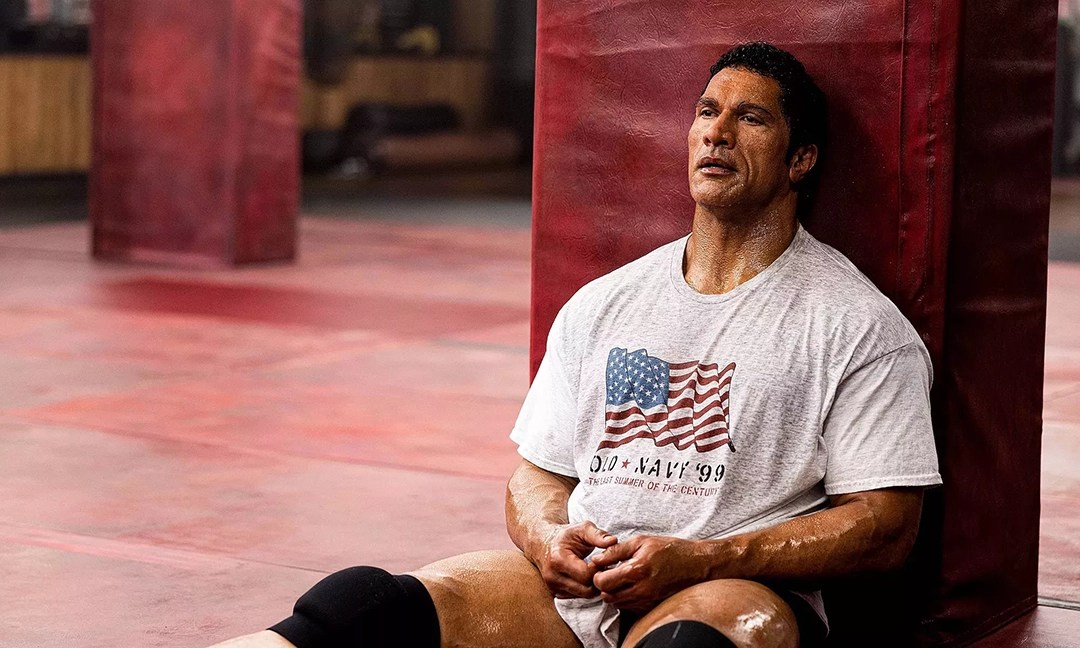
Benny Safdie’s film about MMA pioneer Mark Kerr is not primarily a story about fighting. It is about what happens when strength becomes an identity, winning becomes a drug and the person inside the powerful body begins to disappear.
For most of his public life, Dwayne Johnson’s body has represented certainty.
As professional wrestler The Rock, and later as one of Hollywood’s biggest action stars, Johnson became associated with confidence, control and physical invincibility. His characters may encounter danger, but audiences rarely doubt that he will ultimately overcome it.
In The Smashing Machine, that familiar body means something very different.
Johnson plays former mixed martial arts champion Mark Kerr as a man powerful enough to overwhelm almost anyone placed in front of him, but unable to control the grief, addiction, fear and emotional instability growing inside him.
The result is not simply a physical transformation. It is an attempt to remove The Rock from the screen and reveal the vulnerable man hidden underneath the performance of strength.
The real man behind the machine
Written and directed by Benny Safdie, the 2025 film draws from the life of Kerr and the remarkably intimate 2002 documentary The Smashing Machine: The Life and Times of Extreme Fighter Mark Kerr.
Kerr entered mixed martial arts when the sport was still attempting to establish itself in the United States. A decorated freestyle wrestler, he became one of the most feared competitors of the early UFC and later fought in Japan’s Pride Fighting Championships.
His nickname came from the relentless way he overwhelmed opponents.
Kerr described sensing when another fighter was frightened and feeling the moment that person began to surrender mentally. Once inside the ring, his thinking became direct and primitive. He would hurt the other man before the other man could hurt him.
Yet outside the ring, Kerr was not naturally cruel or confrontational. He was thoughtful, softly spoken and uncomfortable with the idea that people might mistake his profession for his personality.
That contradiction sits at the centre of Safdie’s vision.
The “Smashing Machine” was not Kerr’s entire identity. It was a psychological state he learned to enter because fighting demanded it. The tragedy was that success increasingly required him to return to that state, even as it became harder to leave it behind.
When winning becomes another drug
One of the film’s defining lines comes when Kerr describes winning before tens of thousands of cheering spectators.
“There’s no other high like it in the world,” he says.
The trailer quickly places that statement beside another scene in which Kerr asks for stronger pain medication.
That edit exposes the film’s deeper argument. The cheering crowd and the painkillers may appear to belong to separate parts of Kerr’s life, but both offered escape. One numbed fear and physical pain. The other provided the intoxicating feeling of recognition, dominance and importance.
Kerr’s addiction did not emerge separately from his fighting career. It became entangled with the injuries, anxiety and pressure required to keep competing.
The original documentary captured that decline while it was happening. Kerr was filmed injecting drugs, losing control of his life and eventually being taken to hospital after an overdose that nearly killed him.
It also showed the frightening confusion of addiction. Kerr could recognise that something was wrong while continuing to convince himself that he remained in control. Those around him could see him disappearing before he was able to see it himself.
Safdie does not treat addiction as a dramatic obstacle placed in the way of an otherwise conventional sporting triumph. It is part of the same machinery that produced the champion.
The qualities that helped Kerr succeed, including his ability to ignore pain, suppress fear and continue moving forward, also allowed him to avoid confronting what was happening inside him.
Why Dwayne Johnson was the right choice
Johnson’s resemblance to Kerr was created through extensive prosthetics, altered hair, clothing and close physical observation.
But imitation alone could not carry the role.
Kerr later said Johnson studied his speech, pauses, gestures and even the way he walked. Kerr supplied the production with boxes of personal objects and photographs from the period so the filmmakers could reproduce his environment with unusual accuracy.
When Kerr’s son watched the finished performance, he reportedly found Johnson’s recreation of his father almost unsettling.
The more important connection, however, exists beneath their physical similarities.
Johnson understands what it means to construct a powerful public identity.
“The Rock” is one of the most successful personas in modern entertainment. It transformed Johnson from a professional wrestler into an international celebrity and commercial brand. It was built around charisma, physical strength and apparent fearlessness.
Kerr also created a second self capable of performing under extreme pressure. His fighting persona allowed a gentle man to enter a ring and inflict devastating punishment on another human being.
This makes Johnson’s casting more than a matter of size or appearance. He is playing a man who became trapped inside the identity that made him successful, while temporarily stepping outside the identity that made Johnson himself famous.
The role asks Johnson to do the opposite of what audiences usually expect from him. Rather than projecting certainty, he must show hesitation. Rather than controlling the room, he must appear emotionally dependent and lost. Rather than using his physique as evidence of power, the film presents it as armour that cannot protect the person underneath.
Strength without control
The relationship between Kerr and his then-partner Dawn, played by Emily Blunt, further dismantles the image of the invincible fighter.
Inside the ring, Kerr could impose his will on trained opponents. At home, he struggled through arguments, jealousy, dependency and emotional volatility.
The film does not present this private life as a simple contest between hero and villain. It shows two people caught inside a relationship shaped by love, fear, addiction and repeated conflict.
Kerr later described becoming addicted not only to substances and fighting, but also to the exchange of negative emotional energy within the relationship. He would leave the chaos, miss it and then return to it.
That admission helps explain why The Smashing Machine is not structured as an inspirational story about defeating one opponent and reclaiming a championship.
The greater struggle was never contained within a ring.
Fighting was what he did
Years after the events documented in the film, Kerr reached a clearer understanding of the distinction between occupation and identity.
“What I did was fight. It’s not who I am,” he said.
That may be the most important sentence behind Safdie’s film.
Kerr had spent years measuring his value through victories, championships and his ability to dominate other men. Even success brought no lasting satisfaction. Five achievements produced a demand for ten. Every victory required another victory to prove that the earlier one had not been an accident.
The machine could never be satisfied because it was built to keep moving.
Recovery required Kerr to recognise that the fighter was only one part of him. It also meant confronting grief over his mother’s death, accepting that pain could not simply be defeated and rebuilding trust with the son who had grown up without consistent emotional security from his father.
The man left when the crowd goes silent
The Smashing Machine is ultimately not about discovering how strong Mark Kerr was.
That part was never in doubt.
It is about discovering whether anything remains when physical power stops providing an answer, when the crowd no longer cheers and when the identity that once offered purpose begins destroying the person carrying it.
For Johnson, the role represents one of the most revealing choices of his acting career. His achievement is not that he convincingly looks like a dangerous fighter. Audiences already knew he could do that.
The achievement is that he allows an enormous and familiar symbol of strength to appear frightened, dependent, confused and deeply human.
Behind the broken face and championship victories, Safdie’s film finds a man who never truly enjoyed hurting people, but became exceptionally good at doing it.
The machine could smash almost anyone placed before it.
The harder task was saving the man trapped inside.
Sources and reporting note
The Smashing Machine was written and directed by Benny Safdie and stars Dwayne Johnson alongside Emily Blunt. The film is based on the life of mixed martial arts pioneer Mark Kerr and draws from the 2002 documentary The Smashing Machine: The Life and Times of Extreme Fighter Mark Kerr.
This feature also draws on
Mark Kerr’s interview with Chris Van Vliet
,
in which Kerr discusses his fighting career, addiction, recovery and Dwayne Johnson’s preparation for the role. Film and production details were checked against official A24 materials and information from the Venice Film Festival.