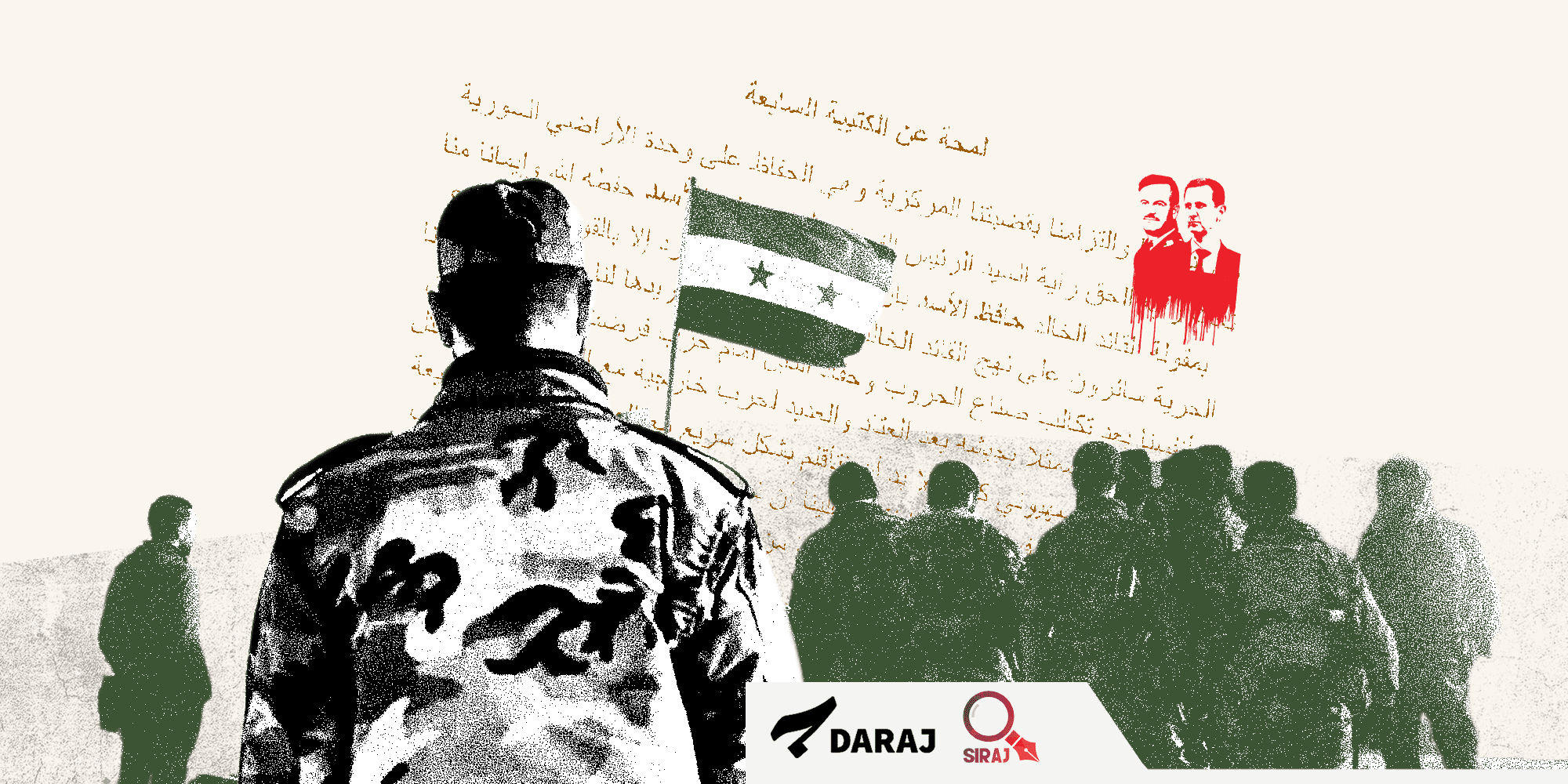
A cache of leaked internal documents from “Battalion 7,” a paramilitary formation stationed at the strategic Prophet Younis summit on Syria’s coast, offers more than a window into a single militia. Taken together, the files amount to a rare schematic of the irregular warfare architecture the Syrian regime engineered after 2011—an architecture that has since become central to its survival.
As the uprising expanded and mass defections hollowed out the regular army, Damascus could no longer rely on conventional military structures to maintain territorial control. What it needed were hyper-local actors with intimate knowledge of terrain, kinship networks, and community fault lines. Out of this need emerged the National Defense Forces (NDF), a constellation of militias that fused state authority with local loyalties, economic precarity, and communal fears.
Battalion 7—established in the coastal region in 2013—was one such node.
The Rhetoric of Nationalism, the Reality of Localized Fear
Publicly, Battalion 7 styled itself as the “Mountain Commandos” (Maghawir al-Jabal), tasked with defending the homeland and safeguarding a state-approved vision of Islam. But the leaked files reveal a stark dissonance between the unit’s sweeping nationalist discourse and its narrow operational footprint.
The battalion’s rhetoric invoked sovereignty, territorial integrity, and resistance to foreign conspiracies. Yet its actual mission rarely extended beyond the tactical defense of the Prophet Younis peak and its immediate environs. In practice, the “homeland” was reduced to a sectarian and geographic enclave. Grand patriotic language served as a veneer for armed provincialism—an ecosystem governed by fear, demographic anxiety, and survivalist loyalty.
Manufacturing Legitimacy: The Aesthetic of a State Army
The documents show that Battalion 7 was as invested in projecting the appearance of a disciplined military institution as it was in conducting combat operations. Foundational paperwork dwells on grooming standards, uniform cleanliness, and the importance of a clean-shaven look—details that reveal a preoccupation with crafting a soldierly aesthetic suitable for propaganda and public reassurance.
This attempt at institutional mimicry, however, soon gave way to ideological drift. In later phases, the battalion adopted the language of “martyrdom operations,” echoing the very extremist groups it claimed to be fighting. The files thus expose a paradox: a pro-regime militia that justified its existence by defending Islam from “terrorists,” while simultaneously borrowing the tactical vocabulary of its adversaries.
Civilian Militarization and the ‘Economy of Need’
The battalion’s ranks were overwhelmingly local, recruited to compensate for the army’s inability to hold ground. Among them were civil servants whose bureaucratic roles were forcibly militarized. Administrative offices merged with checkpoints; municipal employees carried rifles; and the routines of civilian life were subsumed by the logic of the frontline.
Their duties ranged from fortifying positions to manning checkpoints across the Al-Ghab Plain and coastal routes—monitoring the movement of people and the flow of plundered goods, from aluminum and livestock to vegetables and bread.
The internal memos reveal a war machine built on scarcity. Requests for tea, sugar, batteries, and basic tools dominate the paperwork. Fighters appear not as empowered patriots but as dependents tethered to a rationed supply line that offered barely enough to survive in exchange for loyalty and risk.
This deprivation fed the rise of the “checkpoint economy”—a system of extortion, smuggling, and shabiha thuggery that became an informal compensation scheme for fighters whose salaries were delayed, inadequate, or both. The battalion thus functioned as a microcosm of an armed welfare state: a structure that demanded sacrifice while offering little in return.
The Militia–State Gray Zone
Battalion 7 did not operate in isolation. Personnel rosters and communications show links to NDF commanders in other regions, the “Desert Hawks” brigade, and foreign “friends”—a euphemism consistently used to refer to Hezbollah and Iran’s Islamic Revolutionary Guard Corps (IRGC), both of which have been responsible for significant violence and human rights abuses in the Syrian conflict.
The battalion existed in a liminal space: neither fully integrated into the Syrian Arab Army nor entirely outside it. It operated in a gray zone where state authority, militia autonomy, and foreign influence intersected.
The structural fragility of this model is captured in an internal “discussion paper” found in the archive. Rather than outlining strategy, it reads like an autopsy of institutional decay. It details collapsing morale, chaotic personnel transfers, unfulfilled logistical requests, neglect of wounded fighters, and resentment over the marginalization of local commanders. These were not isolated administrative failures but symptoms of a deeper structural fracture.
Conclusion: A State Hollowed Out by Its Own Survival Strategy
The Battalion 7 files demonstrate that the NDF was not merely an emergency response to a military crisis. It was a deliberate mechanism for re-engineering local societies under the rule of the gun. The regime weaponized fear, economic need, and regional identities to build a functional fighting force—but failed to provide it with institutional stability.
The legacy of these units encapsulates the regime’s broader war strategy: nationalist rhetoric masking localized fiefdoms; the total militarization of civilian life; loyalty purchased through rationed scarcity; and an economy of extortion filling the gaps left by a bankrupt state.
In trying to compensate for a collapsing army, the regime created militias that ultimately mirrored its own dysfunction. The archives of Battalion 7 reveal the paradox at the heart of the Syrian state: to survive, it relied on forces that eroded the very foundations of statehood itself.
This article was translated and edited by The Syrian Observer. The Syrian Observer has not verified the content of this story. Responsibility for the information and views set out in this article lies entirely with the author.