A FRESH directive from the Undang Luak Johol has sparked renewed criticism of Negeri Sembilan’s traditional power structure, with insiders increasingly questioning what they describe as a desperate attempt to assert control amid a growing legitimacy crisis.
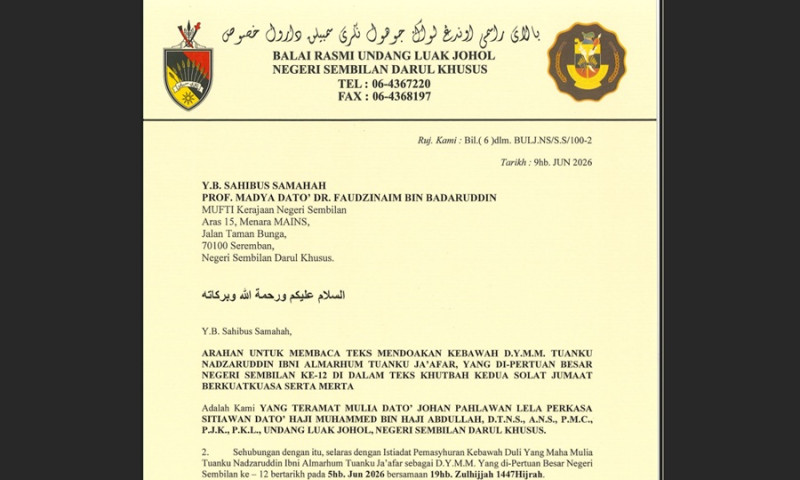
In a letter dated June 9, the Undang instructed the Mufti of Negeri Sembilan to immediately direct all mosques under his jurisdiction to include prayers for Tuanku Nadzaruddin ibni Almarhum Tuanku Ja’afar as the 12th Yang di-Pertuan Besar in the second khutbah of Friday prayers.
While framed as a routine religious-administrative instruction, critics argue the move is anything but procedural. Instead, it is being seen as part of a broader effort by the Undangs to reinforce a contested narrative of authority.
Several insiders familiar with the matter say the directive reflects deeper anxieties within the traditional leadership.
“Undangs that are struggling to maintain legitimacy and having lost the public are still attempting their ‘coup’ in the guise of adat,” one source told Vibes, speaking on condition of anonymity.
The source added that what was once viewed as a matter of customary process has now taken on a more controversial tone.
“Most insiders now consider their action not just illegitimate but petty,” the source said, pointing to what they described as an overreach into religious space to solidify political standing.
The letter itself invokes constitutional provisions and adat prerogatives, asserting that the proclamation of Tuanku Nadzaruddin was carried out by the Undang Yang Empat as the legitimate source of authority.
However, critics argue that repeatedly leaning on adat and legal technicalities does little to address the growing perception gap between the palace and public sentiment.
Observers note that directing mosque sermons — a deeply sensitive religious platform — risks further politicising institutions that are traditionally expected to remain above such disputes.
“This is no longer just about protocol. It’s about control of narrative,” another insider said.
The use of khutbahs, which carry moral and religious weight among congregants, is seen by some as a strategic move to normalise the leadership outcome in the eyes of the public.
Yet, instead of consolidating authority, the move may be having the opposite effect.
Public discourse surrounding the issue has grown increasingly sceptical, with many questioning whether the reliance on top-down directives signals strength — or insecurity.
As the situation continues to unfold, one thing is becoming clear: the battle over legitimacy in Negeri Sembilan is no longer confined to palace halls, but is now playing out in the public and religious sphere alike – June 11, 2026