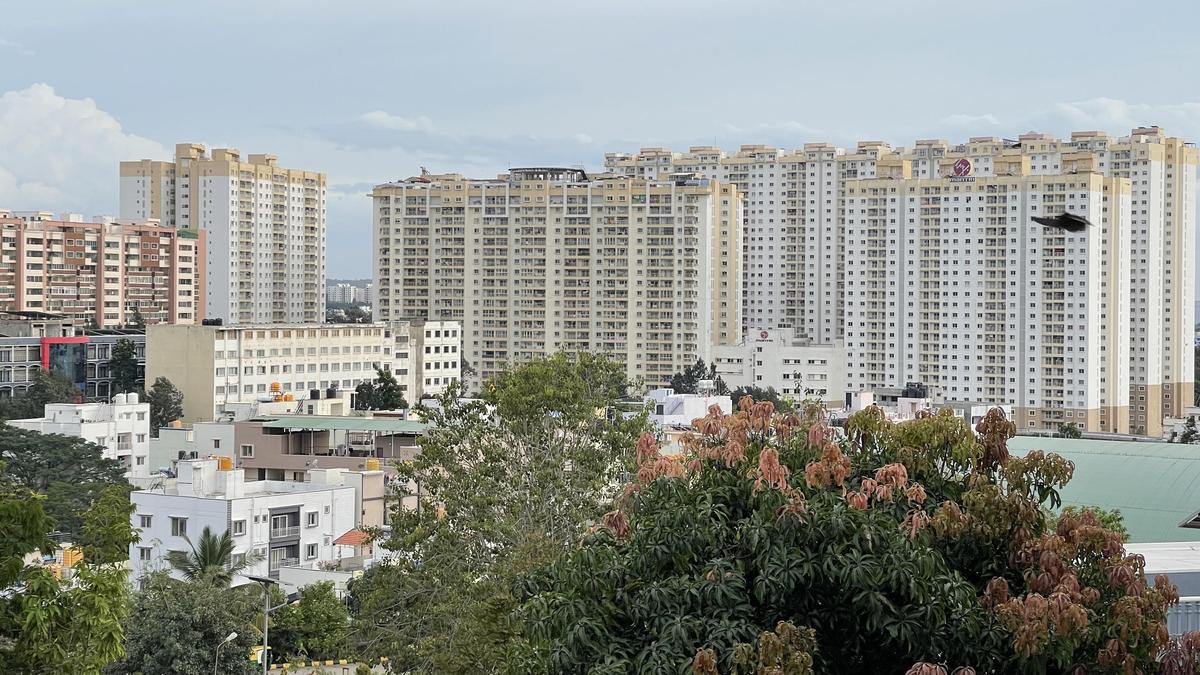
A view of the high-rise buildings in south Bengaluru on Friday, October 24, 2025. Photo: K. Murali Kumar / The Hindu
| Photo Credit: MURALI KUMAR K.
Many apartment dwellers in Bengaluru, with gaps in their documentation, have been running from pillar to post seeking an A Khata for their B Khata properties, or trying to get utility connections without an Occupancy Certificate (OC), under the two ongoing schemes. Though apartment dwellers are not the intended beneficiaries of either scheme, there is no clarity on this, leading to confusion.
OC exemption offers little help
S. Lata, a flat owner in north Bengaluru, said her apartment building did not have an OC and had no utility connection. “I hoped we would be covered by the exemption from availing an OC for homes up to 2,400 sq. ft. But when I approached civic officials, I was told that not the flat, but the plot size itself should be less than 2,400 sq. ft. to avail of the exemption. This means no apartment dwellers will benefit from this scheme,” she said.
Following a December 2024 Supreme Court order mandating an OC for utility connections, lakhs of properties were stuck in Bengaluru. To provide some relief, the Karnataka government first exempted buildings built on 1,200 sq. ft. plots from the OC requirement and recently relaxed it further to buildings built on 2,400 sq. ft. plots. Chief Minister D. K. Shivakumar announced the new relaxation after the first cabinet meeting he chaired on June 3. The order says buildings with ground+3 floors or stilt parking+4 floors on plots smaller than 2,400 sq. ft., with deviation of less than 20 per cent, will be exempted from availing an OC.
Property consultant K.R. Ramesh said a few smaller apartments with six to eight units built on 40×60 sites would benefit. “But according to the rule, these apartments can only have six units, but in practice they are built with eight units. Those with six units on 40×60 plots and no OC will now get utility connections, but their numbers are fewer,” he said.
B Khata apartment dwellers left in limbo
Meanwhile, several apartments built on revenue land are B Khata properties. The Karnataka government is now converting B Khata plots into A Khata properties after collecting a fee of 2 per cent of the guidance value. While the plot is being regularised, the buildings on them are not. However, apartment plots are not covered under this scheme either.
M.S. Shankar, of the Forum for People’s Collective Efforts, Karnataka, said he lives in a B Khata flat in Bhattarahalli, K.R. Puram, and the civic body was not converting B Khata flats into A Khata. He argued that the government should take measures to get the Akrama-Sakrama scheme, which is stuck in the Supreme Court, cleared so that many homeowners get at least one chance to regularise their properties.
K. Arun Kumar, general secretary of the Bangalore Apartments Federation (BAF), said the Karnataka government should stop actively discriminating against apartment dwellers and provide them the same opportunity as independent house owners to regularise their properties.
Apartment Act stuck too
The BAF has been pushing for the Karnataka Apartment (Ownership and Management) Bill, 2025, to be made into law, but so far there has been no progress. Chief Minister D.K. Shivakumar had promised to bring in this law, and two city MLAs have since written to him to fast-track it.
Currently, apartments are governed by two laws in the state—the Karnataka Apartment Ownership Act, 1972, and the Karnataka Societies Registration Act, 1960—which have contradictory provisions, leaving much confusion.
“The new Bill has been in the works for over three years now, and it is high time it is made into law to end confusion in the governance of apartments in the state. We hope it is tabled in the upcoming Assembly session,” Mr. Kumar of BAF said.
Published – June 09, 2026 10:29 pm IST