Heriknaz Poloyan’s childhood was deeply luminous. From the cradle, she listened to the sweet singing of her mother, who would sing: “Sleep, my sweet child, sleep and grow quickly; may the sun embrace you in your dreams.” Even today, her mother continues to sing, giving her the chance to return to her sweet childhood. Poloyan also recalls her grandmother’s rhythmic bounces, or trnotsiner; whenever she visited her grandmother, or when her grandmother came to visit, she would sit Heriknaz on her lap and say “dul-dul.”
Added to all of this were her brother’s Armenian patriotic songs and dances. She always looked at her brother with admiration, thinking: “I wonder if a day will come when I will sing like him and dance like him.”
“Living in such an environment, you simply cannot help but fall in love with Armenian culture and Armenian song,” Poloyan told the Weekly, expressing gratitude to the luminous years of her childhood and especially for the people who helped shape her Armenian identity.
Before singing ethnographic songs, she performed troubadour, or ashughagan, songs. Years later, however, her mother — who often uses allegories and speaks through vivid examples — said something that changed the course of her life: “Our culture is a massive tree, and every Armenian must become fertile soil for its roots. You, too, must contribute, in your turn, to keeping that tree healthy. Therefore, from now on, present the songs that your ancestors sang.” That is how the course of Poloyan’s life changed.
Responsibility and the mystery of the stage
For Heriknaz Poloyan, carrying traditional song is a great responsibility because it carries within it the historical memory of our people.
Advertisement
“When I sing, I understand that I am not representing myself; I am representing my nation, and I am speaking through the lips of those who can no longer speak. Therefore, I must present it either well or excellently, because mediocrity has no place there. Through our songs, the foreigner becomes closer to the Armenian spirit (hayanum e), and the Armenian connects more deeply with humanity (martanum e). That is why you must approach all of this with as much respect and honesty as possible.”
She does not say she is afraid, but she is cautious. If she sings a song incorrectly, others might learn it incorrectly from her, and the song could settle wrongly among people. However, she never misses an occasion to learn and to ask about what she does not know. When questions arise, she quickly turns to Komitas scholar Artur Shahnazaryan and receives answers. As for energy, she says there can be no question: If you are a carrier of the Armenian gene, all of that is passed down through gene and blood, and you simply cannot fail to deliver that energy to the right place.
When she performs onstage, the song becomes the language through which she speaks with people.
When she performs onstage, the song becomes the language through which she speaks with people. Here, she recalls Gagik Ginosyan’s words about Hayrik Muradyan. As Muradyan led him onto the stage, he whispered in his ear that the stage and the altar share the exact same height:
“Just as you send your prayer to God from the altar, you speak with God from the stage. Therefore, you must be honest and sincere so your prayer reaches its destination. Komitas says a song born from a sincere heart is worth a thousand speeches. The song is perhaps the strongest weapon for me because, through it, you are able to influence human consciousness, change a person and make them better.”
The excitement is always there during every performance, but she is able to manage it.
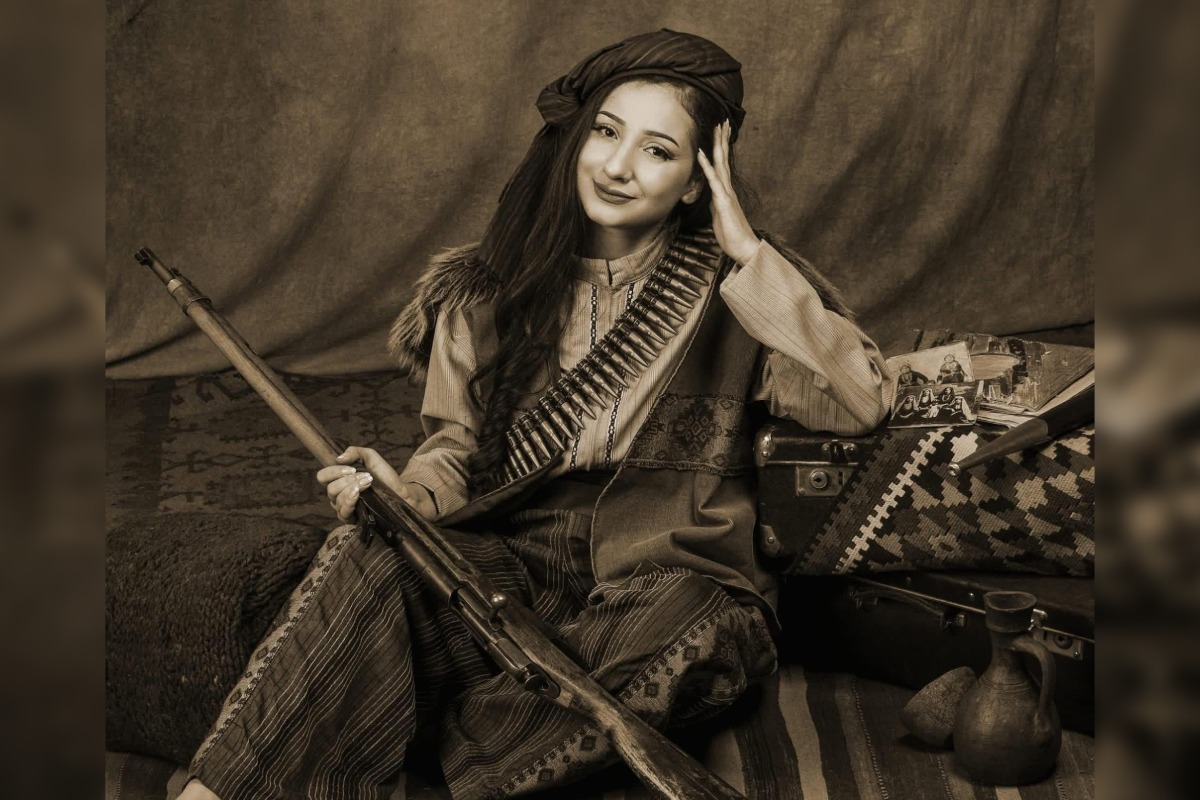
Heriknaz Poloyan.
The selection of songs, dialects and the “Lullaby of Bithynia”
Unfortunately, Poloyan does not have personal experience searching for, finding or saving forgotten songs from oblivion. However, she has talented friends who have dedicated their time to that work and have managed to write down and save songs. For her part, she has chosen a song on which she is currently working, and it will be released soon. She notes that the song is in the Artsakh dialect. The singer attaches great importance to the place and role of dialects: “The smaller we are, the greater we are with those colors, and those colors must be preserved. One of them is precisely the Artsakh dialect.” In this regard, she quotes Khevon Dalishian: “Wherever native songs are sung, the homeland remains alive.”
Her inner state dictates the song of the day. One of the oldest and most precious songs in her repertoire is the “Lullaby of Bithynia” (Buthaniai orore). It is such a sweet song that when she is sad, Poloyan can sing it and comfort herself.
Her inner state dictates the song of the day.
Reflecting on modern arrangements, she notes that she is not against the use of different musical instruments or beautiful arrangements, as long as they do not touch the root. In many cases, she says, you read the title and see that it is an old song; you hear the words and realize they are taken from an old song; but the music has absolutely no connection to that song. If arrangements do not touch the root but simply add other colors through different musical instruments, she is certainly not against it.
The true sound of Armenian song and the connection with nature
Heriknaz Poloyan currently sings in the Akunk Ethnographic State Ensemble, whose artistic director is Komitas scholar Artur Shahnazaryan. He teaches them to leave the songs in their simplicity and purity — just as our ancestors sang them and just as Komitas wrote them down. No matter how much times change, these songs remain clear and timely.
The true sound of Armenian song is born from the blending of technique, inner feeling and connection to the soil. As Komitas said, the two fountains of the Armenian people and the Armenian laborer were nature worship and piety. Thanks to this close connection with nature, one can hear the sound of a babbling brook, the rustling of the wind or the sound of the plow in the songs, leaving a miraculous effect on the listener — as if one were sitting in the lap of nature and enjoying it.
The Armenian person did not sing outside of work; song was born during work.
“For example, you cannot sweep the house or prepare bread and sing a lullaby. That is to say, song was born during labor and as a result of that feeling, the connection with the soil, the connection with nature and, over time, correct performance.”
When Komitas wrote down those songs, he did not record them from just one person. He had several people sing them to find the version characteristic of the Armenian identity, thereby creating the identity and content of our nation’s song.
Pedagogy, succession and the spiritual homeland
As a teacher by profession, Heriknaz Poloyan considers it important to explain the content of the song and unfamiliar words to children before they sing. She also explains the region where the song was sung and the temperament of the people of that region. Preparing a person first and presenting the history, she says, makes them value the song deeply. For her, the most positive and fulfilling form of appreciation is when young people and adults tell her that they did not like a song before but they loved it after her performance.
She conducts her classes using an interesting method, telling her students: “If you study your lessons, I will sing a new song for you every day, and you will know what a rich heritage you possess.” The children come with their lessons prepared, all as one, just so she will sing for them.
“I am confident that from an early age, when a child participates in it and their ear becomes accustomed to pure song, in adulthood they can hardly be degraded or made to resemble everyone else. They will be Armenian, the carriers and guardians of their heritage.”
The singer considers this her greatest professional victory, because we live in a time period when we must be able to preserve our spiritual homeland. Furthermore, the transition from modern, fast-paced urban life to the traditional world does not present a difficulty for her. When you find yourself in the world of traditional song, you understand what it means to live, and you begin to breathe freely. Song is her wings: “Can a bird live without wings? I cannot live without song either.”
“I am confident that from an early age, when a child participates in it and their ear becomes accustomed to pure song, in adulthood they can hardly be degraded or made to resemble everyone else. They will be Armenian, the carriers and guardians of their heritage.”
Heriknaz Poloyan.
Challenges of the digital age and the type of the Armenian woman
In the digital age, she is concerned that people, because they are uninformed or poorly informed, often spread videos created by artificial intelligence in which the title and text are the same, but the national song is completely distorted. But because there are dedicated guardians of Armenian song, her heart is at peace. She says a frontline awakening is taking place in her environment: At both the state and public levels, the national song and word are spreading, and there is a large army of young people who miss no opportunity to participate in events, sing the national song, dance the dance and become culturally educated.
In addition to singing, Heriknaz Poloyan practices ancient Armenian handcrafts. She is engaged in Marash embroidery and felting, and she wants to master carpet weaving and rug weaving.
“And the more I discover this magical world, the more I love my nation. I adore the type of the Armenian woman, seeing how pure and untainted she could be to have been able to preserve all of this and pass it down to us like the light of her eyes,” Poloyan told the Weekly.
She prefers not to speak about her unfulfilled dreams, but to act silently, because in many cases, the realization of a dream depends on silence and action. There is nothing in her life that has not become a reality, she says, because when you dream, all the means are given to you to follow your dream and make it real.
Addressing Armenian readers in the diaspora, Heriknaz Poloyan said:
“I would like my voice to awaken in the heart of every Armenian in the diaspora the feeling that no matter how far they are from the homeland, our root and soul are one. Through song, I want to convey that warmth and that invisible bond, which always returns us to our identity.”
She concludes with the words of Komitas: “Love, love, love much, so that you may live.”
Photos courtesy of Heriknaz Poloyan’s personal archive.