Sixteen months after the flight of Bashar al-Assad to Moscow and the formal end of Syria’s civil war in December 2024, the country has entered a new and uncharted phase: the arrest and prosecution of senior officials accused of some of the worst atrocities of the conflict. Transitional authorities have launched a sweeping crackdown on former regime figures, a move international observers describe as a defining test for the fragile new state — though the long-term trajectory of these accountability efforts remains uncertain.
Over the past six weeks, security forces have detained several high-profile officials long associated with the regime’s most notorious crimes. Among them are Adnan Aboud Halweh, accused of overseeing the 2013 sarin attack on Eastern Ghouta; Jaiz al-Mousa, the former Air Force Chief of Staff sanctioned by the European Union for his role in chemical strikes; Major General Wajih Ali al-Abdullah, who ran Assad’s military affairs office for more than a decade; and Amjad Youssef, the intelligence officer implicated in the 2013 Tadamon massacre, where at least 41 civilians were executed on camera.
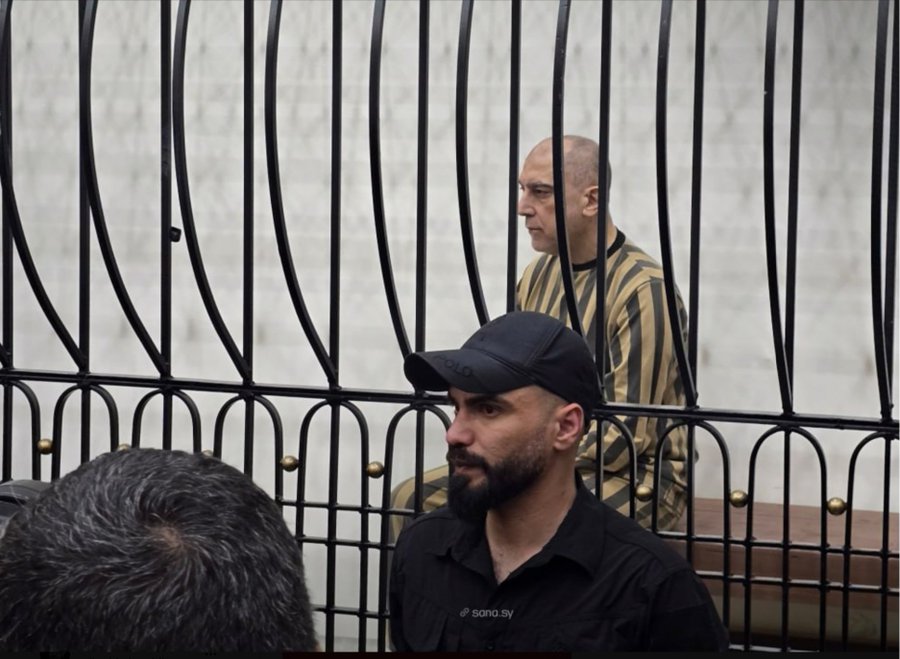
The arrests — broadcast widely on state television and across social media — coincided with the landmark trial of Atef Najib, the former security chief of Daraa. Najib’s torture of schoolchildren in 2011 for writing anti-Assad graffiti ignited the protests that spiraled into a nationwide uprising. On May 10, he appeared in a Damascus courtroom for the second time, handcuffed inside a metal cage and wearing a faded striped prison uniform. Judge Fakhr al-Din al-Oryan, himself once sentenced to death by the Assad regime, read out ten charges including murder and torture. Charges were also filed in absentia against Bashar al-Assad and his brother Maher — a symbolic but unprecedented step. Fadel Abdul Ghany, head of the Syrian Network for Human Rights, said the move marked Assad’s transformation “from absolute ruler to criminal defendant under Syrian law.”
A Political, Legal, and Security Imperative
According to an analysis by Slate, the rapid escalation of prosecutions reflects a convergence of pressures on Ahmad al-Sharaa, head of the transitional government. Victims’ families and domestic human rights groups are demanding justice, while Western governments have tied sanctions relief to measurable progress on transitional justice. Over the past year, al-Sharaa has laid the groundwork by establishing the National Committee for Transitional Justice and a specialized committee for the missing.
Security concerns add urgency. Networks loyal to the former regime remain active, with some factions retaining weapons, funding, and localized influence — bolstered by support from Russia and Iran. These remnants have incentives to exploit the economic fragility of the transition, as Syrians face soaring fuel prices, electricity shortages, and widespread food insecurity. Mutasem Al-Syoufi, Executive Director of “The Next Day,” said the authorities are under “legitimate societal pressure” on both justice and economic relief, making inaction politically untenable.
A Judiciary Rebuilt From Scratch
Arresting suspects is the easy part. Building a functioning judicial system capable of handling complex atrocity crimes is far more difficult. The dismissal of Assad-era judges has created a severe judicial vacuum. Najib is being prosecuted under the 1949 Penal Code — a law designed for ordinary homicides, not systematic crimes against humanity. With no functioning parliament, the government cannot yet enact modern legislation that meets international standards for war crimes.
Legal experts warn of major gaps, including the absence of command-responsibility provisions. The mandate of the Transitional Justice Committee is also limited to Assad-era crimes, excluding alleged violations by new security forces during last year’s coastal clashes targeting Alawites and sectarian violence reported in Suweida.
The scale of potential cases is staggering. Authorities have detained an estimated 4,000 former regime officials, while thousands more implicated in torture remain at large. One case illustrates the challenge: a woman known to survivors as “Monia,” a former guard at the Air Force Intelligence detention center. After she posted photos of her new hairdressing business online, survivors recognized her face and voice. She was arrested in March.
Training a New Generation of War Crimes Lawyers
To fill the expertise gap, academic initiatives are emerging. Slate reported that more than 300 law students at Damascus University recently attended a panel led by international war-crimes specialists, including Stephen Rapp, former U.S. Ambassador-at-Large for War Crimes Issues. The program aims to integrate students into practical legal work supporting judges and prosecutors. Rapp emphasized that mastering case-building, establishing crime elements, and navigating liability structures will be essential for success.
The Five-Year Question
Government officials have floated a target of conducting 500 war-crimes trials over the next five years. Rapp cautioned that such an ambition is “extremely difficult,” noting that authorities will need to make strategic decisions about which cases to prioritize. The true measure of success, he said, will not be the number of generals imprisoned, but whether Syria can establish a transparent, credible transitional justice process — and entrench the rule of law for the first time in its modern history.
This article was translated and edited by The Syrian Observer. The Syrian Observer has not verified the content of this story. Responsibility for the information and views set out in this article lies entirely with the author.