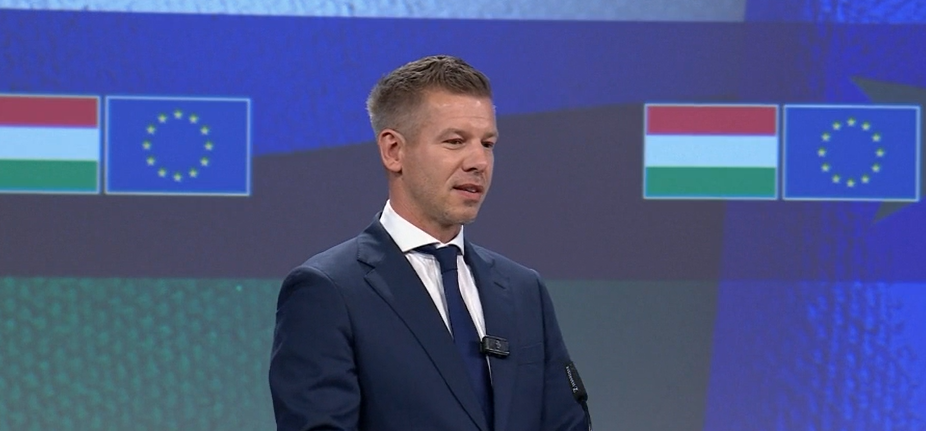
Prime Minister Péter Magyar announced in Brussels on Friday that an agreement had been reached with the president of the European Commission to unlock €16.4 billion in EU funding, equivalent to approximately 6,000 billion forints.
The Hungarian prime minister said the government had reached agreements with the European Commission on every issue necessary to allow Hungarian people access to the funds owed to them.
He stressed that on April 12, people had given the government an unprecedented political mandate, including a mandate to bring the money home and restart an economy that has been unable to grow for four years, where inflation had been the highest in Europe, “where we are currently fighting every day to keep public services from collapsing.”
He declared that these funds would be brought home to rebuild the country, restart the economy and public services, and strengthen the competitiveness of Hungarian companies and small and medium-sized enterprises.
“The goal was clear throughout, we negotiated very hard, we fought for every euro cent,” the prime minister said.
Péter Magyar stated that the real reason the European Union had not been in a position to release the many thousands of billions of forints owed to Hungary was corruption.
At a joint press conference with the president of the European Commission, the prime minister said the real reason was a level of corruption that had long been unimaginable both in the European Union and in Hungary.
He recalled that from the very beginning he had said that if Hungary adopted anti-corruption measures, established the National Asset Recovery and Protection Office, strengthened the powers of the Integrity Authority, and adopted conflict-of-interest rules similar to those in other countries, “then this money will come.”
“And lo and behold, we did nothing more,” he said.
He stated that only a few weeks had been enough to reach an agreement, to conclude a political deal “on this enormous amount of EU funding.” Three or four weeks were enough for “what Viktor Orbán and his outgoing government could not achieve in three or four years. Or perhaps did not even want to achieve, we do not know,” he added.
A total of €16.4 billion in EU funding could become accessible to Hungary following the implementation of the agreed reforms and investments, Ursula von der Leyen, president of the European Commission, announced on Friday in Brussels at a joint press conference with Prime Minister Péter Magyar.
The president of the European Commission said that, as a result of discussions with the Hungarian government, €10 billion in funding from the Next Generation EU fund could be released to Hungary, subject to the adoption of reforms and the implementation of investments.
In addition, due to progress in meeting key milestones, the European Commission has also released €4.2 billion in cohesion funds linked to the conditionality mechanism.
According to von der Leyen, a further €2.2 billion in cohesion support could become available following reforms concerning academic freedom. As part of this, Hungary will gradually phase out the system of public-interest asset management foundations and adopt legislation addressing EU concerns related to conflicts of interest and integrity rules.
The president of the European Commission said that “the strong winds of change are already being felt in Hungary.” She highlighted that the Hungarian parliament elected the new prime minister on Europe Day, and that the playing of the European anthem and the return of European flags to the Hungarian parliament building both signal the opening of a new chapter in the country’s history.
She also praised the fact that the new government had been formed in record time and had quickly begun implementing measures aimed at economic recovery, fighting corruption, and restoring the rule of law.
The Commission president stressed that the European Commission and the Hungarian government had immediately begun work to address EU concerns regarding corruption and the rule of law. She said Hungary would join the European Public Prosecutor’s Office, strengthen the Integrity Authority, review public procurement rules, and gradually phase out public-interest asset management foundations, which the European Commission viewed as structures carrying the risk of state capture.
She declared that these reforms were intended not only to reduce corruption, but also to enable the release of several billion euros in previously frozen EU funds.
Speaking about investments, Ursula von der Leyen said an agreement had been reached on projects to be financed under the revised Next Generation EU plan. The funding will affect the energy, housing and transport sectors, as well as small and medium-sized enterprises. She added that the parties had agreed on a stable and secure financing framework.
Regarding fundamental rights, she noted that further steps were needed in relation to the child protection law, although she believed the process was moving in the right direction.
The president of the European Commission also made special mention of the Erasmus programme. As she explained, Hungarian young people will once again have the opportunity to participate in one of the EU’s best-known education and mobility programmes, meaning they can rejoin the Erasmus community from the next academic year.
At the end of her speech, Ursula von der Leyen said that markets were also beginning to sense the changes, with investor confidence returning toward Hungary, which could provide further momentum to the reform process. She stressed that the European Commission intends to continue working closely with the Hungarian government in the future for the benefit of Hungary and the European Union.
Artificial intelligence was used for the translation of parts of the original Hungarian text.