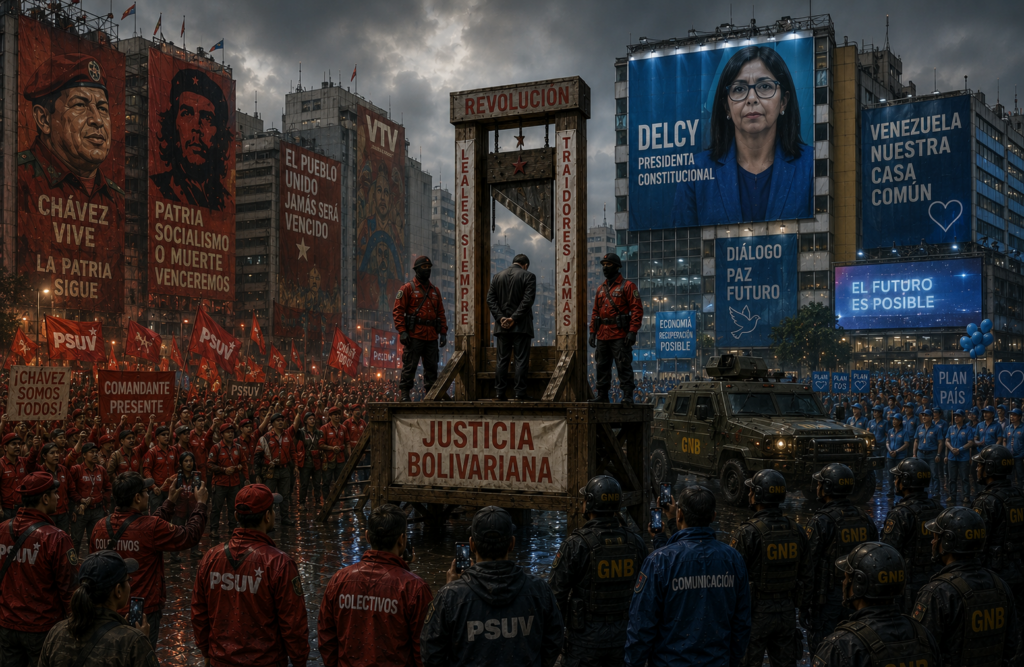
There is something distinctly strange about watching Delcy Rodríguez investigate abuses committed under structures she herself helped oversee.
Not merely because of the hypocrisy. Venezuelans are long past pretending that hypocrisy is shocking. What makes the spectacle unsettling is something else: the sensation that the revolution has begun investigating itself.
Lately, chavismo increasingly feels like a system becoming aware of the dangers of its own machinery.
The atmosphere feels oddly Thermidorian.
By the final phase of the French Revolution, Revolutionary France had entered a dangerous psychological stage. The machinery originally built to defend the revolution increasingly turned inward. Yesterday’s loyalists became today’s suspects. Revolutionary necessity justified nearly everything until enough revolutionaries realized the system they had legitimized could eventually consume them too.
That was the deeper tragedy of Maximilien Robespierre. He did not fall because France suddenly discovered that The Terror was excessive. Many of the men who helped remove him had tolerated, justified or directly participated in the same machinery. The problem was that the revolution had become frightening even to its own caretakers.
And that is increasingly the feeling surrounding late-stage chavismo.
Late-stage chavismo often feels less like radical republicanism than a modernized form of palace politics. Access matters more than institutions.
The issue is not simply corruption or repression. Venezuela has lived with both for years. It is the growing need to politically separate “the revolution” from the consequences of how the revolution actually governed.
Suddenly, figures inside the regime speak the language of investigations, abuses and accountability, as if these emerged independently from the structures they themselves administered. Former insiders disappear into opaque detention systems they once defended. Loyalists quietly begin understanding that proximity to power offers protection only until it doesn’t.
The case of Tareck El Aissami perhaps captures the atmosphere best. Few figures were more deeply associated with the opaque architecture of the Maduro regime. Yet even he eventually disappeared into the same world of silence, isolation and bureaucratic ambiguity that the revolution spent years normalizing for others.
Even some of the system’s loudest propagandists seem increasingly vulnerable to the same cycles of suspicion and disciplinary signaling once reserved for enemies of the revolution. The boundaries of revolutionary distrust rarely remain fixed for long.
The revolution starts sounding tired.
Not defeated, not democratized, simply exhausted by the burden of sustaining permanent exceptionality. For years, every crisis justified extraordinary measures. Every institutional limit became negotiable in the name of defending the revolution. But revolutions are exhausting things to sustain indefinitely. Eventually governing becomes harder than mobilizing.
And that is what makes the French Revolution such a useful narrative lens for understanding this moment, though not in the simplistic way many critics of chavismo try to frame it.
The Terror did not end because the revolution rediscovered moderation. It ended because enough revolutionaries realized they themselves might eventually be next.
The French Revolution was not merely a catastrophe that destroyed France. It helped dismantle a semi-feudal political order and laid many of the foundations of the modern republican state. Its excesses were real, but so were its transformations.
If anything, the irony cuts in the opposite direction with Venezuela.
Chavismo inherited an already existing republic, however flawed, and gradually transformed large parts of it into something far more personalized, opaque and court-like. In many ways, late-stage chavismo often feels less like radical republicanism than a modernized form of palace politics. Access matters more than institutions. Loyalty matters more than predictability. Political survival depends less on republican norms than on remaining inside the protective architecture surrounding power.
The revolution that once spoke in the language of popular sovereignty increasingly governs through much older political instincts.
Which perhaps explains why the old monarchical phrase feels strangely appropriate now:
“The king is dead. Long live the king.”
Revolutions often promise to abolish the court. More frequently, they simply rename it.
And yet the most revealing part of this late revolutionary phase is not the hypocrisy itself. It is the growing sense that parts of the system now understand the dangers of what they built.
That, ultimately, was the true lesson of Thermidor. The Terror did not end because the revolution rediscovered moderation. It ended because enough revolutionaries realized they themselves might eventually be next.
Lately, chavismo increasingly gives the impression of a system arriving at a similar realization.