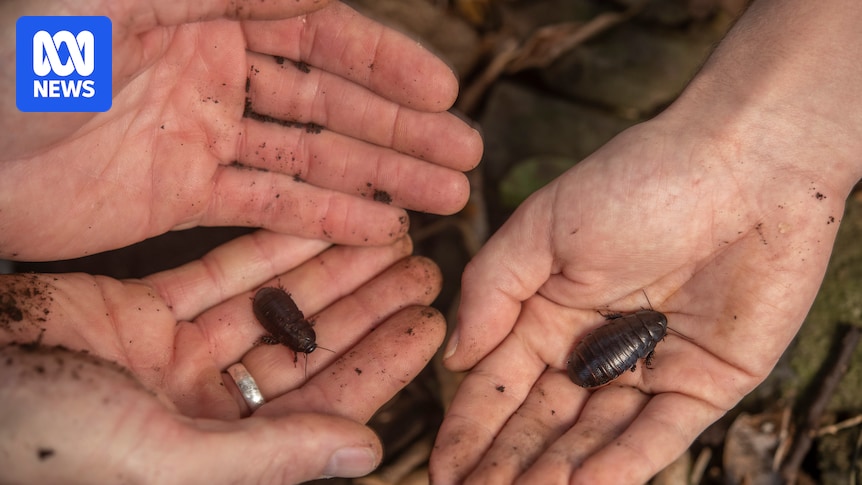
A boom in cockroach numbers is not often welcome news, but Lord Howe Island is a special kind of place.
Invertebrate creatures, including native cockroaches and other insects, are thriving on the World Heritage-listed site after the removal of invasive rodents seven years ago.
The invertebrate life is seen as “fundamental” to the broader ecosystem, helping break down organic matter and providing food for birds and native animals.
“It feels like the island is coming to life,” Sydney University honours student Maxim Adams said.
“There’s been about a 60 per cent increase in invertebrates.”
A native Lord Howe Island cockroach, Panesthia lata, is one of the species rebounding on the island. (Supplied: Justin Gilligan)
Mr Adams is co-lead in a study with the NSW Department of Climate Change, Energy, the Environment and Water (DCCEEW), published in Biological Invasions, examining how invertebrate communities have changed after the island-wide eradication of more than 300,000 rats and mice in 2019.
The team collected invertebrate specimens from 20 forest sites across the island before the eradication program in 2016–17, then again seven years later, and compared the results.
“It’s a dream job really, to be stuck on an island counting all the insects,” Mr Adams said.
Maxim Adams and Nicholas Carlile (NSW DPI) under a banyan tree on Lord Howe Island. (Supplied: Justin Gilligan)
The first study saw about 9,000 specimens collected, compared to 15,000 collected in the second survey.
“Walking around on Lord Howe Island now, it feels more like a paradise of creatures and that’s a really special feeling,” Mr Adams said.
“Invertebrates do the absolute heavy lifting of nutrient recycling, of fertilising the plants … all these wonderful ecosystem processes that make it this beautiful, lush spot we like to visit.”
The strongest increases were observed among larger invertebrates: those more than 13 millimetres long.
Native bush cockroaches on Lord Howe Island have bounced back strongly after the rodent eradication on the island. (Supplied: Justin Gilligan)
“Isopods, which are woodlice and slaters, and native bush cockroaches seem to have increased the most,” Mr Adams said.
“That matters because these animals are also an important food source for native predators including geckos and insect-eating birds.”
One species of Lord Howe Island cockroach was believed to be extinct, before being rediscovered in 2023.
“It was the first sign these special invertebrates were starting to bounce back and we would be finding this unexpected diversity as the years progressed,” Mr Adams said.
Mr Adams noted that while total invertebrate abundance increased, overall diversity patterns were mixed, with some groups increasing while others declined.
A new ecosystem emerging
Views over the top of Lord Howe Island from Mt Gower. (ABC News: Emma Siossian)
The findings came after previous studies documenting the strong bounce back of seabirds and native land birds after the rodent eradication, including the Lord Howe Island woodhen.
But Mr Adams said it was unlikely the island’s ecosystem would return to the state it was in before rodents were introduced more than a century ago.
“The ecosystem will reach some new equilibrium, which is probably a bit different to what was there before,” he said.
Numbers of the Lord Howe Island woodhen have increased dramatically in recent years. (Supplied: J Gilligan)
“Part of the tragedy is that while some of these invertebrates have started to bounce back, others have [already] become extinct.”
Mr Adams is a student under Professor Nathan Lo, who leads the Molecular Ecology, Evolution and Phylogenomics laboratory at Sydney University.
Professor Lo said things were looking positive for the island’s biodiversity and the next step would be studying “higher-order predators” in the ecosystem, including geckos.
Nathan Lo says attention is turning to the island predators that eat the invertebrates. (Supplied: Nathan Lo)
“Ian Hutton, director of the Lord Howe Museum, took me out into the forest in the north of the island one night a few weeks ago,” he said.
“There were endemic geckos all over the place — these were only rarely seen prior to the eradication.
“They are presumably eating all of the large invertebrates, in particular bush cockroaches and slaters, that have bounced back.”
Professor Lo said work was also underway to sequence the DNA of all the invertebrate samples.
“This will give us precise information about which critters have been present on the island over the last 10 years, and help with their longer-term biosecurity and conservation,” he said.
Lord Howe Island sits about 600 kilometres off the coast from Port Macquarie. (Supplied: Ian Hutton)