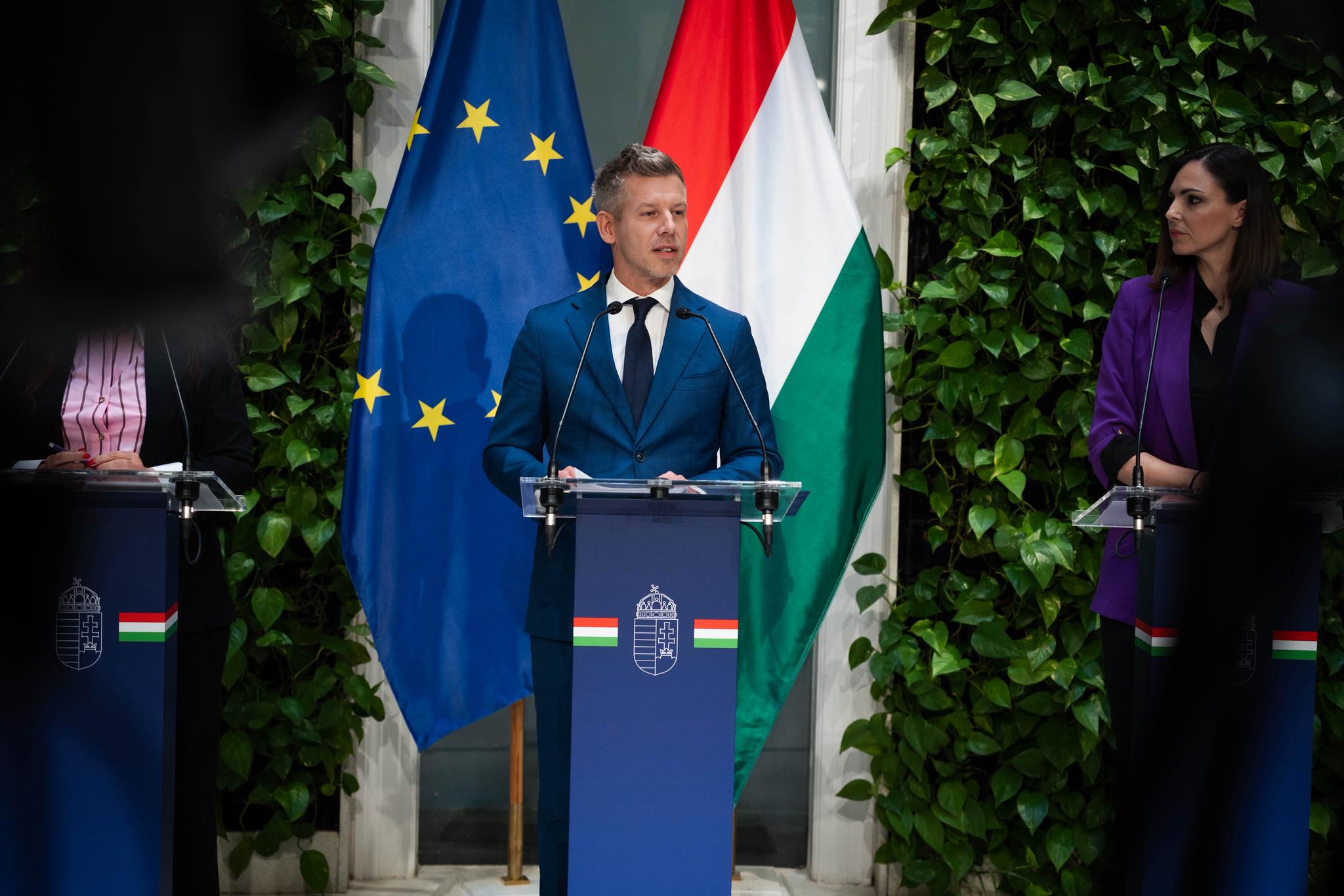
Prime Minister Péter Magyar said salaries for the prime minister, ministers, members of parliament and mayors will be significantly reduced, in an interview with RTL broadcast on Saturday evening. He also said that VAT cuts, tax reductions, the introduction of a pensioners’ SZÉP card and the HUF 100,000 school-start support payment would become available to hundreds of thousands of Hungarian families within a foreseeable timeframe.
Regarding the salary reductions, the prime minister said the same measures would apply to the heads of state-owned companies, as well as members of boards of directors and supervisory boards, alongside cuts to parliamentary expense budgets.
“We will be able to save HUF 50 billion in parliament alone,” Péter Magyar said, adding that under the new rules the prime minister’s gross salary would be HUF 2.3 million, which in his case would be supplemented by the base parliamentary salary, bringing his total income to HUF 3.8 million.
He added that ministers and state secretaries would receive lower salaries than this. “It matters enormously what kind of image and example we present to the Hungarian people, to our own country and to the wider world,” he said.
He stressed that humanity, restraint and humility must not only be demonstrated but also lived, and that MPs and government members are performing a public service.
Péter Magyar also said that in future only the prime minister and the Interior Ministry will have the right to use blue flashing lights, and only in the most necessary cases. In addition, the system of diplomatic passports will be reviewed following preliminary findings indicating that more than 1,000 had been issued without justification.
Speaking about negotiations with European Union institutions regarding funds due to Hungary, the prime minister said it is normal for differences of opinion to exist between the parties. “We will only accept changes that are good for Hungarian people and Hungarian companies,” he said.
He stated that negotiations are progressing well, several rounds of talks have already taken place and EU leaders are “approaching the matter very positively”. He stressed that the task is difficult because the government has only three months to complete work that his predecessor failed to carry out in three years.
Péter Magyar said the main challenge lies in preparing projects to be financed through these funds.
“We want the Commission to approve programmes that genuinely help Hungarian people,” he said, citing transport and energy developments, as well as efforts to launch a large-scale rental housing programme in Hungary.
He added that the necessary structures and legal framework must be established, meaning that “no one in the government or ministries will go on holiday this summer”.
“A huge amount of money is at stake; this is the Hungarian people’s money. Our goal is to secure all of the EUR 10.4 billion in recovery funds currently frozen for Hungary,” he said.
He added that he could not guarantee the government would secure 100% of the funding, but stressed that the money is needed to restart the Hungarian economy.
Péter Magyar described negotiations in Brussels over the EUR 10.4 billion recovery fund and several trillion forints in cohesion funding as decisive. He also referred to a EUR 16 billion defence industry development credit line that had been applied for by the previous government but never drawn down, saying these arrangements must also be reviewed.
The prime minister said the school-start support payment will already be introduced in August 2026. “This was our commitment and remains our commitment, and we have communicated this very firmly to the finance minister,” he said.
He noted that the Tisza Party’s programme estimated that around 700,000 children in need could be affected by the measure, though more recent indications suggest the number of truly needy children may be somewhat lower.
At the same time, Péter Magyar described creating eligibility criteria that ensure the support reaches genuinely needy families as a major challenge.
Asked who would qualify as needy, he said this would be decided by the government and depend on many criteria. He argued that Hungary had operated wastefully not only because of corruption, unnecessary prestige investments, frozen EU funds and expensive financing, but also because some social benefits had been paid to families with high per capita incomes.
“This also has to change,” he said.
He stressed that social inequalities and societal disparities must be reduced, suggesting that the pensioners’ SZÉP card could be introduced gradually and tied to income levels.
He said this would only be possible once the new 2026 budget is in place in early September, adding that he would be satisfied if payments could begin in the fourth quarter of the year.
Among the proposals under consideration is one whereby the HUF 200,000 benefit would not cover a calendar year but run, for example, from October to October, the prime minister said, adding that all measures can only be introduced once the exact state of the budget, expected economic growth and financing conditions are clear.
Péter Magyar also said he wants transparent government communication and pledged that the government will answer all questions from the free press.
“After 20 August, we will travel across the country to inform people, answer their questions and allow them to hold us accountable for the programme of a functioning and humane Hungary,” he promised.
“Every day skeletons are falling out of closets — not just skeletons, sometimes entire cemeteries — in every ministry,” Péter Magyar said about the country’s economic condition.
“We had suspicions, and still do, but I think the situation is worse than any of our assumptions,” he said.
He recalled that more than 40 days have passed since the election and the government was formed two weeks ago, describing it as the fastest government formation in modern Hungarian history.
The cabinet has begun operating, all ministers have been appointed and all state secretaries will be announced over the weekend, he added.
“What matters is that governing is underway. There is no need to defeat Fidesz — the Hungarian people already did that on 12 April — and there is no need for a witch-hunt,” he argued.
However, people have a right to see reality, including the state of the budget, because one of the most important things Hungarians need to know is the condition in which the previous government left the country, he said.
Péter Magyar claimed that the Defence Ministry signed a HUF 1.3 trillion agreement a few weeks before the election and that the former government made a HUF 267 billion foundation commitment linked to Nobel Prize-winning researcher Ferenc Krausz. He also referred to a HUF 17 billion grant scheme of the National Cultural Fund.
He further claimed there was an item worth more than HUF 280 billion at the transport ministry that had not been included in the budget. According to him, it later emerged that János Lázár and Márton Nagy were the responsible ministers whose signatures appeared on the relevant budget chapter.
He said the previous government adopted the 2026 budget without allocating financing for it, adding that this raises not only political but also potential criminal responsibility.
Responding to criticism from Fidesz-KDNP denying that anything had been concealed from the budget, Péter Magyar said they had failed to mention that they had more than tripled state debt, failed to secure EU funds owed to Hungarians, and turned Hungary into the European Union’s most corrupt and poorest member state during their time in office.
He noted that the 2025 budget had originally been adopted with a 3.7% deficit target, later revised to 5%, while during the government handover “Márton Nagy and the other responsible figures hinted they were expecting something around a 6.8–7% deficit”.
He said he does not believe even the 5% deficit target is sustainable, “especially since not all the skeletons have fallen out of the closet yet”.
The cabinet has therefore asked Finance Minister András Kármán to prepare a detailed inventory, based on which a revised 2026 budget can be submitted toward the end of August.
Péter Magyar argued that the previous government had acted with enormous irresponsibility by building budgets on “sand and castles in the air”, causing Hungary to lose investor confidence and forcing the country to finance its high deficit and public debt at much higher costs.
Asked whether mothers over 40 with two children would also receive personal income tax exemptions next year, he said the plan is to maintain all measures beneficial to Hungarian families, whether already introduced or not yet implemented, while emphasising the importance of a sustainable budget grounded in reality.
He said irresponsible financial management would only leave Hungary poor and corrupt.
Péter Magyar also said institutions must be created to hold accountable those who stole state assets and recover a significant portion of them. After that, a structure must be built in which “not even the seeds of corruption remain”.
Recalling his visit to Poland and the development seen there over the past 10 to 15 years, he stressed that Hungary does not need miracles but transparent, genuinely patriotic and professional governance.
Asked when Hungary’s economic development could reach the EU average — currently at 76% — Péter Magyar said that if EU funds are secured, corruption curtailed, stolen state assets partly recovered and the economy restarted, Hungary could achieve growth at least 2–3 percentage points above the EU average.
If those goals can be achieved from 2027 onwards and growth sustained, Hungary could reach the EU average within a foreseeable period, he said, adding that around 2030 the government also wants the country to meet the conditions for joining the eurozone.
Regarding public debt, he stressed that the trajectory matters more than the level itself. “It must be on a downward path,” he said.
Artificial intelligence was used for the translation of parts of the original Hungarian text.