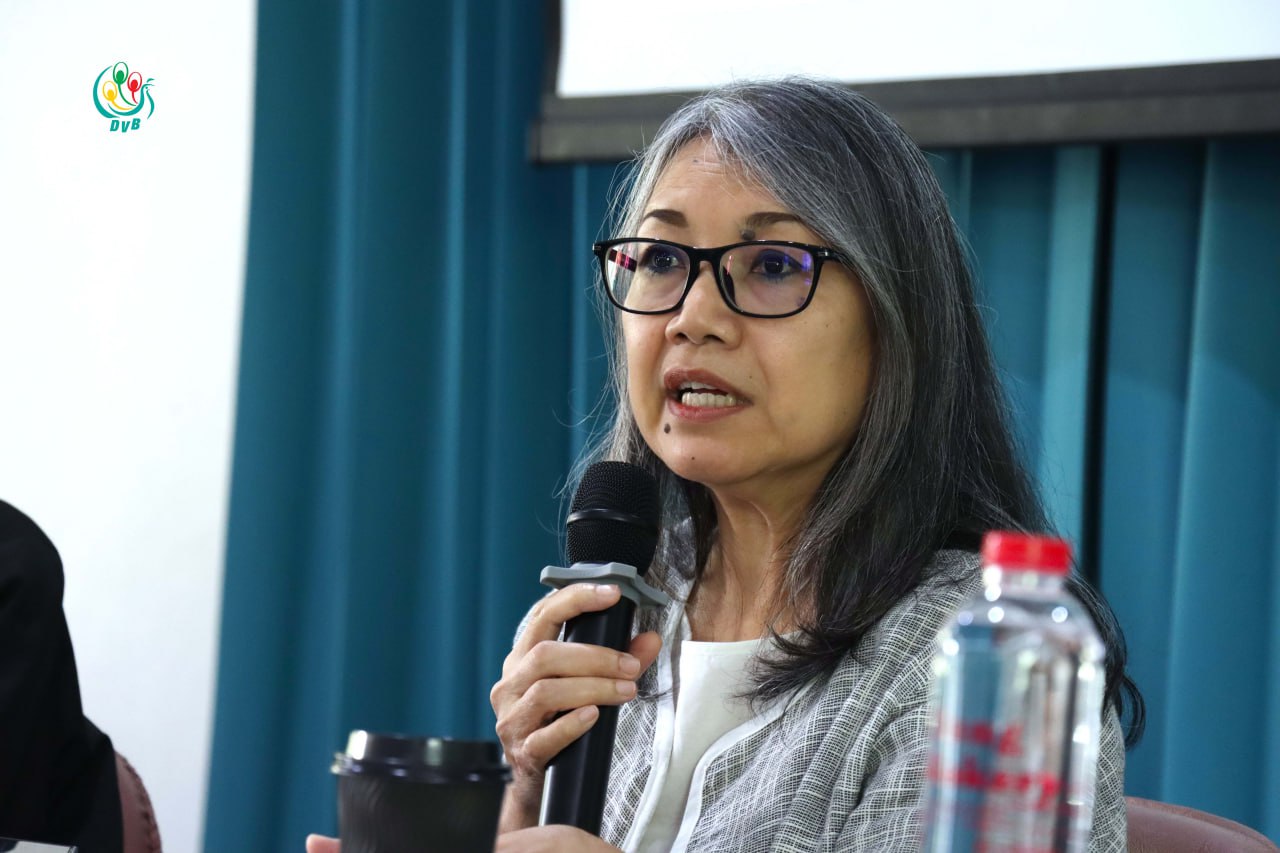
Guest contributor
Khin Ohmar
Five years ago, Myanmar’s military staged an illegal coup attempt, illegally arresting and imprisoning legitimately elected leaders on bogus charges.
Since then, this junta has killed over 17,871 civilians across 328 of Myanmar’s 330 townships, conducted 9,794 aerial bombardments, and displaced more than 3.7 million people.
Twelve million more face acute food insecurity. In March alone, the month the junta’s sham “parliament” convened, 518 civilians were killed. It was the deadliest month since the illegal coup attempt began.
Between December 2025 and January 2026, the junta staged a three-phase “election” through the meticulous weaponization of electoral processes. An estimated 10.5 million voters were deliberately excluded.
Another 11 million boycotted. The rest, except those junta-affiliated, had no choice but to vote for the junta under threat and coercion.
The votes cast claimed by the junta amounted to roughly half of those in the 2020 election—which is to say, the very election the military has been attempting to overturn.
The result was pre-decided. The military’s proxy party swept civilian seats while the military retained its constitutionally guaranteed 25 per cent of unelected parliamentary seats.
This was not a transition. Internationally, it was an attempt at a rebrand. Domestically, it was a violent attempt to claim state authority over large territories the junta does not even currently have control.
ASEAN’s quiet endorsements at Cebu
On May 8, the 48th ASEAN Summit convened while, in Myanmar, the junta continued to bomb civilians.
The summit statement acknowledged “minimal progress” on the Five-Point Consensus (a framework the junta has categorically ignored since signing it in April 2021) but stopped short of naming the junta as the root cause and perpetrator of the crisis.
It referred to the sham election as “the conclusion of the three phases of Myanmar’s general elections,” diplomatic language that functions as a quiet endorsement.
It omitted the official titles of President Win Myint and State Counsellor Aung San Suu Kyi – an unseen but deliberate lack of legitimacy to democratically elected legitimate leaders of Myanmar.
And when addressing the repatriation of Rohingya refugees from Bangladesh, the summit statement refused to name of the people as Rohingya. This is not an oversight. It is only the junta that rejects the Rohingya identity.
ASEAN member states are party to U.N. resolutions that recognize it. By erasing the name, ASEAN chose to continue to give in to the military’s bullying at the direct expense of one of the most vulnerable peoples on earth. In doing so, it breached its own obligations.
Falling for the same old playbook
ASEAN also welcomed the release of over 4,000 “prisoners.” The solitary word is a deliberate choice, a decades-long pattern of denying the existence of political prisoners by dissolving them into a general population.
Only 292 of those released were confirmed political prisoners, and yet there was no discussion of what thousands of general releases have to do with its Five-Point Consensus (5PC) – a diplomatic and political process aimed at resolving the Myanmar crisis.
This is the Myanmar military’s old playbook: release ordinary criminals alongside a handful of political prisoners, time it ahead of an international gathering, and watch the world applaud.
This is not a bloc making “minimal progress.” This is a bloc being systematically deceived and manipulated and choosing, repeatedly, not to notice.
Five years of total non-compliance should be answer enough. The 5PC is not a framework this junta intends to implement. It is one they have enjoyed exploiting.
Thailand and Malaysia failing to stand on principle
Meanwhile, Thailand’s foreign minister reportedly pushed for a sideline meeting with the junta-appointed foreign minister, a move that falls outside the 5PC mandate and signals a willingness to normalize engagement with the post-sham election structures and entities this junta has constructed and appointed.
Ahead of the summit, Malaysia’s Foreign Minister Mohamad Hasan publicly rejected the rebranded junta’s bids to be included in official ASEAN meetings. But just one week after Cebu, he travelled to Naypyidaw for a working visit, meeting directly with junta-appointed foreign minister.
Malaysia was the ASEAN Chair that took the most principled stance on Myanmar’s crisis in 2025, including rejecting the junta’s sham election and deciding to deliver aid to conflict-affected, internally displaced populations through border channels.
The Malaysia that Myanmar’s democracy movement looked up to. That same government is now in the junta’s capital. The trust is gone.
This is how normalization begins. Not with a formal announcement. With a working visit, a cordial meeting, talk of “bilateral relations” conducted behind the backs of our people, lacking transparency, disrespecting our will, and neglecting our suffering.
This gesture was not lost on the junta
The junta wasted no time exploiting the visit and generating propaganda.
It published the meeting on its foreign affairs ministry’s Facebook page, framing it as a restoration of bilateral ties. A Bangkok-based political analyst told Malaysian state media the visit showed “Malaysia has now recognised the election outcome, and it is a good move.”
That post has since been withdrawn. But the damage is done: the junta got its propaganda, and the world has already published it.
Malaysian Foreign Minister Mohamad Hasan should answer a simple question: why, after Malaysia’s principled leadership for the past years that earned the trust of Myanmar’s democracy movement, did he allow himself to be used by the junta this way?
That trust was not a diplomatic courtesy. It was based on Malaysia’s principled stand in solidarity with Myanmar’s people. It was the foundation on which current and any future engagement with our people must be built.
The demands from civil society are clear
In an open letter dated April 24, 201 civil society organizations across Myanmar, the region, and internationally made their demands clear:
● ASEAN must formally declare null and void the junta’s sham electoral process and all institutions it has produced, including the sham parliament and any government emerging from it. Junta-linked figures, including those produced through the sham election, must be barred from all ASEAN meetings.
● ASEAN must operationalize its own October 2025 decision on cross-border humanitarian aid, delivering assistance through ethnic resistance organizations, the National Unity Government, and trusted civil society networks. Aid must not flow through the junta or the AHA Centre, which has consistently failed to reach displaced populations.
● ASEAN must take immediate and concrete steps to restrict aviation fuel and weapons flowing to the junta. The junta’s air force is its most lethal instrument of terror against the people. Cutting fuel cuts airstrikes.
● ASEAN must support international accountability mechanisms, including universal jurisdiction cases brought by Indonesia and Timor-Leste, and the 2025 Argentina arrest warrants against 25 junta officials. Impunity is not an option.
ASEAN must get out of the way
The Philippines holds the ASEAN Chair. ASEAN’s submission to this criminal junta has enabled it to intensify its terror campaign against the people of Myanmar.
Philippine Congresswoman Leila de Lima has called on ASEAN leaders to take bolder action. In Cebu, civil society gathered, protested, and issued the Cebu Declaration.
The people’s demand is not ambiguous. We are losing lives every single day at the hands of this murderous military, and ASEAN has not only delayed but is now moving in the wrong direction.
Five years of an utterly failed 5PC have shown what ASEAN’s complicity in the junta’s crimes against humanity looks like. The Philippines has a chance, and a responsibility, to show what a principled alternative looks like.
That means letting go of ASEAN’s political ego and acknowledging what is plainly true: ASEAN does not have what it takes to resolve this military-made polycrisis alone. It must call on the U.N. General Assembly and Security Council to act.
It must join international community’s efforts to hold Min Aung Hlaing and his criminal junta accountable under international law.
And it must let the people of Myanmar build the federal democratic future they are fighting for, largely without any help from ASEAN, in the face of unprecedented military violence.
This is a people-led, people-owned process. Myanmar’s people are doing this themselves. ASEAN has spent years being impotent while the junta continues its campaign of terror against Myanmar’s people.
If ASEAN cannot stop the junta’s violence and save our people’s lives, the least it can do now is stop lending legitimacy to the junta and get out of the way.
Khin Ohmar is a Myanmar human rights activist who was involved in organizing the 1988 nationwide pro-democracy uprising. She is also the founder and chairperson of Progressive Voice, a Myanmar human rights organization. She developed the Women Peacebuilding Program for Women’s League of Burma and served as program coordinator from 2000 to 2006.
DVB publishes a diversity of opinions that does not reflect DVB editorial policy. We’d like to hear what you think about this or any of our stories: [email protected]