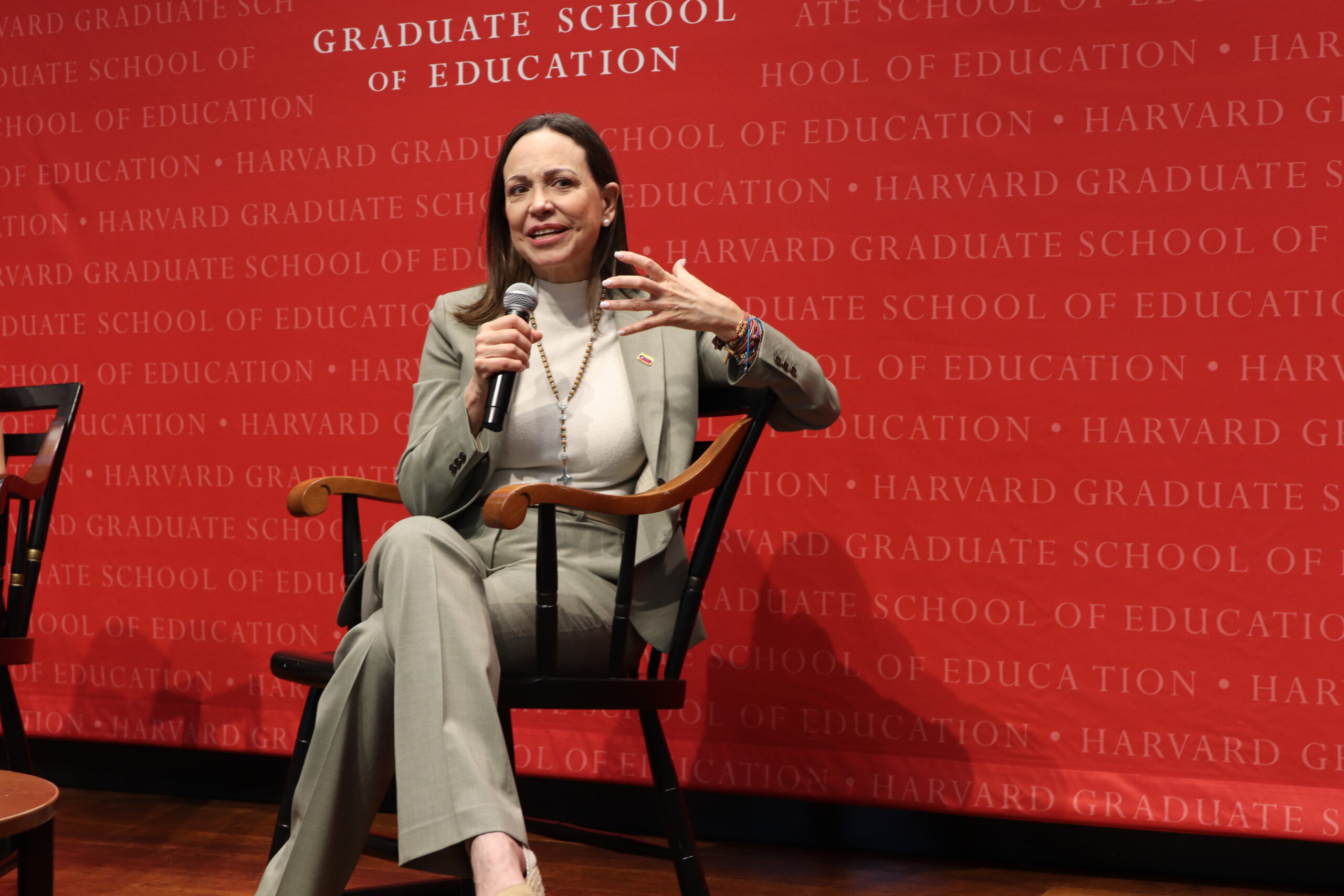
Last Tuesday, on May 12, I attended the conference Education Beyond Oil that was organized by the Harvard Graduate School of Education. When it became public that María Corina Machado would be the keynote speaker, I realized this was the first time I would listen to a Venezuelan political leader speak in depth about a specific public policy issue in my 30 years.
The anxiety in the room was palpable: people changing seats, telling stories about the last time they had been to Venezuela. When Machado showed up, everyone stood up and began applauding spontaneously. It was an applause many of us had been holding onto for years. This was not to be just a speech on education policy. On one hand, it meant celebrating the 28J victory, a movement I feel part of, and the Nobel Prize, something that fills me with pride. On the other hand, I wanted to see how she was doing. But more than anything, I wanted to hear her current perspective and vision for the future. The task ahead for Machado is almost impossible, but if we are honest, we are, implicitly, evaluating her on multiple levels.
I was seated in the first row by sheer coincidence. During the previous panel, I had been asked to serve as the timekeeper, the person responsible for signaling speakers when they had five, three, or one minute left. We were being very strict about timing. Professor Emiliana Vegas, who planned and coordinated the entire event, had repeatedly insisted that we stay on schedule. Several times I had to raise the sign and shut down executive directors of major institutions and Harvard professors, who were the leading voices in education from around the world.
Would I really be able to do it in front of the woman who had led the 28J feat and had just won our first Nobel Prize? I imagined myself having to raise one of the signs, announcing that she had five minutes left. That’s it, I thought. I’m automatically becoming a meme.
Rewriting the State’s role
Machado stood before the microphone and began by saying that this was a day we would remember in the future. I thought she was going to repeat the speech she had given in Madrid, which I had already watched on YouTube. That’s what politicians do. What surprised me was that she had prepared a set of thoughtful talking points specifically about education, which she positioned as the transversal core of the entire plan.
“At the end of the day,” she said, “children, teachers, and classrooms are what this transition is all about.”
She continued: “A country is rebuilt with citizens, and citizens are formed in classrooms. We will be redeemed not by the price of oil, but by whether a seven-year-old learns to read this year instead of losing yet another year of learning.”
Machado laid out the diagnosis: more than one million Venezuelan children of school age are not attending school. More than 50% of public schools lack reliable electricity and running water. We have lost more than 120,000 public school teachers, and those who remain earn an average of 20 USD a month, roughly 4% of the average teacher’s salary in Latin America. As for the children who are still in school, they are, on average, ten years behind where they should be in basic competencies such as math, reading, and writing. A picture so bleak it could become paralyzing.
A family with a voucher would be able to enroll their kid in a private school of their preference. The State’s role would shift from running every public school to financing access, regulating standards, and guaranteeing quality.
Just as Machado began outlining the plan to address this reality, I suddenly remembered my role as the timekeeper. Oh no. In our contemporary political culture, figures in her position often grant themselves license to speak broadly. I looked around for guidance from Professor Emiliana or the organizers, but everyone was listening with complete attention.
One commitment stood as the cornerstone of the entire proposal: restoring the right to learn for every Venezuelan child and adolescent. A contract, she called it, between the “new republic” and its youngest citizens. The education plan has four components: a) short-term recovery, b) nutrition, c) teachers, and d) families. There are clear goals and an estimation of the budget for both the short and medium term. For example, for the first 100 days it is expected to reintegrate around 50,000 students into the education system and provide emergency stipends for around 500,000 teachers.
Goals for the first 100 days
- Reactive school meal programs for 5 million children
- Reintegrate at least 50,000 excluded students
- Urgent repairs in at least 4,000 schools
- Emergency stipends to 600,000 teachers
- Create the Instituto Venezolano para la Calidad Educativa (National Institute for Quality Education)
- Improve connectivity in 25% of schools
- Launch training programs and recruit 100,000 new teachers
The vision in the long run is to build an educational system in which the State guarantees, but does not monopolize teaching. Every Venezuelan child would be entitled to a voucher, with funding following the child to the school chosen by the family. For example, a family with a voucher would be able to enroll their kid in a private school of their preference. The role of the State would shift from running every public school to financing access, regulating standards, and guaranteeing quality, while public schools would remain a central pillar of the system. Machado acknowledged that some of the policies she was proposing remain contested.
This type of education policy is part of a broader set of school choice reforms, which seek to expand the options parents have in determining their children’s education. Originally promoted by Milton Friedman in the 1960s through voucher systems similar to those proposed by the opposition leader, these reforms have, in recent decades, also taken the form of charter schools, which remain publicly funded but are privately managed. Machado did not go into the details of whether her plan would be based mostly on vouchers or whether some form of charter schools will also take place.
What gives me confidence is not so much the specific details of the long-term vision, but rather the way the overall plan appears to have been developed.
The results of these initiatives in the US are mixed and depend on what is being measured. On the voucher side, there is limited evidence that vouchers causally improve student learning. In practice, this means that students who received the opportunity to choose schools did not, on average, perform better on standardized tests than those who did not receive vouchers. By contrast, the evidence on charter schools tends to show more positive effects on academic outcomes. Still, these findings should be interpreted carefully, since the educational system in the United States differs substantially from Venezuela’s.
The closest evidence we have to a voucher program like the one proposed by Machado comes from Colombia’s PACES initiative. In the 90s, the Colombian government provided more than 125,000 students in poor urban areas with vouchers that initially covered over half the tuition cost at low- and middle-cost private schools. The program showed positive educational outcomes: participants completed on average 0.1 additional years of schooling, were around 10 percentage points more likely to finish 8th grade, scored higher on standardized tests, and, seven years later, were also more likely to graduate from high school.
A whole plan
What gives me confidence is not so much the specific details of the long-term vision, but rather the way the overall plan appears to have been developed: informed by some of the best international practices available and shaped by a diverse team, that understands both the nuances and limitations of the evidence, while remaining committed to building the best possible educational system for Venezuela. Throughout the conference, we heard from experts from countries such as South Korea and India, countries that have faced challenges on a scale similar to ours, reflecting on how to prioritize and scale the solutions being proposed.
I encourage everyone interested in education or public policy to watch the videos of the Education Beyond Oil conference once they are published. And I also hope that those in a position to do so will try to replicate this kind of exercise in other critical sectors, such as healthcare, pensions, etc.
When Machado finished answering questions from the audience, I checked the clock. Fortunately for me she was right on time.