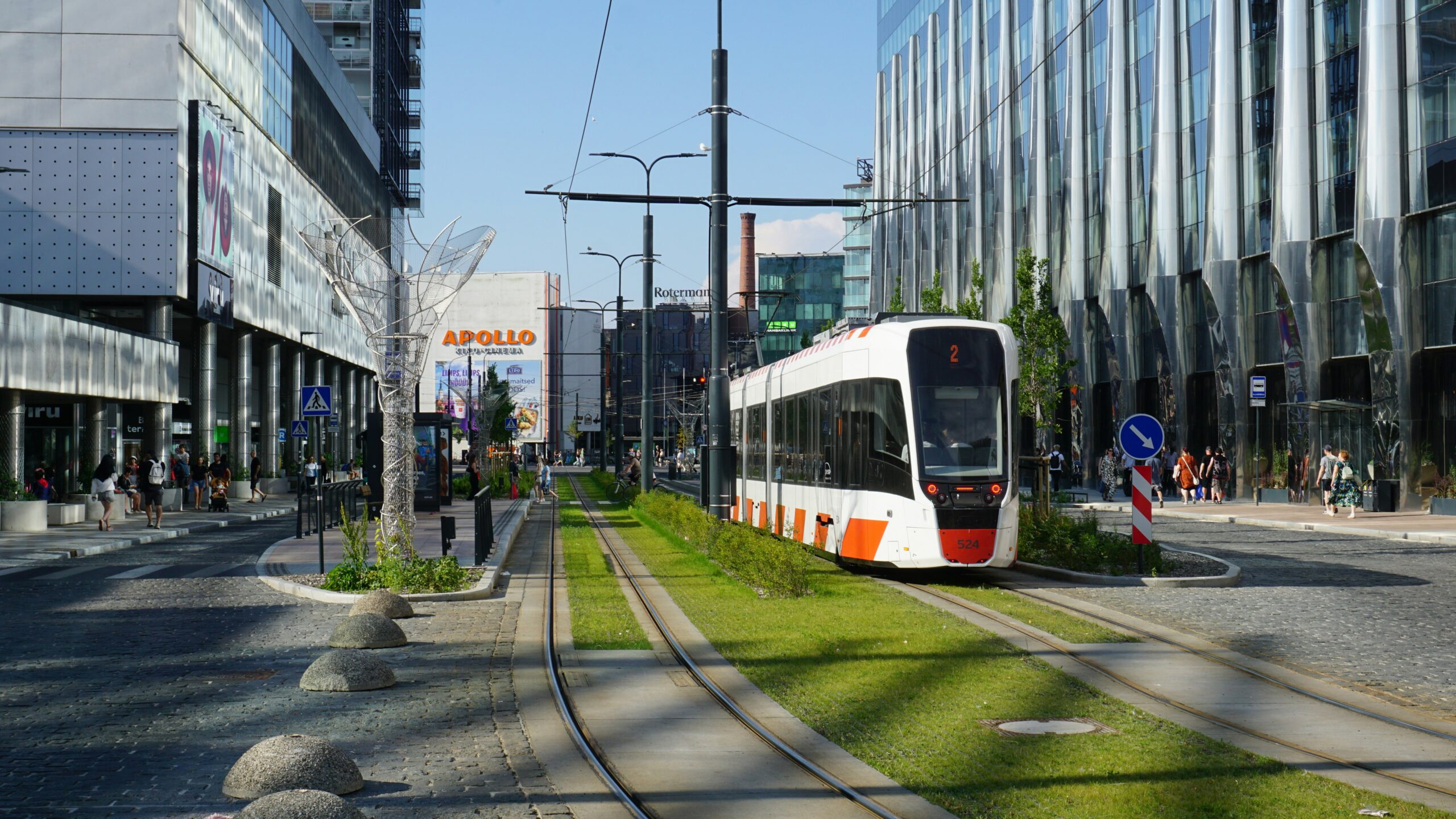
Tallinn is preparing a significant shift in the way it develops its tram network, with the city planning to buy 22 new bidirectional trams – a move that could make future extensions cheaper, more flexible and better suited to a denser European capital.
The decision, included in Tallinn’s 2026 supplementary budget and approved by the city government, marks more than a routine fleet purchase. It signals a change in the planning logic behind the city’s tram system: away from routes that depend on large turning loops at their termini, and towards a more adaptable model commonly used in many European cities.
At present, new tram lines in Tallinn usually require a sizeable turning loop at the end of the route. These loops take up valuable urban space, increase construction costs and make it harder to extend lines gradually through compact districts. Bidirectional trams remove much of that constraint. With driver’s cabs at both ends and passenger doors on both sides, they can simply change direction at the end of a line, much like a train or metro.
An older Škoda tram on Narva Road in central Tallinn. The city plans to buy 22 new bidirectional trams as it rethinks how to expand its public transport network. Photo by Marek Lumi/Unsplash.
For Tallinn, this could have practical consequences. Existing tram lines could be extended section by section – towards Lasnamäe, Järve or other parts of the city – with each completed stretch brought into service immediately. Passengers would not have to wait for an entire line to be finished before benefiting from new infrastructure. Temporary termini could also be used during construction works, diversions or network changes.
The city says the new trams would also improve the resilience of the network. If one section of track is blocked by an accident, technical fault or other disruption, bidirectional vehicles offer more options for keeping services running.
Tallinn is not inventing a new idea so much as catching up with a wider urban trend. Cities including Vienna, Berlin, Zurich, Basel, Stockholm, Amsterdam, Tampere and Helsinki have either retained, favoured or reintroduced bidirectional trams, particularly in network expansion projects. The reason is straightforward: in cities where street space is contested and construction is expensive, flexibility matters.
A tram in front of Amsterdam Centraal. Amsterdam is among the European cities that have used bidirectional trams to make their networks more flexible in dense urban settings. Photo by Sandro Gonzalez/Unsplash.
The benefits are not limited to line endings. Bidirectional trams can also make stop design easier. In narrow city-centre streets, a single central platform can replace two separate side platforms, saving space and helping public transport fit more gracefully into historic or densely built environments. For a city such as Tallinn – compact, fast-growing and increasingly conscious of the quality of its public realm – that is no small matter.
The shift does not mean Tallinn will replace its entire tram fleet with bidirectional vehicles. Rather, the city plans to acquire enough of them to support new lines and the extension of existing ones. The vehicles themselves are more expensive, but they can reduce the need for costly infrastructure and open up more options for future development.