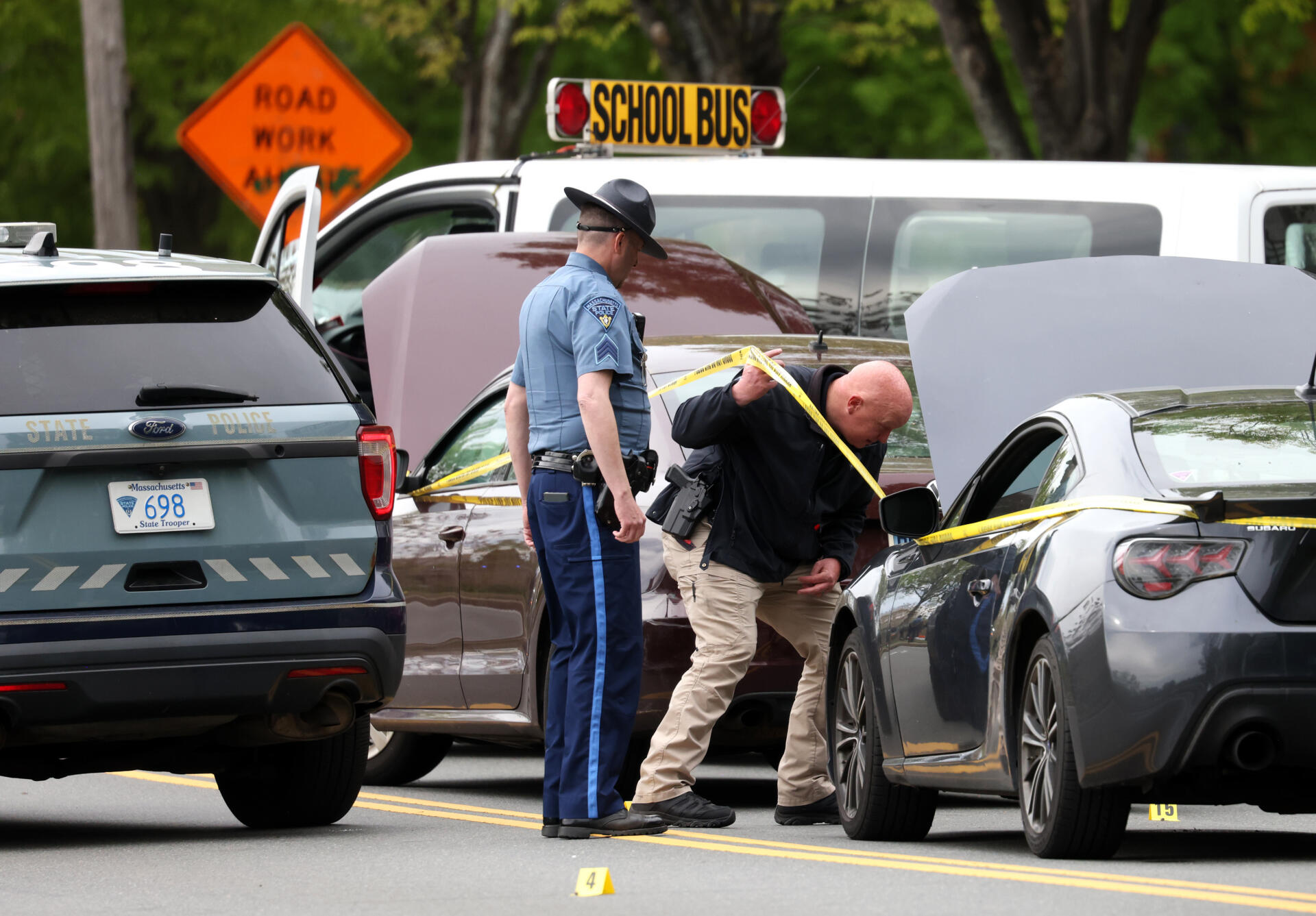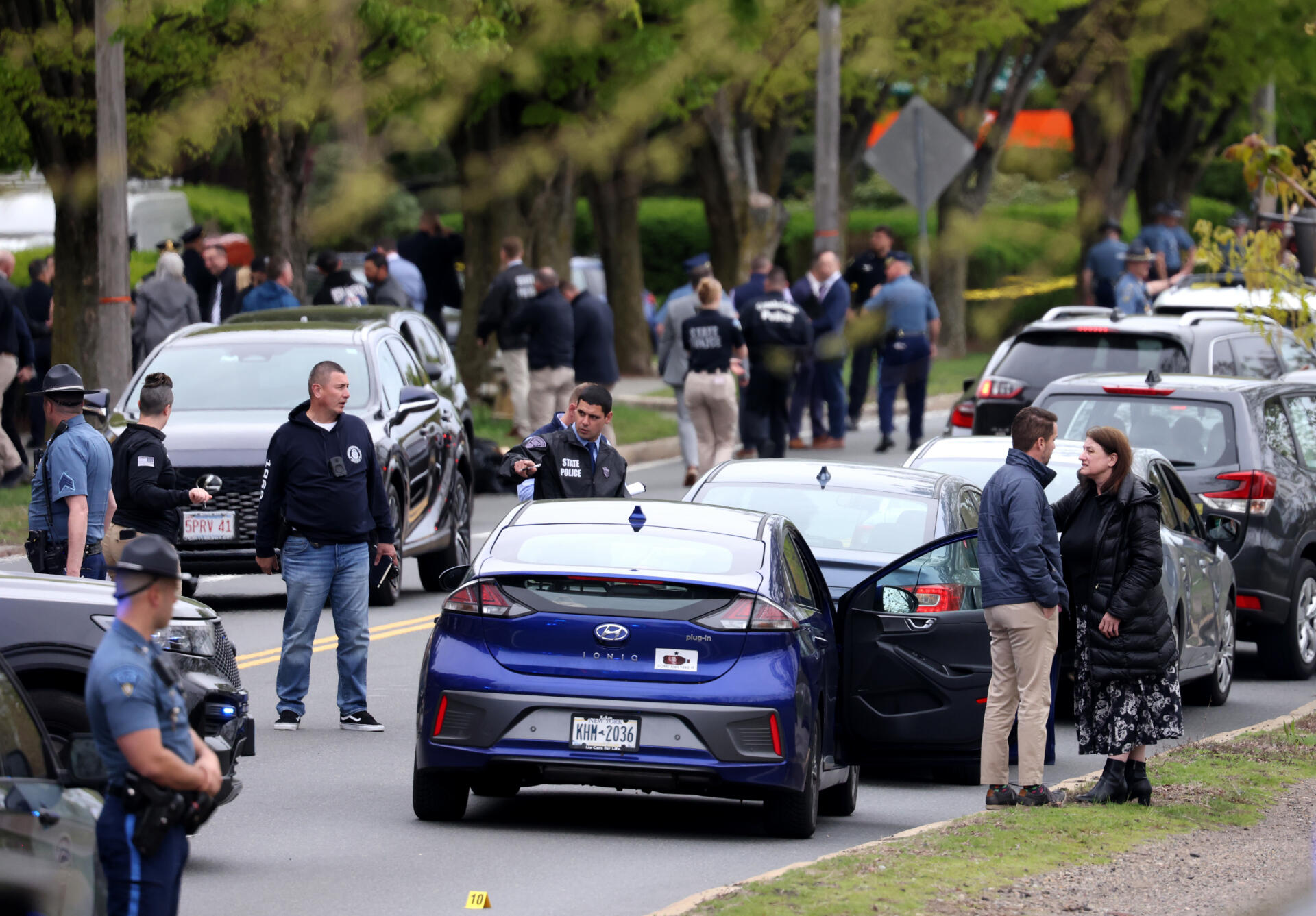
Videos of Tyler Brown allegedly slamming car windows with the butt of a rifle and spraying bullets across Memorial Drive have flooded social media this week. He looked very different at his arraignment hearing on Thursday — lying in a hospital bed.
As the case against Brown, 46, moves forward, questions persist. How did a man with his criminal history get a gun? Why was he released from a psychiatric hospital just three days before the shooting? And how did he slip through the grip of the parole system?
At the arraignment, held over Zoom, Cambridge District Court Judge David E. Frank checked to make sure Brown was alert.
“Mr. Brown, you can hear me okay?” he asked.
“He’s nodding affirmatively, your honor,” Brown’s public defender, Carolyn McGowan, responded.
Tyler Brown appeared from a hospital bed for a virtual arraignment on Thursday. (Screenshot of Zoom)
Brown never spoke during the hearing. His eyes were shut, his head propped against a pillow almost the entire session, as McGowan explained Brown was on medication. She informed the court that Brown was pleading not guilty to charges of armed assault and intent to murder. The judge ordered Brown to be held in custody, at the hospital or in jail, until his next court date in a week.
Over the past several days, prosecutors sketched out some key details about Brown and his history. They said he’d been treated in the past for depression, anxiety and post-traumatic stress. He has a long history of violence, encounters with law enforcement and time behind bars. Most recently, he was out on parole after five years in prison for shooting at police officers.
And on Monday, about an hour before Brown allegedly fired 70 rounds from a semi-automatic rifle seriously injuring two people near the Charles River, he called his parole officer — apparently high on drugs, brandishing a gun and making serious threats.
“These people are gonna f—ing pay,” he said, without saying who he meant. He also talked about harming himself, according to state police records.
But just weeks before Brown was at the center of a terrifying scene, he was living at “Brie’s House,” a 12-room triple decker for formerly incarcerated people.
One resident who asked to go by his nickname “A,” for fear of angering parole officers, said he didn’t know Brown well, but would see him around, though not in the past few weeks.
“We used to hear him making music,” he said. “I used to hear him playing the keyboard.”
A said there were rumors Brown was using drugs again, and that’s not allowed at the house. The owner of Brie’s House did not answer questions about Brown. Nor did a spokesperson for the Massachusetts Parole Board.
There were other apparent signs that Brown was not faring well in the days and weeks before the shootings. Stacey Borden, executive director of New Beginnings Reentry Services and a friend of Brown’s family, said she talked to him a week ago.
“ He said he just couldn’t — his living condition wasn’t good. He just wasn’t able to manage things with parole on his back,” she said. “And in his head, he kept seeing police and he was determined to not go back to jail.”
She said he told her in a phone conversation that he needed professional help and they talked through a complicated and ever-pressing question: “Why does it take so long for someone to get a mental health provider?”
Brown was at McLean psychiatric hospital for some period recently. He was released three days before the shootings, according to a state police report.
Middlesex District Attorney Marian Ryan said Brown’s record of instability and violence date back as far as 1994, when he was convicted of armed robbery in Michigan. He faced drug charges in New Hampshire in 2007 and in 2014 was convicted for assault and battery with a knife.
Most recently, Brown was sentenced in 2021 to five to six years in prison for shooting at Boston police officers in the South End.
“ Mr. Tyler Brown could care less if innocent people get hurt, and he showed everyone that day by firing approximately seventeen rounds indiscriminately at 2:13 p.m. on a Saturday afternoon,” an officer testified at the 2021 sentencing. “I’m a firm believer that [if] Mr. Tyler Brown gets out, he will hurt, or worse, kill someone.”
Prosecutors pushed for a 10 to 12 year sentence in that case. But Suffolk Superior Court Judge Janet Sanders rejected their recommendation, based on a few factors.
One of those: Brown had a previous conviction dismissed due to a drug-lab scandal that opened the door to thousands of cases being overturned. That cut down a longer mandatory sentence he would have faced. The judge also seemed swayed by Brown’s testimony in court, according to a recording of the sentencing reviewed by WBUR.
“ I did get a GED,” he told the judge when she asked about his educational background. “I got some college credits. I did a couple of semesters in college.”
Sanders asked about medication Brown was on and praised him for getting treatment. And she read from his letters of support.
According to two letters dated January and November 2020, Boston City Hall staffers helped Brown develop a post-release plan that included employment and housing.
“So far, Mr. Brown has sought assistance with our partners at the Urban League, Community Works Servings, and he is looking into the construction apprenticeship program with Madison Park,” wrote Kevin Sibley, then executive director of the Mayor’s Office of Returning Citizens. “We believe that if Tyler is provided with the reliable opportunities for personal growth, he will be a valuable, contributing member of our community.”
Then, Judge Sanders acknowledged she was taking a big chance.
“I can’t look into a crystal ball and figure out what’s going to happen once you get out. But I do understand that I am taking a risk here,” Sanders said that day in court. “And I just pray that my intuitions are right and that you have the ability, the smarts, the will, the support not to go out there and endanger other people’s lives as you have in the past.”
Recently, at the Brie House, A said he’s frustrated that Brown wasn’t locked up at the time of Monday’s shooting, if he was indeed back on drugs. And he worries other incarcerated people seeking parole will now be punished.
“They bundle us all together,” he said. “For his mistake, I’m going to have to pay.”
Others in the house are fearful, too, A said.
“The kid upstairs who works every day, just came home [from prison] after 30 years, got right, got a job, got his license, got a car,” he said, “he’s worried now.”
Phil Kassel, executive director of the Mental Health Legal Advisors Committee in Quincy, which advocates for poor people with mental health issues, said the fears of A and others like him are justified.
“The thing that worries me the most is the reaction to these kinds of incidents, which are typically overreactions,” Kassel said. “It’s complicated and, you know, we’re all very upset and we’re looking for some quick fix. But there just isn’t one.”
A lot of people were terrified in the wake of Brown’s alleged rampage in Cambridge. One of the shooting victims remains in the hospital with four gunshot wounds to the leg; the other was shot in the back of the head, according to prosecutors. He’s since been released.
Brown is a man who’s had many chances. His next time before a judge comes this Thursday, for a dangerousness hearing to decide whether he gets bail.
“ I could feel sorry for him too,” A said. “But I’m also going to hold him responsible.”