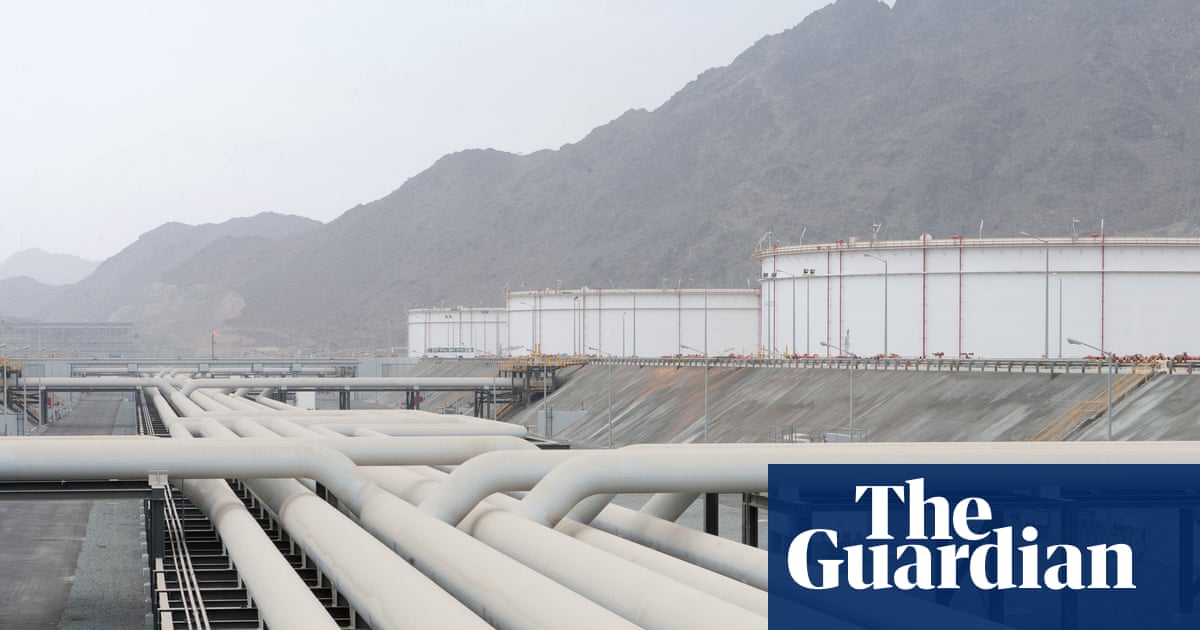
The United Arab Emirates has announced it will complete a new oil pipeline bypassing the strait of Hormuz by next year to secure its future crude exports against the threat of disruption.
The current blockade of the vital waterway, through which 20% of oil and seaborne gas flowed before the Iran war, is approaching the 11-week mark, sending energy prices soaring around the world and throttling Gulf economies.
Sheikh Khaled bin Mohamed bin Zayed Al Nahyan, Abu Dhabi’s crown prince, has directed the UAE state oil company to fast-track the previously undisclosed project so that the pipeline can begin carrying oil from the emirates to the port of Fujairah by 2027.
The new pipeline is expected to double the UAE’s export capacity via the existing Habshan-Fujairah pipeline which can carry up to 1.8m barrels a day to the port on the Gulf of Oman.
This pipeline has proved crucial to the UAE in continuing oil exports since Iran blocked tankers passing through the strait of Hormuz shortly after the US and Israel launched attacks on 28 February.
The UAE and Saudi Arabia are the only Gulf producers with pipelines that export crude outside the narrow waterway running between Iranian and Omani territory.
The decision to fast-track a second pipeline comes just weeks after the UAE quit Opec after 60 years of membership in a clear sign of a schism with Saudi Arabia, the group’s de facto leader.
map
Leaving the oil cartel was expected to allow the UAE, the group’s third-largest oil producer, to pump more oil than the group’s future production quotas may allow once the conflict ends and normal trade through the strait of Hormuz resumes.
But a new pipeline means the UAE could pursue its plan to ramp up oil exports even if the conflict continues for longer than expected, or an eventual peace plan stops short of allowing a free flow of tankers through the waterway to return to pre-crisis levels.
The UAE’s departure has laid bare the long-running tensions between Abu Dhabi and Riyadh, with the Saudis normally favouring strict production quotas to keep oil prices high enough to support their economic agenda.
The exact capacity of the new pipeline has not been disclosed but doubling its existing capacity to 3.6m barrels a day would bring the UAE’s pipeline exports closer to that of Saudi Arabia, which can transport roughly 7m barrels a day from its eastern oilfields to the Red Sea port of Yanbu, of which 5m barrels are exported.