When US Energy Secretary Chris Wright visited Venezuela in February, he left Miraflores with an ambitious message. After meeting Delcy Rodríguez in Miraflores, he told reporters: “This year, we can drive a dramatic increase in Venezuelan oil production, in Venezuelan natural gas production and Venezuelan electricity production.”
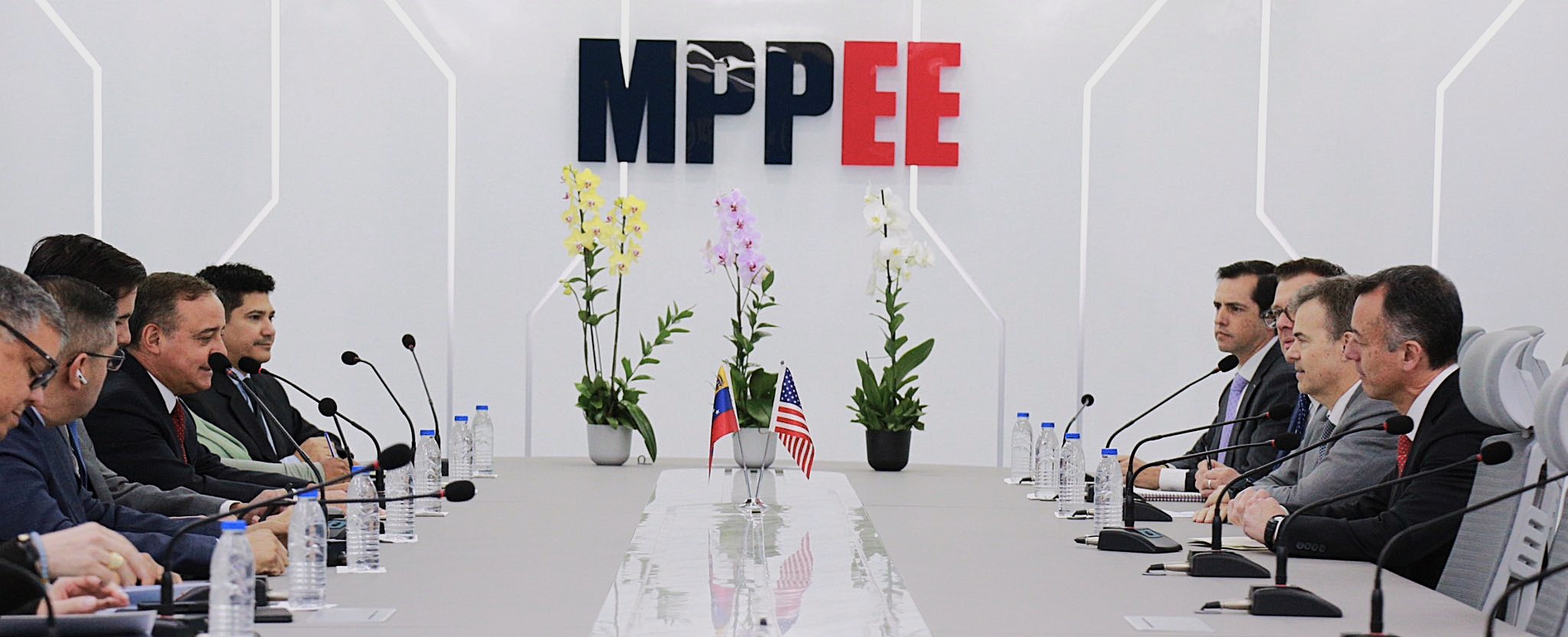
Three months later, large parts of the country are enduring heavy electricity rationing, with daily cuts lasting between five and eight hours. Even after the government imposed a 45-day electricity-saving plan in late March to cope with high temperatures and surging demand, the situation continues to deteriorate. As the system faces renewed strain, the US Embassy in Caracas publicized a meeting with Ronald Alcalá, Delcy’s new electric energy minister, where US Chief of Mission John Barrett said Washington will “work with the interim authorities to rebuild the power grid.”
“The three-phase plan of President Trump and Secretary Rubio focuses on restoring reliable energy supply through experience, investment, and collaboration with the US,” Barrett’s brief statement read.
Caracas has resorted to nationwide measures like banning cryptocurrency mining, as power consumption recently reached its highest levels in nearly a decade. El Pitazo reported that current nationwide rationing has exceeded those seen in 2012 across much of the country, with Caracas remaining the main exception.
The latest chapter of this long-running crisis arrives at a sensitive moment for the post-Maduro regime. As has been widely reported, Rodríguez is trying to boost some parts of the economy and attract foreign investment into oil, gas and mining. But the country’s electrical system—weakened by decades of underinvestment, mismanagement and institutional collapse—has re-emerged as an obstacle.
For Luisa Palacios, a Venezuelan professor and energy executive that served as CITGO’s chairwoman, the current blackout cycle reveals something deeper than previous ones.
“This new episode should serve as a wake-up call about the urgency of restructuring the country’s electrical system,” she says. “We are witnessing a stress test of the system even under a modest recovery in demand.
One huge challenge is to bring back investment and expertise required, Palacios wrote in February along with Francisco Morandi, an AES Corporation executive who did strategic planning for Electricidad de Caracas. However, some major companies are hesitating to join after meetings with officials last month, Reuters reported. One executive shared his view: “I returned very skeptical from Venezuela (…) The power plants have not been properly repaired in 10 years, so the needs are almost infinite. But they still have no clue on how we would get paid.”
“The electricity sector is a highly capital-intensive sector that requires large investments to be made before a single cent of profit is seen,” Palacios told Caracas Chronicles. “That is why counterparty risk is fundamental in the electricity sector: ensuring that the user pays you, and on time, is essential.”
The most immediate problem is straightforward. Except for Haiti, Venezuela is the only country in the region where power consumption has actually declined over the past decade, according to OLADE, with per capita consumption falling by roughly 30% since 2014. Nevertheless, the country still does not generate enough electricity to meet demand.
Palacios was firm in the idea that it is necessary to move beyond the State’s central role in power generation, which can’t afford the necessary investments, and that the time to do so is now.
“Without increasing power generation offered significantly by the private sector and improving transmission and distribution, the country won’t recover from the structural electric crisis that today remains the main bottleneck in terms of infrastructure”.
One of the central proposals advanced by Palacios and other energy experts is to restore thermal generation using Venezuela’s own natural gas resources. Large volumes of gas currently burned or flared during oil production could instead feed thermal plants and combined-cycle gas turbine (CCGT) facilities, systems that generate electricity more efficiently by combining gas and steam turbines. Such a shift would not only reduce pressure on the hydroelectric system but also lower emissions associated with gas flaring.
“This could be the single biggest climate action Venezuela could take in the short term,” Palacios argues.
Other proposals involve allowing independent power producers to generate electricity for specific industrial regions and oil hubs, reducing pressure on the fragile national grid. She has also suggested the creation of autonomous microgrids operating in “island mode” (localized systems capable of functioning independently when the national grid fails) to provide more reliable service to critical industrial, commercial, and residential areas. Battery storage systems could also help stabilize electricity supply.
Renewable energy is also part of the conversation. Venezuela relies on largely clean, hydroelectric energy, but Palacios sees potential for solar, wind and biofuel projects. Other oil-producing neighbors like Brazil, Colombia and Argentina serve as prime examples in that sense.
The challenge is not just technical. Broadly speaking, there is agreement among specialists about what Venezuela’s electrical system needs, and what requires fixing: new thermal generation, modernization of transmission infrastructure, decentralized generation capacity, tariff reform, and a new regulatory framework capable of attracting investment. The financing problem is huge: rebuilding Venezuela’s grid would require enormous amounts of long-term capital. Gelvis Sequera, who chairs the domestic Association of Electrical and Mechanical Engineers, places the required investment at around $20 billion.
“The electricity sector is a highly capital-intensive sector that requires large investments to be made before a single cent of profit is seen,” Palacios told Caracas Chronicles. “That is why counterparty risk is fundamental in the electricity sector: ensuring that the user pays you, and on time, is essential.”
But many investors remain cautious. According to Reuters, several companies that recently held meetings with Venezuelan officials left unconvinced about the prospects of doing business. One executive summarized the dilemma bluntly: “The power plants have not been properly repaired in 10 years, so the needs are almost infinite. But they still have no clue how we would get paid.”
The vicious cycle of regional power cuts affecting refineries and fuel production, and therefore also undermining the power sector, needs a major overhaul to finally be brought to an end.
When considering whether to deploy capital in Venezuela, investors are less confused about the needs and more about the ifs. They are uncertain about whether the Venezuelan State can offer credible guarantees, stable regulation, enforceable contracts, and reliable payment mechanisms over the long term.
As Palacios put it: “Power infrastructure is a low-margin business, established for the long term and highly dependent on regulatory and macroeconomic risks.” For that reason, she argues that regulatory clarity, transparent tariffs, and technically competent institutions are indispensable if Venezuela hopes to attract serious capital into the sector.
This also raises uncomfortable political questions about the future role of CORPOELEC, the omnipotent overseer of Venezuelan electricity. Founded by Hugo Chávez in 2007, the public company serves as the power grid’s service provider, operator and developer.
“Venezuela needs to seriously rethink the role of CORPOELEC and the State in providing such a fundamental service,” Palacios says. “It is not possible to solve this crisis with the current management structure.” At the moment, however, there are few signs that such reforms are imminent.
“To build and rebuild a reliable system will depend on having the right actors on the table”, she continues, pointing out that multilateral organizations can provide technical capacity and long-term financing that can “de-risk investment”, giving some assurances to the private sector.
“There’s a lot of Venezuelan entrepreneurship more than willing to invest in a system with clear rules based on international standards”.
For now, as hopes of an economic recovery reach their highest levels since the Chávez era, Venezuelans long accustomed to blackouts are desperate to avoid a repeat of the worst 2019-esque scenarios. The contradiction is also acute for Delcy Rodríguez, whose critical infrastructure problem is one of the most immediate constraints on the reopening she is attempting. The vicious cycle of regional power cuts affecting refineries and fuel production, and therefore also undermining the power sector, needs a major overhaul to finally be brought to an end.