Your support helps us to tell the story
From reproductive rights to climate change to Big Tech, The Independent is on the ground when the story is developing. Whether it’s investigating the financials of Elon Musk’s pro-Trump PAC or producing our latest documentary, ‘The A Word’, which shines a light on the American women fighting for reproductive rights, we know how important it is to parse out the facts from the messaging.
At such a critical moment in US history, we need reporters on the ground. Your donation allows us to keep sending journalists to speak to both sides of the story.
The Independent is trusted by Americans across the entire political spectrum. And unlike many other quality news outlets, we choose not to lock Americans out of our reporting and analysis with paywalls. We believe quality journalism should be available to everyone, paid for by those who can afford it.
Your support makes all the difference.Read more
A new Ebola outbreak has been confirmed in Congo’s remote Ituri province, with 246 suspected cases and 65 deaths reported so far.
The Africa Centers for Disease Control and Prevention, the continent’s leading public health body, made the announcement on Friday.
The majority of the fatalities and suspected cases have been recorded in the Mongwalu and Rwampara health zones, according to a statement from the Africa CDC.
The agency added: “Four deaths have been reported among laboratory-confirmed cases. Suspected cases have also been reported in Bunia, pending confirmation.”
The Ebola virus is highly contagious and can be contracted through bodily fluids such as vomit, blood, urine, or semen. The disease it causes is rare but severe, and often fatal.
This latest outbreak emerges just five months after Congo’s previous Ebola epidemic was declared over, following 43 deaths.
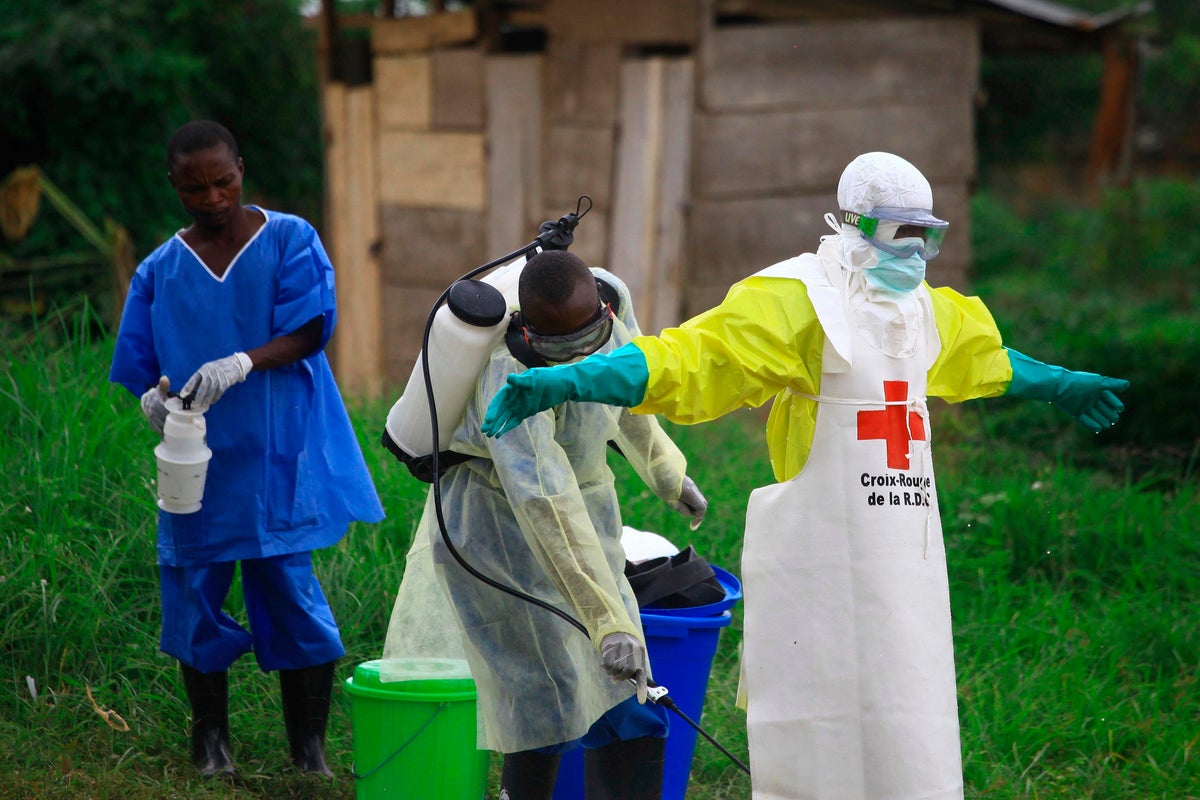
A health worker sprays disinfectant on his colleague after working at an Ebola treatment center in Beni, eastern Congo (AP)
The new outbreak is the country’s 17th since the disease first emerged in the Congo in 1976. An Ebola outbreak from 2018 to 2020 in eastern Congo killed more than 1,000 people.
Ituri is in a remote part of Congo characterised by poor road networks. It is more than 1,000 kilometres (620 miles) from the nation’s capital of Kinshasa.
The new outbreak will create more worry for the Central African country, which has been battling various armed groups in the east, including the M23 rebel group, which launched a rapid assault in January 2025 and has since occupied key cities.
Ituri in particular is also battling violence from the Islamic State-linked Allied Democratic Force militant group which has killed dozens there and in other parts of the east.
Congo, Africa’s second-largest country by land area, often faces logistical challenges in responding to disease outbreaks. During the 2025 outbreak, which lasted three months, the World Health Organization initially faced significant challenges in delivering vaccines due to limited access and scarce funds.
A colourised transmission electron micrograph file image made available by the Centers for Disease Control and Prevention (CDC) shows an Ebola virus virion (AP)
Ebola symptoms
According to the NHS, Ebola symptoms can start between two and 21 days after being infected.
They can appear suddenly and include flu-like symptoms, such as a high temperature, extreme tiredness and a headache.
Other symptoms include:
- being sick
- diarrhoea and stomach pain
- a skin rash
- yellowing of the skin and eyes
- blood in the faeces
- lots of bruises all over the body
- bleeding from the ears, eyes, nose or mouth
- muscle pain
- sore throat
- blood in vomit or faeces
- bleeding from nose, gums or vagina.
Ebola patients are treated in isolation in hospital and given specialist care in an ICU.