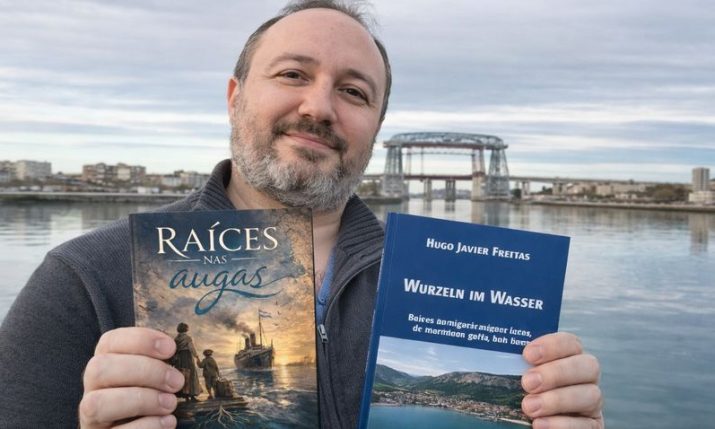
Hugo Javier Freitas (Photo: Private album)
For many years, the name Marko Grandić survived in my family only as a distant echo. A surname altered by time, fragmented stories, silences, lost photographs, and the persistent feeling that something important had remained buried across generations.
I was born and raised in Buenos Aires. I am a historian and a History teacher. For years I worked with documents, archives and migration processes, but I never imagined that a personal investigation would eventually lead me to a small town on the Adriatic coast: Baška, on the island of Krk.
It was there that my great-great-grandfather, Marko Ilario Grandić, had been born on April 18, 1871.
The confirmation arrived from Croatia after a long documentary search.
The parish priest of Baška, Ivan Milovčić, sent me images of Marko’s baptismal record together with family documents that allowed me to reconstruct an entire forgotten branch of the family. Suddenly, names, dates and places that had remained almost erased for generations began to recover life.
I understood then that this was not only a family story. It formed part of a much broader phenomenon: the story of thousands of Croatians who, between the late nineteenth and early twentieth centuries, left the Adriatic coast and crossed the Atlantic toward the Río de la Plata.
Marko was one of them.
He had been born in an austere Baška, still under the Austro-Hungarian Empire, into a humble family marked by work, hardship and the early death of his father.
(Photo: Private album)
Like many young Dalmatians of his generation, he grew up in a world with few opportunities, where emigration gradually appeared as the only possible path.
Toward the end of the 1880s, he departed from the Adriatic toward America. He most likely traveled first to Trieste and later to Genoa, where he boarded a ship bound for the Río de la Plata.
He arrived in Buenos Aires in 1890, during the great immigration era, when the city was rapidly expanding among ports, tenements and major infrastructure works.
Later, he crossed to Uruguay and eventually settled in Las Conchillas, a small workers’ settlement connected with quarries and port construction projects in the Río de la Plata region. There he formed a family and began a new life far away from the island where he had been born.
But emigrating did not simply mean changing countries.
(Photo: Private album)
It also meant carrying absences, silences and a nostalgia difficult to explain. Through my research I came to understand that Croatian emigration to South America was not only an economic or demographic process: it was also a deeply emotional experience, shaped by distance, loss and the constant reconstruction of identity.
That is precisely what my book Roots in the Waters (Korijeni u vodama / Raíces en las aguas) seeks to explore.
The book reconstructs migration stories between Croatia, Galicia, Argentina and Uruguay through civil and parish records, historical archives and family memory.
But it also attempts to narrate what often remains outside official documents: fears, family bonds, departures, letters and the emotional echoes that continue across generations.
(Photo: Private album)
Today, more than a century after that departure from Baška, I still feel that an invisible bridge exists between the Adriatic and the Río de la Plata.
And perhaps that is one of the most extraordinary aspects of migration: even after generations, seas and distances never completely break the connection with the place of origin.
Roots in the Waters has already been published in Galicia (Spain) and Germany, and part of the research related to the Croatian branch of the family has also recently appeared in media outlets from Rijeka.
In some way, the story has finally returned to the place where it began.
(Photo: Private album)
By Hugo Javier Freitas