- by croatiaweek
- May 14, 2026
-
in
News
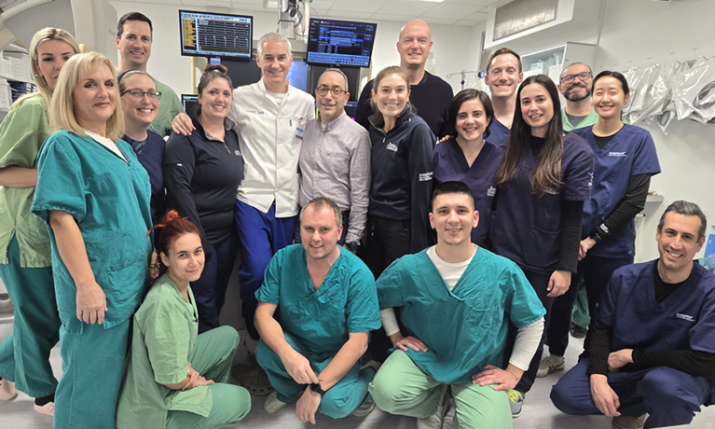
Team at KBC Split (Photo: KBC Split)
Clinical Hospital Center Split (KBC Split) has achieved major international recognition after the AVANTGUARD clinical study led by cardiologist Dr Ante Anić was published in the The New England Journal of Medicine.
The journal is considered one of the world’s most influential medical publications, with research published there often shaping modern clinical practice and future treatment guidelines.
The AVANTGUARD study was also recently presented at the world’s largest conference dedicated to heart rhythm disorders, held in Chicago.
The study examined the effectiveness of early treatment of atrial fibrillation using catheter ablation with Farapulse technology, following a treatment approach developed at KBC Split and internationally recognised as the “Split Protocol”.
According to Dr Anić, atrial fibrillation is the most common heart rhythm disorder today and is becoming increasingly common due to ageing populations and modern lifestyles.
The study compared two treatment strategies for patients with persistent atrial fibrillation.
One group received standard treatment with medication and electrical cardioversion, while the second group underwent early catheter ablation using Farapulse technology immediately after diagnosis.
Results showed that early ablation was twice as effective as conventional drug treatment. After one year of monitoring, a significantly higher number of patients treated with early ablation remained free from arrhythmia compared to those receiving standard medication therapy.
Researchers highlighted the importance of the findings because persistent atrial fibrillation is considered more difficult to treat and can lead to serious symptoms, including heart failure.
A key aspect of the study was the use of an ablation technique developed in the electrophysiology laboratory at KBC Split, leading to international recognition of the “Split Protocol”.
The AVANTGUARD study was co-developed by Dr Anić and Oussama Wazni, head of electrophysiology at Cleveland Clinic. Their collaboration dates back to Dr Anić’s training in Cleveland in 2008.
KBC Split was among the first centres in the world to use and develop Farapulse technology before it became widely available.
Professor Wazni later visited Split and participated in the work of the local team, while other international centres involved in the AVANTGUARD study adopted the protocol developed in Split.
Farapulse technology represents a newer generation of ablation treatment. Unlike older methods that use heat or cold, the procedure uses pulsed electric fields, known as pulsed field ablation (PFA).
Dr Ante Anić (Photo: KBC Split)
KBC Split was one of only three global centres involved in the early development phase of the technology between 2018 and 2020. The method entered standard clinical practice in 2021.
According to the hospital, more than 1,500 procedures using the technology have now been performed in Split, including more than 500 last year alone. The hospital says procedure numbers continue to rise as teams work in two shifts to reduce waiting lists.
Doctors also highlighted the strong safety profile of the treatment, with most patients returning home the day after the procedure and complication rates remaining very low.
The international recognition of the AVANTGUARD study and the Split Protocol is being seen as a major achievement for KBC Split, Croatian cardiology and Croatian medicine more broadly.
Hospital officials say the success demonstrates that globally recognised medical innovation can also emerge from Croatia through expertise, teamwork and continued investment in modern treatment methods.