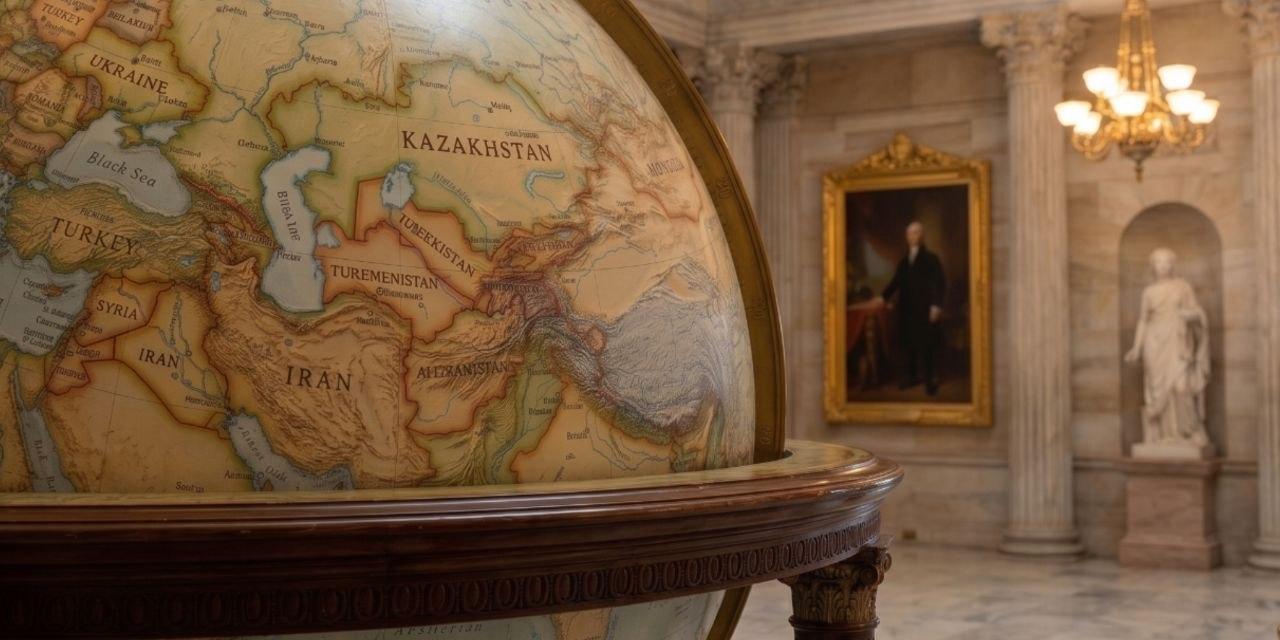
Washington cannot decide where Central Asia belongs. Is it part of Europe? Asia? The Middle East? The confusion is on full display in how the House of Representatives has reassigned the region across subcommittees in rapid succession.
In the 116th Congress, which convened in 2019, Central Asia fell under the Subcommittee on Europe, Eurasia, Energy and the Environment. Two years later, in the 117th Congress, it was moved to the Subcommittee on Asia, the Pacific, Central Asia and Nonproliferation. That arrangement barely settled before the 118th Congress shifted it again—this time to the Subcommittee on the Middle East, North Africa, and Central Asia. Now, in the 119th Congress, it has been relocated to the Subcommittee on South and Central Asia.
On the banks of the Potomac, Central Asia has taken on a nomadic life of its own—constantly on the move, never quite settling in one place.
At the State Department, Central Asia is grouped under the Bureau of South and Central Asian Affairs alongside Afghanistan, India, Pakistan, and Sri Lanka. At the Pentagon, by contrast, the Middle East team oversees relations with Central Asia, alongside countries like Israel, Saudi Arabia, Iran, and Pakistan.
These mismatches are not just clumsy; they are strategically dangerous. By misplacing Central Asia, Washington is misreading the geography of China’s rise.
It is time for Washington to stop the bureaucratic musical chairs and place Central Asia within a coherent grand strategy. Far from being an afterthought, the region is one of the most consequential pieces of the geopolitical puzzle facing the United States: how to respond to China’s strategy.
This is because Central Asia sits at the heart of China’s decades-long effort to move its critical lifelines away from the Indo-Pacific and onto the Eurasian landmass.
Over the past 15 years, China has quietly reoriented its energy routes, reducing reliance on maritime pathways vulnerable to U.S. naval dominance—particularly chokepoints such as the Strait of Hormuz and the Strait of Malacca—and expanded overland imports across Eurasia.
Today, China imports significant volumes of natural gas via pipelines from Turkmenistan and Russia, as well as crude oil from Kazakhstan. These continental routes are largely insulated from maritime interdiction, giving Beijing strategic resilience.
Central Asia should be understood through this lens. For China, the region is not peripheral—it is essential. The pipelines, railways and trade corridors that underpin China’s resilience all pass through Xinjiang and Central Asia. In this sense, Central Asia is not merely adjacent to China; it is embedded in China’s vision of the future.
This is why Washington’s practice of grouping Central Asia with South Asia misses the mark. The two regions operate under fundamentally different strategic logics. South Asia is centered on the Indian subcontinent, shaped by maritime dynamics and the India‑Pakistan rivalry. Central Asia, by contrast, is a continental crossroads—defined by overland connectivity, energy flows and great‑power competition across Eurasia.
India, meanwhile, is geographically constrained—lacking direct land access to Central Asia due to territory administered by Pakistan and separated from China by the Himalayas—leaving it peripheral to Beijing’s continental strategy.
Treating these regions as a single unit blurs critical distinctions and complicates the formulation of a strategy for one of the most important arenas of geopolitical competition.
If Washington is searching for a more coherent framework, it should consider a broader conceptual map—what might be called a “Greater Asia.” This would span the Eurasian landmass from Turkey to Japan, echoing the logic of the ancient Silk Road. Within this framework, Central Asia is not marginal—it is pivotal.
In the same context, the U.S. government should also rethink how it organizes expertise on China itself. Much of Washington’s China-focused policymaking remains concentrated among East Asia specialists. A deeper understanding of China’s westward push – often described as “marching West” – and the strategic logic of the Belt and Road Initiative would lead to more accurate prescriptions. This would do more than tidy up bureaucratic inconsistencies; it would align U.S. policymaking with geopolitical realities.
China already treats Central Asia as crucial to its westward strategy. Russia, despite its diminished influence, still views the region as part of its near abroad. If the United States persists with fragmented and outdated regional definitions, it risks becoming the great power without a coherent strategic approach.
Reorganizing government bureaus may seem like a technical fix, but it is also a signal of priority. A framework that places Central Asia within a broader Eurasian and China-focused strategy would demonstrate that Washington understands the region not as an appendage of somewhere else, but as a central piece of the strategic landscape.
More than a century ago, British geographer Halford Mackinder warned that control of the Eurasian “Heartland” would shape global power. Central Asia lies at the core of that insight. China understands this geography instinctively and is acting on it. It is time for Washington to do so, too.
The views expressed in this article are those of the author and do not necessarily reflect the official policy or position of the publication, its affiliates, or any other organizations mentioned.