Orhan Sait Berber – Geneva
Press freedom experts and a UN special rapporteur have warned that authoritarian governments continue to misuse INTERPOL mechanisms to target journalists living in exile, despite reforms aimed at preventing politically motivated cases.
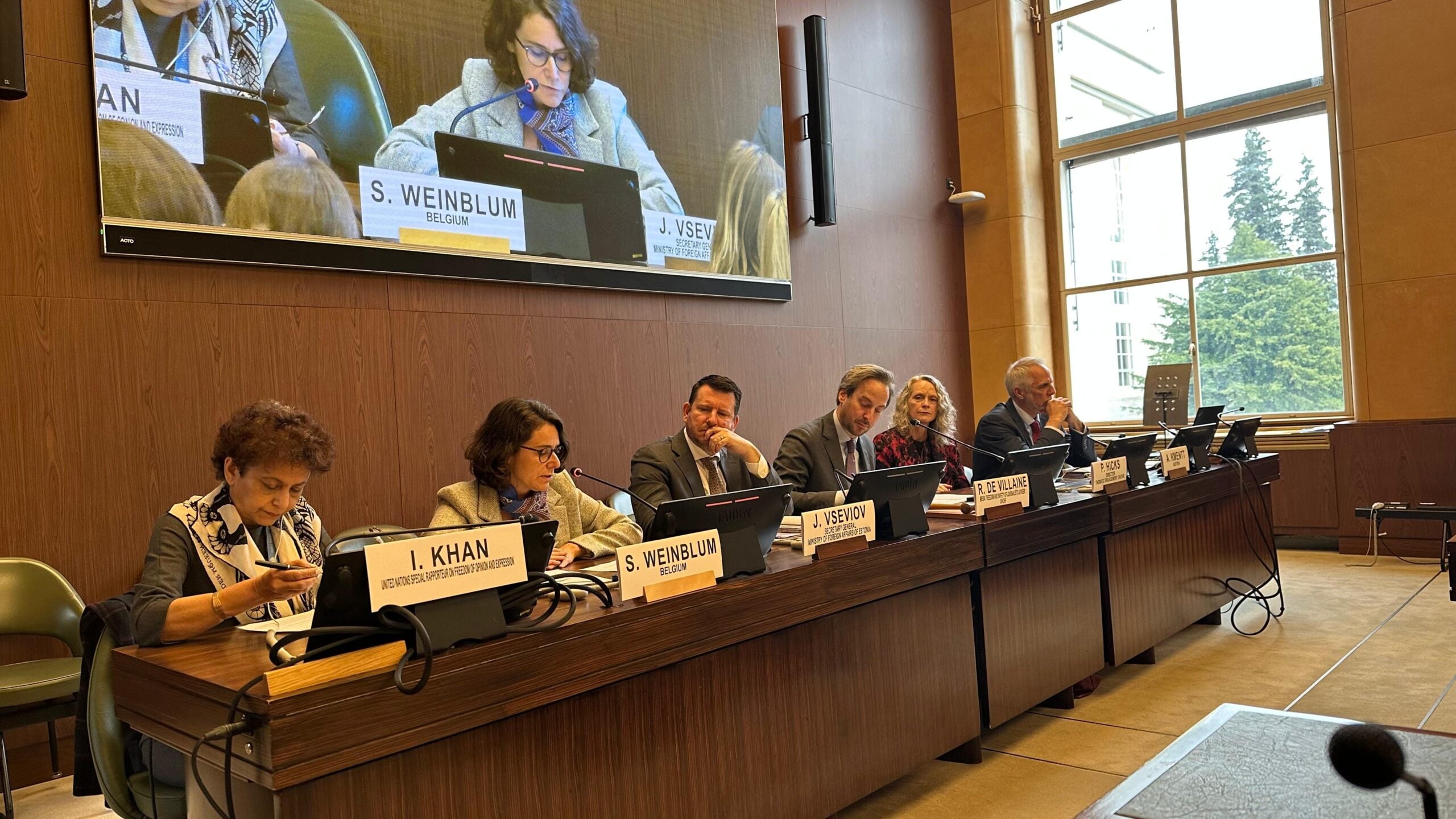
The remarks came during a series of interviews with Turkish Minute on Tuesday at the United Nations Office in Geneva, where a panel discussion examined transnational repression and the gaps in protection facing journalists forced to flee their home countries.
Participants said authoritarian governments were increasingly extending pressure beyond their borders, targeting dissident journalists even after they were granted asylum abroad.
Several speakers pointed to alleged abuses of INTERPOL mechanisms, particularly Red Notices and travel document alerts, which they said can severely restrict journalists’ movement and daily lives.
“One of the problems is that journalists often don’t even know there is a Red Notice against them,” said Fiona O’Brien from the Committee to Protect Journalists (CPJ), noting that such measures can affect travel, employment and family life even when requests are politically motivated.
Irene Khan, the UN special rapporteur on freedom of opinion and expression, said loopholes still remain in international mechanisms designed to protect journalists living in exile, despite reforms introduced in recent years by INTERPOL.
“We have been in touch with INTERPOL, and they have tightened some of their rules, but there are still loopholes that need to be addressed,” Khan said, stressing that host countries also have a responsibility to resist politically motivated requests targeting journalists in exile.
Can Yeğinsu, a member of the High Level Panel of Legal Experts on Media Freedom, an independent advisory body of the Media Freedom Coalition, said transparency remained the key structural issue within INTERPOL.
“Civil society and states have to review the transparency obligations within the INTERPOL framework,” Yeğinsu told Turkish Minute, arguing that individuals must have greater opportunities to challenge notices and accusations made against them.
Emily Foale from the International Bar Association’s Human Rights Institute said there were still insufficient safeguards protecting journalists and human rights defenders targeted through INTERPOL systems.
Foale said countries granting refuge to journalists should independently assess politically sensitive Red Notices and strengthen cooperation with international organizations to prevent abuse of such mechanisms.
Participants stressed that responsibility lies not only with INTERPOL but also with democratic host countries that grant asylum to persecuted journalists. Governments hosting exiled reporters, they said, must resist politically driven extradition requests and provide stronger local protections.
The issue has drawn increasing scrutiny in recent years amid allegations that Turkey extensively used INTERPOL systems after a failed coup July 2016 to pursue critics and journalists abroad.
A recent investigation by Disclose reported that INTERPOL rejected hundreds of Turkish Red Notice requests deemed political in nature and removed tens of thousands of Turkish entries from its Stolen and Lost Travel Documents database after concerns over misuse.
Khan said journalists in exile remain particularly vulnerable in the digital sphere because they depend heavily on online platforms to communicate with audiences and gather information from their home countries.
“There is a huge responsibility on digital companies to make sure journalists can operate safely on these platforms,” she said, pointing to online smear campaigns, harassment and cyberattacks targeting reporters abroad.
Participants criticized major technology companies for failing to adequately protect journalists from coordinated harassment campaigns, impersonation attacks and spyware.
Foale said technology companies and social media platforms were not currently doing enough to protect journalists from digital threats and online abuse.
She referenced ongoing legal action involving NSO Group and its Pegasus spyware, which has been linked to surveillance of journalists, activists and dissidents worldwide. Pegasus became globally notorious after investigations revealed that authoritarian governments allegedly used it to infiltrate phones belonging to reporters, opposition figures and human rights defenders.
Foale also warned that social media platforms are increasingly being exploited to spread disinformation, impersonate journalists and suppress independent reporting through coordinated online attacks and manipulated copyright complaints.
“There needs to be more robust thinking from social media platforms about how their systems are being misused to target journalists,” she said.
Yeğinsu said international legal protections for journalists formally exist but often fail in practice because governments do not implement them effectively.
“The question is whether the system is operating in a practical and effective way,” he said, arguing that states remain responsible for enforcing protections guaranteed under international law.
He also pointed to emergency visa mechanisms developed for journalists facing immediate threats, saying several countries had begun implementing recommendations first proposed in 2020 by the High Level Panel of Legal Experts on Media Freedom.
Foale said transnational repression had evolved into an increasingly sophisticated system of digital and legal pressure deployed across borders.
“State institutional responses have been slow to catch up,” she said, arguing that governments, law enforcement agencies and international organizations still struggle to fully understand the complexity of modern transnational threats.
She also pointed to the 2018 killing of Saudi journalist Jamal Khashoggi inside the Saudi Consulate General in İstanbul as one of the clearest examples of transnational repression attracting global attention. Khashoggi, a columnist for The Washington Post critical of Saudi Crown Prince Mohammed bin Salman, was murdered and dismembered inside the consulate on October 2, 2018, in a killing that triggered worldwide condemnation.
Foale additionally referred to intimidation and attacks targeting journalists from outlets such as BBC Persian in London, arguing that democratic governments needed stronger protection mechanisms for media workers in exile.
Khan said European governments must strengthen protections for Turkish journalists living abroad and ensure that bilateral or commercial relations with Ankara do not override international legal obligations.
“There have been cases where the Turkish government has sought the return of journalists living in European countries or sought to harass them,” Khan said.
She added that once a journalist receives asylum abroad, that status must be fully respected.
“European countries should not allow bilateral concerns or commercial concerns with Turkey or any other state to interfere with the protection of human rights,” Khan said.
Turkey was repeatedly referenced during the interviews as a prominent example of transnational repression concerns in Europe. Speakers said many Turkish journalists who received asylum in European countries still face intimidation, harassment and security concerns abroad.
Khan also addressed the broader geopolitical dimension of the issue, saying Turkey’s political and strategic importance within NATO sometimes affects how European countries respond to pressure involving dissidents and journalists in exile.
The discussion additionally touched on financial difficulties facing independent media organizations operating in exile. Experts said many outlets depend heavily on international funding to continue reporting while countering disinformation campaigns originating from authoritarian states.
Foale said independent exile media should be viewed not only as a press freedom issue but also as part of a broader democratic security framework, particularly in relation to countries such as Russia and Belarus.
She pointed to examples of Russian independent media organizations relocating to European countries after crackdowns following Russia’s invasion of Ukraine, saying such outlets remain vital sources of uncensored information for audiences living under authoritarian governments.
Ricardo Espinosa, director of the International Alliance for Human Rights Advocacy Geneva, said transnational repression was becoming an increasingly urgent issue affecting not only journalists in exile but also their families and professional circles back home.
Espinosa said stronger international collaboration between governments, civil society groups, national human rights institutions and UN bodies would be necessary to address the growing problem more effectively.
Meanwhile, Renaud de Villaines, who moderated the Geneva discussion on transnational repression targeting journalists in exile, said events such as the panel discussion were important for raising international awareness and identifying practical ways to address the issue.
De Villaines said journalists in exile often become the human face of broader human rights violations carried out across borders and stressed the importance of solidarity with reporters forced to flee authoritarian governments.
He also pointed to narratives presented during the event by Belarusian journalists, saying their experiences reflected the increasingly global nature of transnational repression affecting media workers from countries including Belarus, Russia and Turkey.
According to de Villaines, closer cooperation between governments, civil society organizations, UN institutions and human rights groups would be essential to strengthening protections for journalists living in exile.
![[OPINION] No 'third way' in a decoupling world: How defying the ECtHR is pricing Turkey out of Europe](https://conven.org/wp-content/uploads/2026/05/OPINION-No-third-way-in-a-decoupling-world-How-defying.png)