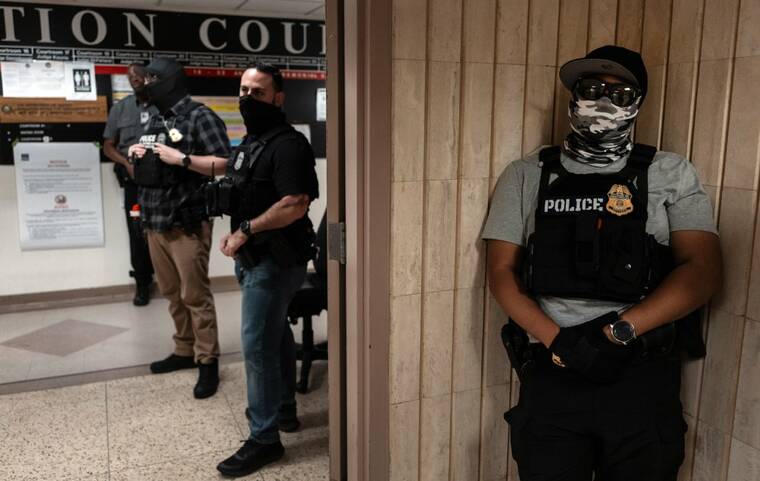
ALBANY, N.Y. >> Four months after masked federal agents shot and killed Renee Good and Alex Pretti on the streets of Minneapolis, New York leaders announced a plan to implement some of the strictest rules for immigration officials of any state in the country.
The package, which was included in the state budget deal announced today, prohibits state and local officials from entering into formal or informal cooperation agreements with Immigration and Customs Enforcement, and bars law enforcement agents from wearing masks.
The rules also prohibit ICE from using local jails to house detainees and from searching New Yorkers’ homes, hospitals, churches and schools without a warrant signed by a judge.
Gov. Kathy Hochul said today that the changes were necessary given the extent of the Trump administration’s immigration crackdown.
“They didn’t just target hardened criminals and gang members, which I would have supported — we did support,” Hochul said. “They also targeted mothers still nursing their infants, separating them; an 85-year-old widow in her nightgown.”
She said that ICE had used intimidation tactics to evade responsibility, adding, “New York will no longer stand for it.”
Don’t miss out on what’s happening!
Stay in touch with breaking news, as it happens, conveniently in your email inbox. It’s FREE!
Still, the new rules place no restrictions on unofficial communications between law enforcement and ICE, after Hochul fought hard to ensure that was the case.
Democrats expect many of the measures — including a new provision that would allow the families of those who have had their constitutional rights to life, liberty or property violated by government agents to seek retribution — to be challenged in court.
Those cases will not only set up a novel legal battle, but will also provide an opportunity for the country to see in real time what happens when states and their citizens resist the federal government’s immigration enforcement efforts.
Days before the measures were finalized, Tom Homan, President Donald Trump’s border czar, threatened to respond with force if they were approved.
“We’re going to flood the zone,” Homan said this week during a speech in Phoenix. “You’re going to see more ICE agents than you’ve ever seen before.”
Hochul pushed back on his comments today. “I don’t take well to threats,” she said. “They’re going to find that out. We’re going to pass what we think is important to protect New Yorkers.”
The package’s inclusion in the budget deal speaks to increased momentum among Democrats to counter the Trump administration’s mass deportation campaign.
It also reflects the evolution of Hochul, a moderate Democrat who first rose to national attention as a county clerk opposing a state mandate to provide driver’s licenses to immigrants without legal status.
In an interview earlier this year, Hochul said that the Trump administration’s deployment of ICE — and in particular its separation of families — threatened the value system on which the country was founded.
“I feel like it’s unraveling, and I have a moral responsibility as a human being, but also as a leader, to use my platform, my voice, to call it out and try to rectify it with every fiber in my being,” she said.
The issue was elevated by the death of Nurul Amin Shah Alam, a blind Rohingya refugee who was found dead after immigration agents left him alone outside on a cold Buffalo night. The city’s medical examiner ruled his death a homicide.
Hochul referred to Shah Alam’s death, which occurred in her hometown, when announcing the budget agreement today. “Come on, that’s not who we are,” she said. “Not as New Yorkers, not as Americans.”
Even so, several lawmakers said the package’s failure to address informal communication between police and ICE severely limited its impact.
“I don’t think any of these proposals or what we landed on would have made a difference in the Nurul Alam case, and I’m disappointed by that,” said Sen. Andrew Gounardes, a Brooklyn Democrat.
It was a long road to a deal, and the question of how much cooperation local law enforcement should have with federal agents became a sticking point.
Hochul announced early on that she would back a statewide ban on formal measures, called 287(g) agreements, that deputize local officers to help with immigration enforcement.
The proposal had for Hochul the added benefit of antagonizing her Republican opponent in the November general election, Bruce Blakeman, who, as Nassau County executive, has trumpeted his county’s work with ICE.
Blakeman defended his county’s agreement and said earlier this week that he would challenge the new law in court. “In the last year, because we were with ICE, we have not raided one school, we have not raided one church, not one hospital, not one daycare center, and we removed 2,000 illegal migrants with criminal records,” Blakeman said.
Many Democratic lawmakers had wanted a more sweeping package that would have banned all communication between state officials, including law enforcement, and the federal government.
But Hochul insisted that local police should be able to work with ICE to remove immigrants they believed were dangerous.
The issue split not only Democrats but also prosecutors and law enforcement agencies, some of whom wanted to be able to move quickly to deport people, and others who argued that New York crimes should be adjudicated in New York courts.
At one point, lawmakers were considering a complex system in which communication with ICE was allowed only with regard to certain serious crimes, and was banned in the case of less serious ones. In the end, the debate fell out of budget talks.
The new package bans 287(g) agreements and prohibits state and local employees other than law enforcement from sharing information with immigration officials.
Natalia Aristizabal, co-executive director of Make the Road New York, an immigrant advocacy group, said that the measures were a meaningful step forward that would have a material impact on thousands of New Yorkers.
Even so, she said she thought the agreement fell short, noting that it failed “to address the informal collusion between local law enforcement and ICE, which is the primary way that New Yorkers are being caught in the dragnet of the Trump administration’s violent mass deportation regime.”
Under New York’s new law, Hochul said, all state and federal officials, including ICE agents, will be prohibited from wearing masks on duty, unless there is a safety need. Federal officials have argued that agents need to be able to wear masks to protect themselves from harassment, while supporters of such bans say masks allow ICE agents to act with impunity and avoid accountability.
A similar law was passed last year in California, but was struck down by a federal judge who ruled that applying the rule only to federal officers was discriminatory. Lawmakers hope that broadening New York’s version to include more officials will give it a better chance of withstanding a legal challenge.
Another element expected to be hashed out in the courts is the private right of action for those who believe their constitutional rights have been violated by state and federal officials.
Andrea Stewart-Cousins, the majority leader of the state Senate, praised the package as a hard-won compromise that advanced individual rights while protecting public safety.
And Assembly member Tony Simone, a Manhattan Democrat, praised the package. “New York must never back down to Trump and his masked ICE thugs,” he said, adding: “This is a massive win for our constitutional rights, safety and accountability in policing.”
This article originally appeared in The New York Times.
© 2026 The New York Times Company