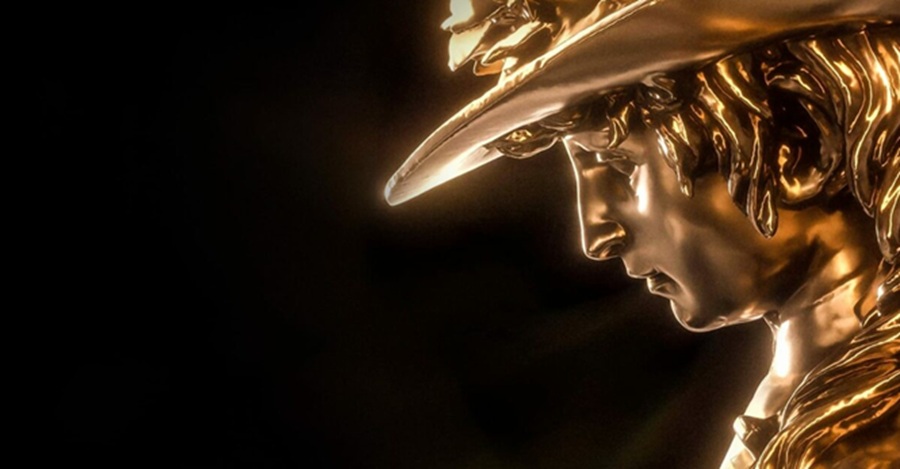
As Italy’s film industry gathers each year to honour its finest work, the prize it awards carries the name of one of the greatest sculptors in the history of Western art. Donatello was a Florentine whose mastery of the human form changed what art could be.
The David di Donatello is Italy’s foremost film prize, awarded annually by the Accademia del Cinema Italiano since 1956. Named in honour of the fifteenth-century Florentine sculptor Donatello, the award takes the form of a small reproduction of his most celebrated work — the bronze David — and is presented across categories covering the full range of cinematic achievement, from direction and performance to technical craft. It is the Italian industry’s closest equivalent to the Academy Awards, carrying equivalent prestige and serving as the principal measure of a film’s standing within Italian cinema.
Donatello’s David
Donato di Niccolò di Betto Bardi — known to history simply as Donatello — was born in Florence around 1386 and died there in 1466, having spent eight decades reshaping the possibilities of sculpture in ways that would influence every artist who came after him. He trained in the workshop of Lorenzo Ghiberti and worked alongside Brunelleschi, absorbing the lessons of classical antiquity while developing a language entirely his own.
David by Donatello
His David, cast in bronze for the Medici family, was a work without precedent in the post-classical world. It is the first known free-standing nude statue of a male figure produced since antiquity. The young shepherd stands in relaxed contrapposto, one foot resting on the severed head of Goliath, a broad-brimmed hat on his head and an expression of serene, almost indifferent calm on his face. The work is held today in the Bargello museum in Florence, where it has been since 1865.
What makes the David so remarkable is not simply its technical accomplishment, though the casting is extraordinary, but the quality of psychological presence Donatello brings to the figure. The boy who has killed a giant does not exult. He simply is. That stillness, that inwardness, is the hallmark of Donatello’s mature work.
Beyond the David
Donatello’s influence extended far beyond a single statue. His St George, carved for the guild of armourers at Orsanmichele in Florence around 1415-17, introduced a new conception of the heroic figure in Italian sculpture. His equestrian statue of the Venetian condottiere Gattamelata in Padua drew directly on classical Roman precedents while achieving something new in its psychological intensity. Donatello’s late works, including the wooden Penitent Magdalene now in the Museo dell’Opera del Duomo in Florence, push toward an expressionism that anticipates Baroque art by more than a century.
The Penitent Magdalene by Donatello Image credit: Sarah Cater of Floeasy
Michelangelo, who also carved a David is said to have acknowledged his debt to Donatello, and the influence is visible. Yet the two works are profoundly different in spirit: where Michelangelo’s David is tense with anticipation, a figure braced for combat, Donatello’s is retrospective, already on the other side of the act. Both are supreme achievements; they simply ask different questions of the same story.
ItalyNews.Online covers Italian politics, society, and culture for an international readership.