Keep our news free from ads and paywalls by making a donation to support our work!
Notes from Poland is run by a small editorial team and is published by an independent, non-profit foundation that is funded through donations from our readers. We cannot do what we do without your support.
By Patryk Strzałkowski
Until recently, the European Union’s Emissions Trading System (ETS), a mechanism intended to gradually reduce the bloc’s emissions and make polluters pay for them, was not particularly high in the consciousness of most Poles.
Yet that has changed in recent months, as the ETS has become drawn into growing political and public debates over rising energy costs, climate policy and Poland’s broader relationship with Brussels.
In March, the main opposition party, the national-conservative Law and Justice (PiS), even called for Poland to unilaterally withdraw from the system, which it declared to be a “Brussels scam” that makes “Poles a cash machine for absurd leftist climate policies”.
The opposition PiS party has called for Poland to leave the EU’s Emissions Trading System, which it says makes Poles a “cash machine for absurd leftist climate policy”.
But the government warns that the only way to leave ETS is to exit the EU entirely https://t.co/mRRBH09uAc
— Notes from Poland 🇵🇱 (@notesfrompoland) March 16, 2026
However, the government argues that, under European law, there is no way to quit the ETS. Doing so would either result in enormous ongoing fines or require Poland to leave the EU entirely.
Instead, it has focused on reforming the system, with Prime Minister Donald Tusk recently declaring that he had succeeded in helping Brussels “start speaking Poland’s language” on softening the impact of the ETS.
What is the reality behind this political rhetoric? Is the ETS as much of a burden as critics claim? And what are the prospects for reform?
How does the ETS work?
It is important to note that the ETS is not new. The system was agreed by EU member states before Poland joined the bloc in 2004 (and came into force in 2005), meaning Warsaw entered the EU already aware that emissions would carry a price – and potentially a painful one for its coal-heavy energy sector.
“Although climate policy – like any other – is implemented through a whole range of tools, the ETS has over its more than 20 years in operation come to be seen as the cornerstone of the EU’s climate policy”, says Robert Jeszke, deputy director for emissions management at the Institute of Environmental Protection-National Research Institute (IOŚ-PIB) in Warsaw.
He notes that it is built around the “polluter pays principle”, meaning companies must pay for the carbon they emit to the atmosphere. “It requires that environmental and climate policies do not allow for the cost-free – and therefore unsustainable – use of the environment. Emissions are not treated as a free resource in the EU ETS, but as a cost that must be factored into economic activity,” Jeszke tells Notes from Poland.
According to the European Commission, the system serves its purpose: by 2023 emissions from power energy and industry (covered by the EU ETS) were down approximately 47%, compared to 2005 levels.
While sometimes branded a “climate tax”, the ETS is in fact a “cap-and-trade” system in which the EU sets a shrinking limit on total emissions, while companies can trade allowances.
With a decreasing number of allowances, prices increase, incentivising businesses to lower emissions to avoid costs and be more competitive. “It is not merely an environmental regulation, but also a mechanism that shapes investment decisions, energy prices, and industrial competitiveness,” says Jeszke.
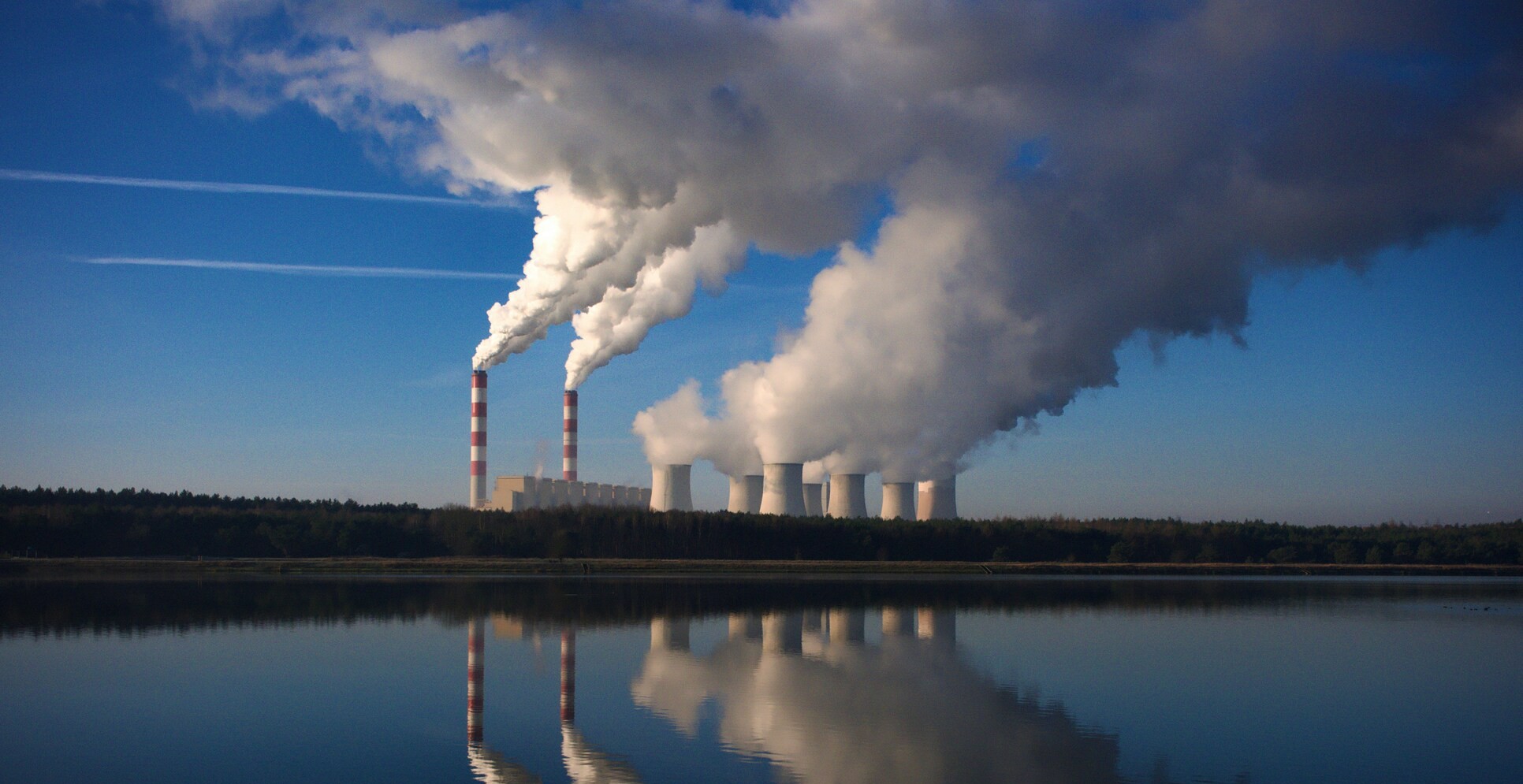
The system does not cover all polluters; it is limited to the biggest sources of carbon emissions: electricity and heat generation, energy-intensive industry sectors like steel and cement production, as well as aviation and maritime transport. In Poland, the largest share of allowances is purchased by big energy companies such as PGE (a state-owned utility running, among others, Europe’s largest coal-fired power plant) and Orlen.
Poland’s Belchatów coal-fired power station was by far the EU’s biggest single emitter of CO2 last year.
Three Polish coal plants were among the EU’s top 10 emitters, up from two in 2019 https://t.co/PQu0r68XkZ
— Notes from Poland 🇵🇱 (@notesfrompoland) April 13, 2021
Most of the revenue from allowances sold at auctions flows to the national budgets of the EU’s member states. They are required to use it to support actions like the deployment of renewable energy and increasing energy efficiency. Part of the money is used for EU funds supporting energy transition, like the Modernisation Fund.
The revenue is substantial: in 2025, the Polish state received around 16.5 billion zloty (€3.9 billion) from selling allowances. However, while such figures may superficially suggest that Poland benefits from delaying decarbonisation, any short-term budget boost is far outweighed by the longer-term costs, says Jeszke.
“The more carbon-intensive the economy remains, the greater its demand for allowances and the greater its exposure to high CO2 prices, energy prices, and costs for industry and households”, he explains.
Poland has recorded the EU’s third-fastest rise in household electricity prices this year.
The country now also has the bloc’s second-most-expensive electricity, when taking cost of living into account https://t.co/WNLdCfOP16
— Notes from Poland 🇵🇱 (@notesfrompoland) October 30, 2025
Additionally, Poland is among the countries that emit more CO2 than their allotted permits allow, creating what is known as an “ETS gap”.
“This difference must be made up for by purchases on the European market, which translates into additional costs for businesses,” says Jeszke.
Right-wing politicians have been pointing to the ETS gap as the mechanism that leads to billions of zloty flowing out of Poland. However, the gap exists largely because of Poland’s heavy reliance on coal, which those same politicians have long championed.
Polluter pays – and Poland pollutes a lot
While ETS fees are paid by companies like energy utilities and steelworks, the cost flows down to consumers who buy the end product. But how much it actually affects prices depends on two things: the price of emission allowances and how carbon-intensive the activity is – that is, how much CO2 is emitted for each unit of power or product produced. Both of these explain why the ETS has become a major topic in Poland recently.
For years, the ETS stayed below the political radar for a simple reason: the price of allowances was low, at around €7-8 per tonne of CO2, and therefore barely affected electricity bills.
However, in 2018, the price jumped to almost €25 at one point. It then surged again amid the war in Ukraine, peaking at €105.73 per tonne in February of 2023. In 2025, it averaged around €73, according to Polish energy think tank Instrat.
@RobertPietzcker and colleagues consider a surge in EU ETS carbon prices, and find actors’ increased foresight driven by commitment to climate targets has played a role. https://t.co/LaukZ2R5so pic.twitter.com/Z0aTmHFj1E
— Nature Energy (@NatureEnergyJnl) July 10, 2024
Even with these elevated prices, not all were affected equally. In France, which generates just 5% of electricity from fossil fuels, and Denmark (11%), the cost of ETS constituted only around 1% of households’ electricity bills.
However, Poland still produces over 50% of its electricity from coal, far more than any other EU country. While we can only estimate how much the ETS cost accounts for on a typical household power bill, Jeszke (using a few assumptions) puts that number at 15-16% in 2024 and 2025. That figure ranks among the highest in the EU.
The right-wing opposition attributes this to Poland’s disadvantaged starting point (its heavy reliance on coal and the legacy of communist-era industry) compared to western Europe. But, equally, for years successive Polish governments have delayed decarbonisation in order to placate politically influential mining unions.
How much is the ETS actually costing consumers and industry?
Criticism of the ETS from the right has escalated since PiS in March named Przemysław Czarnek, a hard-line conservative figure, as its prime ministerial candidate for the 2027 parliamentary elections. Czarnek used his speech at the announcement to condemn EU climate policies, criticise renewables, and call for Poland to focus on coal.
Soon after, he submitted a resolution to parliament that called on the government to present a plan for Poland’s exit from ETS. However, Czarnek’s claim that the system makes Poles “a cash machine” for Brussels is misleading.
According to Poland’s Supreme Audit Office (NIK), between 2013 and 2025, Poland earned 138.6 billion zloty from selling emission allowances. It was meant to use at least half of that money (and 100% since June 2023) to reduce emissions, but NIK found that only 1.3% was actually spent for that purpose.
Renewables generated 29.4% of Poland’s electricity in 2025, almost exactly the same figure as in 2024, ending a period of strong growth since 2021.
Coal (52.2%) remained the dominant source, though its share declined.
For more, read our full report: https://t.co/XjD9hfhabo pic.twitter.com/WklP7dYL78
— Notes from Poland 🇵🇱 (@notesfrompoland) January 2, 2026
Instead, consecutive governments have largely treated ETS money as just another source of income to the state budget, exploiting a loophole that allows it to be used for general spending rather than for the energy transition.
“Poland and Italy are the unfortunate leaders in the ranking of countries least effective in spending funds from the ETS,” Michał Hetmański, head of Instrat, tells Notes from Poland.
Czarnek is also misleading the public when he says that exit from the ETS would “immediately lower electricity bills” by “several dozen percent”. As mentioned above, it constitutes around 15% of a typical electricity bill. While the amount is significant, it is far below the rises caused in recent years by other factors.
President Nawrocki has presented a bill to cut electricity prices by 33% for households and 20% for businesses
The measures fulfil a key campaign promise. But they still require approval by parliament, where the ruling majority is opposed to the president https://t.co/OY9PUW9dFC
— Notes from Poland 🇵🇱 (@notesfrompoland) November 7, 2025
Another popular line used by the ETS critics is that it harms industry, lowering its competitiveness and contributing to deindustrialisation. The picture here is complicated. As Instrat points out, the system has worked well in electricity production, leading to lower emissions and incentivising investment in renewables.
But “it did not work in the same way in steel, cement or chemical plants”, which differ in “investment cycles, cost structures, and competitive pressures”.
While rising costs lead to emission-heavy industries moving outside the EU (known as “carbon leakage”), the ETS is just one of the factors. China is often named as the destination of such leakage, but it also has lower labour costs and cheap domestic coal (as well as its own ETS system, albeit with a much lower price of carbon).
To address this, the EU has introduced a “carbon tariff”, known as the Carbon Border Adjustment Mechanism (CBAM), designed to level the playing field by applying a carbon cost to certain imports. The system entered force this year.
What can – and what can’t – be done about the ETS?
President Karol Nawrocki, who won last year’s election with PiS support and pro-coal slogans, has also criticised the ETS. However, unlike Czarnek, he admits that abolishing it is politically impossible within the EU.
Yet even getting the majority of EU nations to agree to what Nawrocki proposes – such as lowering the ETS price to just €10 per tonne of CO2 – seems highly unlikely, as some member states strongly support the ETS – either for its climate effects or for budget income.
Hetmański notes, however, that details of the president’s proposal are “more constructive” compared to others on the political right, and with “adjustments” it would have “a chance of becoming EU law”.
But it is the government, not the president, that represents Poland at EU summits and has a say in negotiations in Brussels. Tusk also wants to see changes in the ETS – but far more moderate than Nawrocki’s.
Poland has celebrated its success in delaying the introduction of a new EU system for reducing emissions from vehicles and heating.
However, it was also among a losing minority of four member states that voted against a target to cut emissions 90% by 2040 https://t.co/FKj49Wg2Lc
— Notes from Poland 🇵🇱 (@notesfrompoland) November 5, 2025
At a summit in March, EU member states agreed to introduce immediate changes to the system in the face of a possible energy crisis, and to implement more reforms after a review of the ETS directive planned for the summer. The first changes were announced on 1 April.
The European Commission has proposed an amendment to the so-called Market Stability Reserve. That mechanism, initially designed to keep prices from falling (due to surplus of permits), will now serve the opposite purpose and keep the price of the ETS from rising too fast.
The government in Warsaw has welcomed that proposal, but wants to go further. Its suggestions include more free allowances for industry and district heating as well as a mechanism insulating the system from speculation on allowances (that can now be traded not only by emitters, but also financial institutions).
Dzieje się to, co jeszcze dwa lata temu wydawało się niemożliwe. Komisja Europejska stopniowo, krok po kroku, luzuje system ETS.
Dzisiejsza propozycja Komisji Europejskiej, żeby wstrzymać unieważnianie pozostawionych w rezerwie uprawnień, z czasem zmniejszy wahania ich cen.…
— Paulina Hennig-Kloska (@hennigkloska) April 1, 2026
“I consider the government’s position to be well-crafted with a view to forging alliances with the most climate-ambitious leaders in the European Union”, says Hetmański. With countries like Italy and Austria, but recently also France and Germany, agreeing that change is needed, some adjustments now look more realistic.
But it will be possible to judge the possible effects of any changes only once we see a concrete proposal from the European Commission due in July.
However, given the certainty that the ETS will not be abolished in its entirety, as demanded by the Polish opposition, it seems sure to remain a political tool for them to attack the government with, often with little heed for how the system actually works, what effects it has, and how they can realistically be mitigated.
Notes from Poland is run by a small editorial team and published by an independent, non-profit foundation that is funded through donations from our readers. We cannot do what we do without your support.
Main image credit: konrad dobosz/Unsplash
Patryk Strzałkowski is a climate and environmental reporter and a 2023 “Journalist for the Planet” award winner. He previously edited Zielona.Gazeta.pl and reports for outlets including Oko.press and Clean Energy Wire.