(function(w,q))(window,”_mgq”);
- Ukraine’s AI drones are ranging across the Russian logistical zone, hunting buhanka vans
- The buhankas haul troops and supplies to front-line regiments
- Blowing up the buhankas weakens regiments before they can attack
- The Ukrainian counterlogistics campaign may explain why Russia’s spring offensive has stalled
Ukraine’s middle-range zones are striking harder and more often, fraying Russia’s front-line logistics at the very moment Russian field armies should be launching their usual spring offensive.
Russian regiments need buhankas to move troops and supplies from rear bases to staging points near the front. Blowing up more of the vans with increasingly far-flying, accurate and autonomous drones, the Ukrainians are starving Russian regiments of supplies and manpower before the regiments even get a chance to engage Ukrainian defenders along the gray zone—and Russia’s spring 2026 offensive is the first one in this war to stall before it started.
For the Russians, “just reaching the front line (which is the prerequisite for an assault) has become very risky,” French mapper and analyst Clément Molin noted.
The drumbeat of buhanka hits seems to be quickening.
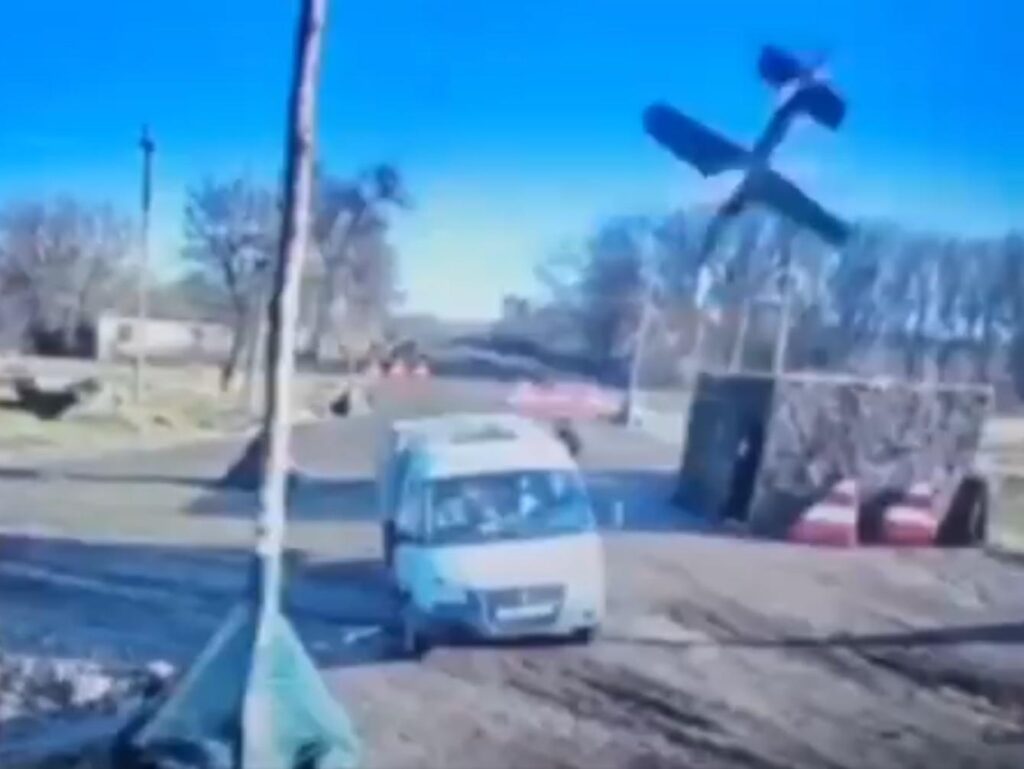
A strike on a Russian vehicle at a checkpoint. The camera captured the impact of a drone resembling a “Lancet”. It is likely its Ukrainian counterpart, the “Bulava” or “RAM”. pic.twitter.com/knCyObiGKz
— WarTranslated (@wartranslated) April 30, 2026
On or just before Monday, a Ukrainian Hornet drone blasted a buhanka right outside a Russian brigade headquarters, likely tens of kilometers inside the logistical zone stretching as far as 200 km behind the gray zone. “We are deep in the rear, not far from the forward base of one of the brigades,” one witness to the strike wrote.
The occupants of that particular buhanka may have thought they were safe from drones. The van was “packed to the brim with electronic warfare systems,” the witness wrote. “Yet the weather is clear enough for flight operations. And nowadays, that is often the deciding factor for everything.”
Left unsaid by the witness is that the Hornet drone is highly autonomous thanks to its AI targeting system, which can be programmed to recognize buhankas and other targets—and home in on them without help from a human operator.
Radio jamming and other traditional forms of electronic warfare don’t work against A.I. drones, as they don’t rely on radio signals to search and destroy. Other Hornets operated by the Ukrainian 3rd National Guard Brigade have been hunting buhankas and other supply vehicles around Donetsk city, as far as 80 km from the gray zone in eastern Ukraine.
russian POV: Loaf hit by UA Hornet, “in the deep rear near our brigade command post”https://t.co/HASK2VOYPj pic.twitter.com/RmGXXSPa5R
— imi (m) (@moklasen) April 27, 2026
AI targeting
The Ukrainian Bulava drone also has A.I. for targeting. Which may be how a Bulava blew up a buhanka at a Russian checkpoint on or just before Thursday.
All these van strikes have a corrosive effect on Russian logistics. And that corrosion can be felt in the gray zone, as Russian regiments struggle to conduct assaults with too few troops and supplies.
“Ukraine has largely stymied Russian advances across the front line, blunting the Russian spring-summer 2026 offensive thus far,” the Institute for the Study of War in Washington, DC reported.
The Russians not only aren’t advancing, overall—they’re actually falling back. According to ISW, Russian forces lost 67 square kilometers of Ukrainian territory in April after losing 31 square kilometers in March. Their last monthly gain, in February, was just 119 square kilometers.
Explore further
More Ukrainian drones are hitting Russian supply lines. The hardened targets are fine.
“The start of 2026 is not going very well for the Russian army,” Molin quipped. And it may get worse for the Russians. Every week they fail to seize the initiative is another week Ukrainian forces can devote to strengthening their fortifications all along the 1,200-km gray zone.
“In addition to the classic obstacle lines,” Molin explained, “the Ukrainian army has placed barbed wire everywhere along the front, and we’ve already seen the conclusive results of this strategy.”
Russian forces are attacking while weak, and running headlong into new trenches, concrete obstacles and barbed wire. Further slowed by the fortifications, Russian troops are easier targets for the same Ukrainian drones that are also blowing up the Russians’ buhankas—and starving the troops before they even attack.
(function(w,q)w[q]=w[q])(window,”_mgq”);