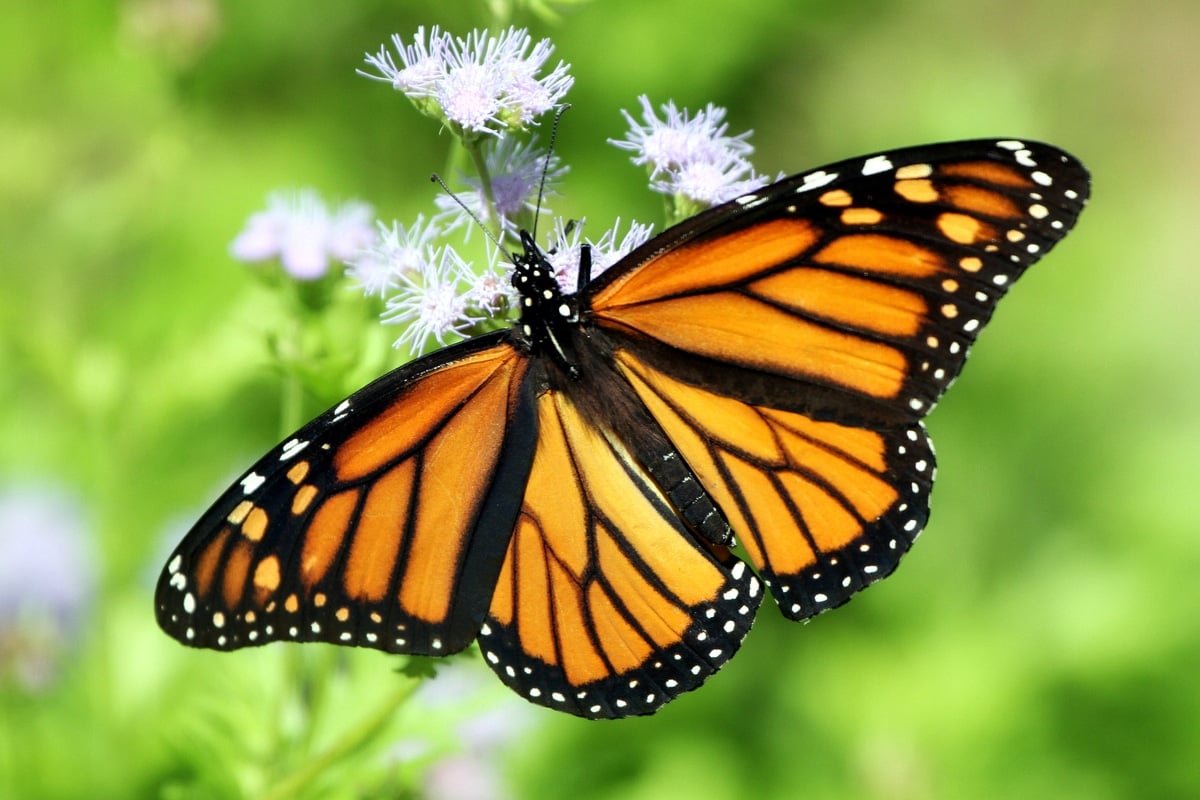
Monarch butterfly. Credit: TexasEagle / Flickr / CC BY-NC 2.0
Evolution reuses the same genes to produce identical wing color patterns in butterflies and moths that diverged up to 120 million years ago. The research, published in PLOS Biology, settles a long-running scientific debate about whether mimicry in nature is driven by a few large genetic switches or many small changes scattered across the genome.
Yacine Ben Chehida from the Department of Biology at the University of York led the team. Researchers studied species belonging to the neotropical “tiger mimicry ring,” a group of more than 100 species from five insect families found across South America. Many share nearly identical wing patterns despite being only distantly related, a phenomenon scientists call convergent evolution.
The tropical mimicry ring that puzzled scientists for decades
The team used genome-wide association studies across eight species, including seven butterfly species from the genera Melinaea, Mechanitis, Hypothyris, and Heliconius, as well as the day-flying moth Chetone histrio.
They traced which genetic regions controlled two key traits: yellow forewing bands and black-orange hindwing coloring in species that diverged between 1 and 120 million years ago.
The results pointed consistently to two genes, ivory and optix. Across all butterfly species studied, the genetic changes appeared in nearly identical locations within these genes.
Researchers confirmed these findings through CRISPR gene knockouts in Mechanitis messenoides, showing that disabling ivory turned black and orange scales yellow, while disabling optix turned orange scales black.
CRISPR knockouts confirm two genes drive wing patterns
The moth Chetone histrio added another striking parallel. Its color pattern differences were tied to a roughly one-million base-pair chromosomal inversion containing ivory.
Heliconius numata butterfly. Credit: Greg Hume / Wikimedia Commons / CC BY-SA 4.0
This structure closely mirrored one already documented in the butterfly Heliconius numata, despite the two species sharing a common ancestor approximately 120 million years ago.
In Heliconius pardalinus, researchers found the same pattern through a different method. Quantitative trait locus mapping confirmed that ivory controlled yellow forewing patterns and optix governed orange hindwing coloring, consistent with findings across all other species.
Evolution reuses the same genes across species
The study also found that modifiers fine-tuning the mimicry sat close to ivory and optix rather than scattered across the genome, contradicting earlier predictions by the statistician Ronald Fisher.
Researchers also found little evidence that species borrowed color-pattern genes from one another through interbreeding, unlike patterns previously observed in closely related Heliconius species.
Ben Chehida said the repeated use of the same two genes across such a vast time span points to a deeply constrained evolutionary process, suggesting that when it comes to wing color, nature has very few paths available and takes the same ones repeatedly.