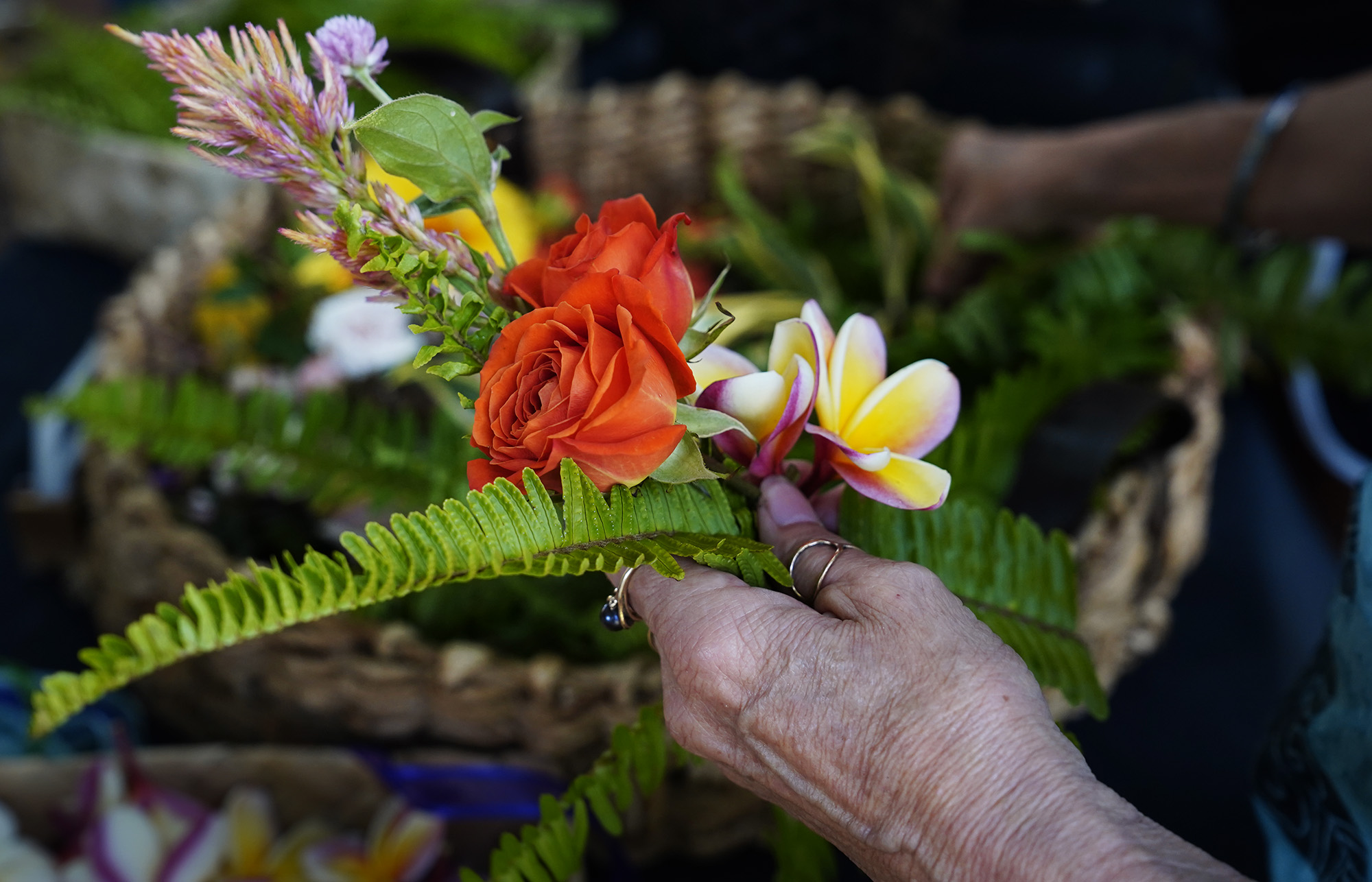
Recent storms and other economic issues have taken their toll on Hawaiʻi’s flower vendors.
When I think of May Day, my enduring memory is about arriving at school in a stiff cotton muʻumuʻu and a yellow plumeria lei – the fragrant plain janes of the lei world — my mother always ordered for us from her lei maker in Waikīkī.
Many of my friends strung their own lei from their abundant backyard plumeria trees. We huddled together on the grass at Punahou School in colorful Hawaiian wear to watch our school May Day pageant, the air heavy with the sweet scents of plumeria, pīkake and tuberose.
Hawaiʻi’s most fragrant flower lei are also the most delicate. This year, the scarcity at May Day is like the proverbial canary in the coal mine, a warning of the pressures affecting Hawaiʻi’s flower growers and lei sellers after thousands of blossoms meant for May Day, Mother’s Day and school graduations were wiped out by by two Kona low storms in March.
“The flowers drowned,” says lei maker Kuulei Kaʻae.
Ideas showcases stories, opinion and analysis about Hawaiʻi, from the state’s sharpest thinkers, to stretch our collective thinking about a problem or an issue. Email news@civilbeat.org to submit an idea or an essay.
The spicy smelling pikake must be white and closed to be perfect. The Kona rain seeped into the tiny pīkake blossoms turning them purple or brown, and stale smelling — unusable, says Kaʻae.
For days, rain accompanied by blasting wind blew plumeria off the trees and broke the stalks of tuberose plants, pushing the white flowers into ponds of oozing mud, the pelting deluge turned yellow puakenikeni into mush.
The storms delivered another blow to Chinatown lei sellers when they were left with hundreds of lei intended for the Kamehameha Schools Song Contest — a lei-filled event the school abruptly postponed March 13 because of safety concerns.
“We were geared up for the song contest, making many lei. We have a strong Kamehameha following,” said Karen Lee, manager of Cindy’s Lei and Flower Shoppe in Chinatown. “The cancellation was so last minute. We get it. You can’t control nature, but it was painful.”
Lee said she was touched when many of the song contest attendees still came to the shop to pay for their pre-ordered lei. “I guess they decided to have their own small celebrations at home instead of at the contest.”
The song contest will be held Friday but it will be difficult for lei buyers to find their favorites as demand intensified with May Day events.
Forget about plumeria for May Day school events, said longtime Maunakea Street lei seller Sam Say of M.P. Lei Shop.
“My grower said he is regrouping from the storm with his plumeria so small now they won’t be ready to sell for many weeks,” Say said.
Today’s flower shortages reflect larger, long-running problems: labor shortages, competition from Thailand growers selling inexpensive orchid lei to hotels and commercial luaus, high real estate costs pushing farmers into wetter, more storm imperiled areas, and the rising cost of nearly everything.
Fely Magallanes, the manager of Nita’s Leis and Flower Shoppe, substituted ginger for plumeria this year after strong storms soaked the flower crops and ruined delicate blooms. In Chinatown today, shops are selling lei made of Thailand orchids strung in Thailand. (Denby Fawcett/Civil Beat/2026)
Walking down Maunakea Street in Chinatown this week, I kept hearing the same refrain: “It’s hard,“ or “Times are difficult now.”
Fely Magallanes, manager of Nita’s Leis and Flower Shop on Thursday was among the sellers repeating the message as she told a disappointed customer that plumerias were unavailable and would be for a long time.
Magallanes said for decades they have been making up to 70 plumeria lei for Bishop Museum’s May Day festival. This year she is substituting leis of ginger, one of the few delicate blooms that holds up slightly better to heavy rain.
While we were talking, flower grower Melvin Lin walked in to Nita’s to deliver a small bunch of yellow ginger. He said his 5-acre family farm in Hauʻula lost about 80% of its production in the Kona storms.
“The persistent rain damaged the ginger plant roots. Fertilizer was washed out to sea. It will take months to recover,” he said.
Since the storms, his farm has been bringing Lita’s only a fraction of its usual delivery — a few hand-carried bunches of ginger instead of the usual cardboard box of 30 bunches. Magallanes said she also struggles to secure flowers from Oʻahu’s main tuberose supplier, Yamada Farms.
Flower growers deliver flowers to lei vendors like Nelita Gabbaut in small bunches these days, rather then boxes full of flowers as in years past. (Denby Fawcett/Civil Beat/2026)
At Yamada’s fields in Waimānalo and Haleʻiwa, employees are working full speed to recover crops of tuberose, white ginger and lantern ʻilima.
“It is the worst year ever. During the height of the storm, we couldnʻt even get our delivery trucks into our farm in Haleʻiwa to pick up flowers,” said office manager Kari Machida.
Owner David Yamada said the collapse in sales during Covid was the first major blow.
“We never fully recovered,” he said. “Then came heavy rain this December, saturating the ground, followed by more rain in February. When that rain finally stopped, we hoped business would gradually improve but the Kona storms soon followed, leaving us unable to grow enough to satisfy our buyers.
Yamada’s parents launched their business nearly 70 years ago. In its heyday, their farm workers produced truckloads of tuberose and their in-house lei stringers could fill orders of up to a thousand lei at a time.
Before Covid, the farm had 48 workers. Today it has only 24.
Yamada worries about the future: persistent employee shortages, the soaring equipment costs, especially for tractors, and the rising costs of fuel and fertilizer.
“We are facing the same challenges of many businesses in Hawaiʻi,” he said.
The nonprofit BEHawaiʻi launched Lei Poinaʻole Project in 2022 in response to growing concerns among lei makers about the accelerating decline in flower production. Lei Poina‘ole means “the never forgotten lei.”
Board member Nalani Jenkins said the nonprofit aims to strengthen Hawaiʻi’s flower-growing sector.
So far, it has contacted about 80 flower growers statewide to discuss ways to increase the supply for lei makers and vendors increasingly dependent on imported flowers.
“Lei are becoming harder to find for weddings and funerals and birthdays. Favorite local flowers are getting rarer each year. Our goal is to change that,” said Jenkins, a member of the musical group Na Leo Pilimehana.
In 2022, the project received a three-year federal grant from the Administration for Native Americans to help rebuild and sustain the islands’ flower industry.
Still, Chinatown lei seller Karen Lee worries about the future of Chinatown lei makers in an increasingly mechanized world.
“My heart goes out to everyone on Maunakea Street. How about it? After all these years no one has found a machine to string lei. We are aging out of the business. It is sad.”
My own takeaway is to stop grumbling about the high cost of lei and to keep buying them — even for the smallest occasions. It is hard to imagine life here without their fragrance especially pua melia, the humble yellow plumeria.
Sign up for our FREE morning newsletter and face each day more informed.
Sign Up
Sorry. That’s an invalid e-mail.
Thanks! We’ll send you a confirmation e-mail shortly.