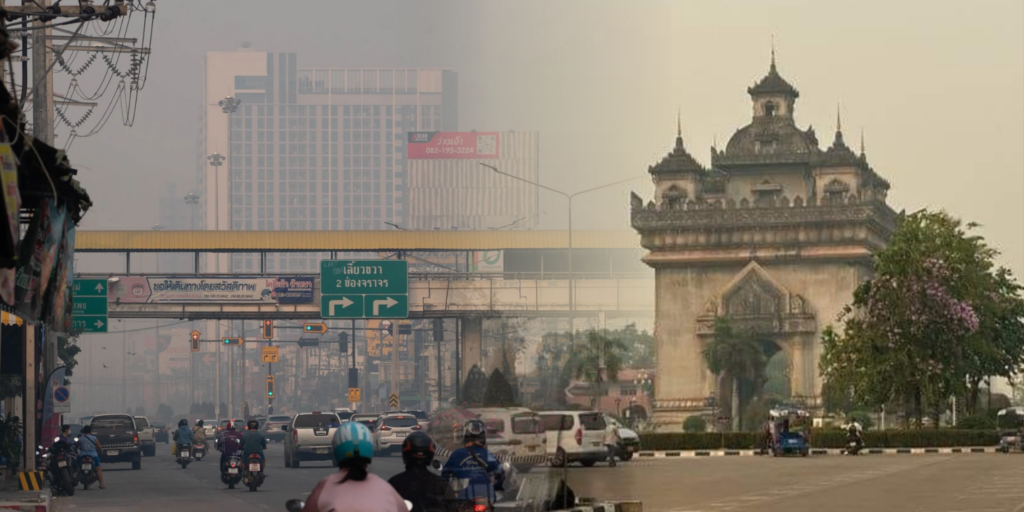
Laos and Thailand are stepping up efforts to tackle cross-border haze pollution, with new focus on forest fires, agricultural burning, and rising PM2.5 levels that continue to affect air quality across the region.
On 29 April, Thai Minister of Natural Resources and Environment, Suchart Chomklin, met with Lao Prime Minister Sonexay Siphandone in Vientiane. Both sides reviewed existing cooperation and agreed on new measures to tackle seasonal haze caused by forest fires, agricultural burning, and drifting smoke across their shared border.
On the same day, Suchart and Lao Minister of Agriculture and Environment Linkham Douangsavanh held a separate ministerial consultation. Together, they reviewed progress under the CLEAR Sky Strategy 2030, a joint plan involving Laos, Thailand, and Myanmar covering five priority areas: wildfire control, pollution forecasting, sustainable agriculture, law enforcement coordination, and implementation.
Regional Framework
The April talks build on January 2026 trilateral agreement between Laos, Thailand, and Myanmar to jointly combat PM2.5 pollution using satellite technology and shared real-time monitoring.
Under the 2026-2027 plan, the three countries committed to exchange hotspot data, track forest fires in border areas, and improve early warning systems during the dry season, when haze pollution usually peaks.
The agreement also included support for alternatives to slash-and-burn farming and greater community involvement to reduce open burning, reflecting a wider regional push to address pollution at its source.
Laos Air Quality Improves, But Risks Continue
After weeks of severe haze, Laos has seen a notable improvement in air quality, aided by rainfall during the peak dry season.
Government data released in late April showed most provinces returning to “good” levels, with AQI readings between 26 and 37, a sharp drop from earlier in the month when some locations recorded nearly 300, classified as “very unhealthy”.
However, some areas remain in the moderate range.
While the rainfall has brought short-term relief, the speed at which haze returned this season underscores the need for sustained regional action. Cross-border smoke from fires remains a recurring annual challenge across mainland Southeast Asia, and meaningful progress will depend on consistent cooperation in fire prevention, real-time monitoring, and reducing agricultural burning across borders.