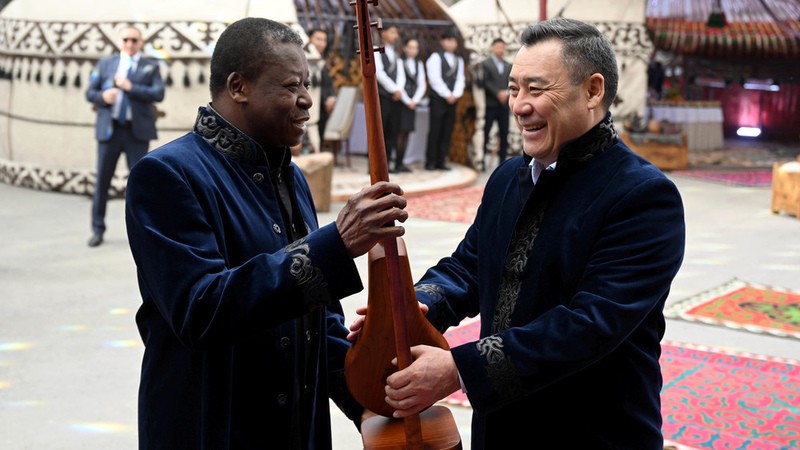
The official visit of Togo’s head of government, Faure Gnassingbé, to Kyrgyzstan on April 28–30 should not be read as an isolated diplomatic event. It is taking place inside an unusually dense cluster of activity: the SCO Council of Defence Ministers, the presence of China’s defence minister, the fifth meeting of Shanghai Cooperation Organization (SCO) digital and ICT ministers, and a parallel SCO Forum on Artificial Intelligence.
Bishkek, in other words, was not simply hosting an African leader. It was presenting itself — intentionally or not — as a Eurasian platform where security, digital governance, AI, transport, tourism, and external partnerships intersect.
This geometry deserves attention.
Bishkek as a Digital Interface
Over the past several years, Kyrgyzstan has worked to reposition itself — not only as a mountainous transit country, but as a provider of digital state capacity: e-government tools, secure documents, digital identification, fintech infrastructure, and special financial regimes such as the proposed Tamchy special financial and investment territory, which combines Kyrgyz sovereignty with elements of English law and international arbitration.
For many African countries, this offer can be attractive. Governments across the continent are looking for administrative modernization, digital sovereignty, and alternatives to legacy Western-controlled infrastructure. For Bishkek, such partnerships offer something equally valuable: visibility, geopolitical relevance, and an opportunity to export state technology beyond Central Asia.
Togo is a particularly interesting test case. Lomé is one of West Africa’s important maritime and logistical hubs, with access not only to the Gulf of Guinea but, indirectly, to the Sahel region — Mali, Burkina Faso, and Niger — where Russia has expanded its security footprint.
If Kyrgyz digital infrastructure were to enter this corridor, it would not be a minor technical export. It would connect a Central Asian jurisdiction to one of Africa’s most strategically sensitive zones.
It must be said honestly: this remains a hypothesis. Public information about specific Kyrgyz digital products being offered to Togo remains limited. But the political signal is difficult to ignore: Bishkek is not approaching this visit as a routine bilateral courtesy.
The Russia Question
There is a more sensitive layer to this picture.
Kyrgyzstan is a close partner of Russia. Russia, in turn, is under heavy Western sanctions and is searching for alternative financial, commercial, and logistical routes. This creates a natural suspicion that Kyrgyz digital and financial infrastructure could — directly or indirectly — become useful to Russian-linked actors.
This does not mean every Kyrgyz initiative abroad is directed from Moscow. That reading is too simplistic.
A more precise framing is this: Kyrgyzstan may be becoming part of a distributed sanctions-era infrastructure in which Russian, Chinese, Central Asian, and Global South interests increasingly overlap.
In this sense, Bishkek may not be a “front office” for Russia alone. It may be emerging as a Eurasian adapter — a jurisdiction through which larger actors can interact with sensitive markets under a less toxic, more flexible brand.
A7A5 and the Closing Window
The crypto-financial dimension makes this issue urgent.
A7A5, a ruble-pegged stablecoin issued by the Kyrgyzstani company Old Vector LLC, has attracted growing attention from blockchain analytics firms, sanctions researchers, and Western regulators. Elliptic has reported more than $100 billion in transactions less than a year after launch, while The Guardian has also described the token as a central instrument in concerns over Russian sanctions evasion. The U.S. Treasury has stated that the A7A5 token is issued by Old Vector and was linked to a broader crypto network involving sanctioned actors.
The function of such instruments is not abstract. They offer speed, cross-border reach, reduced transparency, and the ability to bypass SWIFT, correspondent banking, and Western compliance frameworks. This is precisely what a sanctioned economy needs, and precisely what worries Western regulators.
The EU’s 20th sanctions package, adopted in April 2026, marks a doctrinal shift. Crypto assets are no longer peripheral to sanctions enforcement; they are becoming a primary target. Reuters reported that the EU banned certain exports to Kyrgyzstan over concerns about re-export to Russia and sanctioned a Kyrgyz entity involved in trading A7A5. Local reporting has identified this entity as TengriCoin, operator of the Meer platform, where significant volumes of A7A5 are traded.
The signal is clear: third-country virtual asset service providers facilitating Russian state-adjacent crypto instruments are now within the scope of European sanctions, regardless of where they are incorporated.
The pressure is not only European. In April 2026, The Guardian reported that a cross-party group of British MPs and peers had called on the UK government to impose personal sanctions on senior Kyrgyz officials over alleged facilitation of Russian sanctions evasion. They also warned of broader sectoral measures if the situation does not change.
Earlier this year, one could still argue that Bishkek had a wide window of opportunity to institutionalize new financial and digital routes before facing serious pressure. That window now appears to be narrowing. Western attention has already arrived. The question is no longer whether it comes, but how fast it escalates — and whether Kyrgyzstan can formalize new external partnerships before the sanctions environment becomes significantly harsher.
The SCO Layer
This is where the Shanghai Cooperation Organization context becomes important.
The simultaneous presence of SCO defense and digital events in Bishkek gives the Togo visit a broader meaning. It places the African track inside a Eurasian setting shaped not only by Russia, but also by China, India, the Central Asian countries, and a growing non-Western institutional vocabulary around security, digital sovereignty, AI, infrastructure, and alternative development models.
China’s role is especially important and should not be reduced to a protective background. Beijing is a second center of gravity. Its infrastructure investments, trade volumes, and institutional weight create the environment in which smaller states like Kyrgyzstan can expand their room for maneuver.
Any hard Western measure against Bishkek would have to factor in the risk of affecting Chinese infrastructure, trade, and investment interests across Central Asia.
This does not mean China is directing the Togo track. But it does mean that Bishkek’s emerging role cannot be understood through a Russia-only lens.
Proxy Sovereignty
The concept that best describes Kyrgyzstan’s possible new position is proxy sovereignty — a small country monetizing its sovereignty, jurisdiction, neutral brand, and digital infrastructure by offering services that larger, more constrained actors cannot easily provide under their own name.
For Kyrgyzstan, this role may look attractive. It offers agency, revenue, diplomatic visibility, and a path beyond the status of a peripheral post-Soviet economy. But the risks are serious.
If Western capitals conclude that Kyrgyzstan is not just a partner of Russia but an active operational node in sanctions circumvention, pressure could move quickly from warnings to secondary sanctions, banking restrictions, export controls, personal designations, and measures targeting digital infrastructure.
The visit of Togo’s leader to Bishkek may therefore be more than a diplomatic courtesy. It may be an early signal of a new geography — one in which Central Asia, the SCO space, Africa, digital governance, crypto-finance, and sanctions politics begin to converge.
The central question is no longer whether Kyrgyzstan is participating in a larger geopolitical game. Increasingly, it appears that it is.
The real question is whether Bishkek can turn this role into a durable strategic agency — or whether it risks becoming an expendable proxy node in someone else’s architecture.
The views expressed in this article are those of the author and do not necessarily reflect the official policy or position of the publication, its affiliates, or any other organizations mentioned.